Buying Guides
Buying a Car With a Trade-In and a Down Payment: How It Works
OVERVIEW
- Positive trade-in equity and a cash down payment can both reduce the amount you need to finance.
- If your current car is paid off, its entire agreed trade-in value can generally go toward your next purchase.
- If you still have a car loan, subtract the loan payoff from the trade-in offer to determine your available equity.
- A qualifying trade-in may reduce your sales tax, depending on state regulations.
- Negative equity can absorb part of your cash down payment or increase your new loan balance.
- Compare the purchase price, trade-in allowance, financing terms, and total purchase cost before signing.
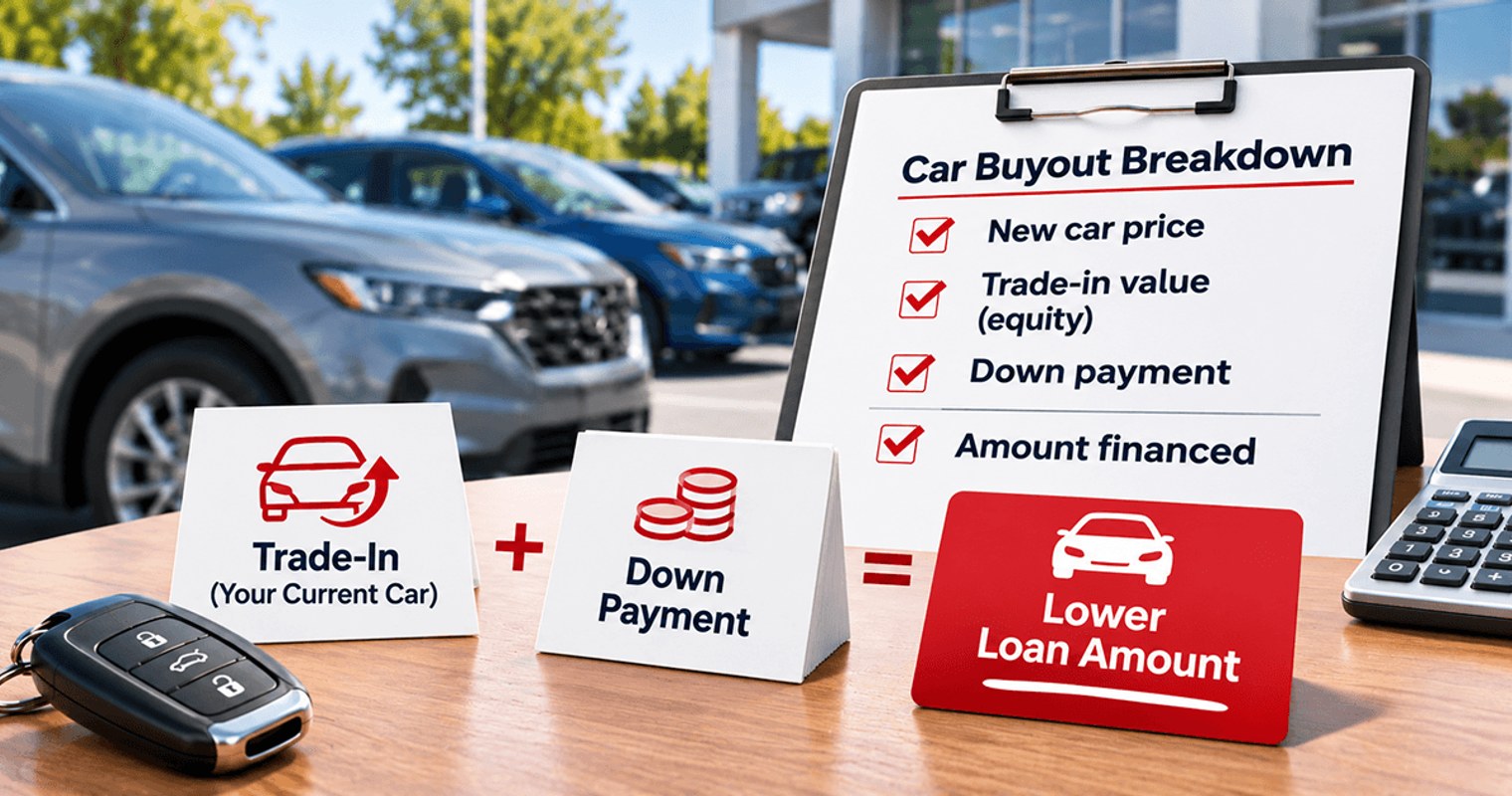
When buying a car with a trade-in and a down payment, you can combine the positive equity in your current vehicle with a cash contribution to reduce the amount you need to finance. If you still owe money on your trade-in, the existing loan payoff determines how much equity is available.
For example, if you're purchasing a $32,000 car, have $8,000 in trade-in equity, and make a $4,000 cash down payment, you'll need to finance $20,000 before taxes and fees.
The basic calculation is:
Amount financed = Vehicle purchase price + taxes and fees − trade-in equity − cash down payment
For a more complete calculation that accounts for an outstanding loan, applicable rebates, and additional purchases, use:
Amount financed = Vehicle purchase price + taxes and fees + financed extras + existing trade-in loan payoff − trade-in allowance − cash down payment − applicable rebates
These calculations assume that taxes and fees are included in your financing and that rebates have not already been deducted from the purchase price.
How Does Buying a Car With a Trade-In and a Down Payment Work?
When you trade in your current vehicle at a dealership, its agreed value becomes part of the financial arrangement for your next purchase. You can also contribute cash to reduce the remaining balance. The dealership accounts for both contributions alongside any outstanding loan payoff, taxes, fees, and applicable incentives.
The Purchase Price of Your Next Car
The purchase price is the amount you agree to pay for the vehicle before applying your trade-in or cash down payment. Taxes, registration charges, dealership fees, and any optional products you choose affect the total purchase cost.
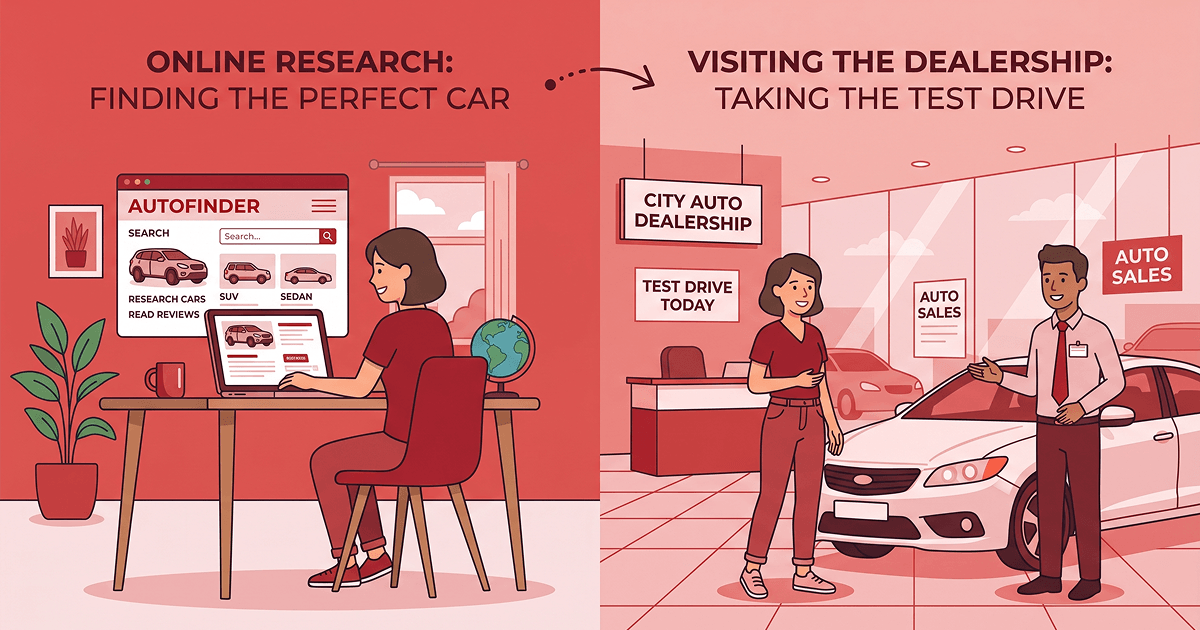
Start by comparing advertised prices for similar vehicles. You can research car models and compare local pricing on AutoFinder to establish a realistic budget before discussing your trade-in.
Your Trade-In Value and Available Equity
Your trade-in value is the amount a dealership agrees to pay for your current vehicle. Mileage, condition, service history, vehicle age, and local market demand can all influence that offer.
Your trade-in equity is calculated as follows:
Trade-in equity = Trade-in value − Existing loan payoff
If your car is worth $12,000 and your loan payoff is $5,000, you have $7,000 in positive equity. If you own the vehicle outright, the full $12,000 is generally available to apply toward your next purchase.
If you're unfamiliar with the appraisal and ownership transfer process, read our complete guide to how trading in a car works.
Your Cash Down Payment
A cash down payment is money you contribute in addition to your trade-in. According to the Consumer Financial Protection Bureau (CFPB), a down payment can consist of cash, net trade-in proceeds, or a combination of both.
Combining positive equity with cash reduces the amount you borrow. It may also improve your financing options by lowering the loan amount relative to the vehicle's value, although approval and interest rates depend on the lender and your financial circumstances.
Example: Buying a $32,000 Car With a Trade-In and a Down Payment
Suppose you've found a $32,000 vehicle, and the dealership offers $8,000 for your current car, which is fully paid off. You also have $4,000 available for a cash down payment.
Your combined contribution is $12,000, leaving $20,000 before taxes and fees.
Here's how the purchase could look in a state that allows a full qualifying trade-in deduction when calculating sales tax.
Trade-In and Down Payment Example
| Purchase Breakdown | Amount |
|---|---|
| Agreed vehicle purchase price | $32,000 |
| Trade-in allowance | −$8,000 |
| Remaining vehicle purchase price | $24,000 |
| Illustrative sales tax at 6% | +$1,440 |
| Estimated title and registration fees | +$500 |
| Cash down payment | −$4,000 |
| Estimated amount financed | $21,940 |
In this example, you would finance $21,940 if you included the sales tax and registration fees in your loan.
Your actual purchase agreement may include dealership fees, eligible manufacturer incentives, optional equipment, or other charges. Some of those charges may also be taxable.
AutoFinder's out-the-door price calculator can help you estimate the total purchase cost before finalizing your financing.
Does Trading In a Car Reduce Sales Tax?
Many states allow buyers to subtract a qualifying trade-in allowance from the taxable selling price of their next vehicle. This potential tax savings is worth considering when deciding whether to trade in your car or sell it separately.
Using the same $32,000 purchase and $8,000 trade-in, here's how the sales tax could differ.
Sales Tax With and Without a Trade-In Deduction
| Sales Tax Calculation | Without Deduction | With Deduction |
|---|---|---|
| Vehicle purchase price | $32,000 | $32,000 |
| Eligible trade-in deduction | $0 | $8,000 |
| Taxable vehicle price | $32,000 | $24,000 |
| Illustrative sales tax rate | 6% | 6% |
| Sales tax | $1,920 | $1,440 |
| Potential tax savings | $0 | $480 |
The $8,000 trade-in deduction reduces the taxable purchase price, not the tax bill itself. At a 6% sales tax rate, the resulting tax savings would be $480.
A cash down payment generally does not provide the same tax benefit because it changes how you pay for the vehicle rather than its taxable selling price.
Your trade-in allowance for tax purposes may also differ from the equity available for financing. In states that calculate the deduction using the full qualifying trade-in allowance, an $8,000 trade-in with a $5,000 loan payoff may still qualify for an $8,000 reduction in the taxable purchase price, even though only $3,000 in equity is available toward the purchase.
For example, the Florida Department of Revenue permits qualifying trade-in allowances to be deducted from the taxable vehicle selling price when the trade occurs as part of an eligible transaction. Other states may limit the deduction or offer no deduction at all. Local taxes and taxable fees can also affect your final cost.
When deciding whether to trade in your car or sell it privately, consider potential tax savings alongside the amount you expect to receive for your vehicle.
What Happens If You Still Owe Money on Your Trade-In?
You can trade in a car that still has an outstanding loan. Dealerships frequently handle these transactions and can coordinate the payoff with your existing lender as part of the purchase process.
Whether your trade-in reduces your new loan depends on how much equity you have.
Trading In a Car With Positive Equity
Suppose a dealership offers $8,000 for your current vehicle, but your existing loan payoff is $5,000.
After your current loan is satisfied, the remaining $3,000 is available to apply toward your next vehicle.
If you're purchasing a $32,000 car and contributing another $4,000 in cash, your combined contribution is $7,000. You would need to finance $25,000 before taxes and fees.
Trading In a Car With Negative Equity
Negative equity occurs when your existing loan payoff exceeds your car's trade-in value.
If the dealership offers $8,000 for your vehicle but your loan payoff is $11,000, you have $3,000 in negative equity.
You can cover that shortfall with cash, or a lender may allow you to include some or all of it in your new auto loan.
If you have $4,000 available in cash, covering the $3,000 shortfall would leave only $1,000 to reduce the replacement vehicle's purchase price.
Alternatively, the $3,000 could be included in the financing calculation while the full $4,000 is recorded as your cash down payment. Both arrangements produce the same estimated loan principal in this example, although lender requirements and financing terms may differ.
How Trade-In Equity Affects Your New Car Loan
| Purchase Breakdown | Paid-Off Trade-In | Positive Equity | Negative Equity |
|---|---|---|---|
| Vehicle purchase price | $32,000 | $32,000 | $32,000 |
| Trade-in value | $8,000 | $8,000 | $8,000 |
| Existing loan payoff | $0 | $5,000 | $11,000 |
| Net trade-in equity | $8,000 | $3,000 | −$3,000 |
| Cash contribution | $4,000 | $4,000 | $4,000 |
| Estimated amount financed before taxes and fees | $20,000 | $25,000 | $31,000 |
Despite purchasing the same vehicle, receiving the same trade-in allowance, and contributing the same amount of cash, the buyer with negative equity needs to borrow $11,000 more than the buyer whose trade-in is paid off.
Both the Federal Trade Commission (FTC) and the CFPB advise consumers to understand how outstanding loan balances are handled before signing a new financing agreement.
Including negative equity in your new loan may increase your loan-to-value ratio, or LTV. This measures how much you're borrowing relative to the vehicle's value. A higher LTV may make financing approval more difficult, affect available loan terms, or require a larger cash down payment.
If you're carrying substantial negative equity, consider paying down your existing loan, choosing a more affordable replacement vehicle, or waiting until your equity position improves. If replacing your car cannot wait, your dealership can help you explore financing arrangements subject to lender approval.
Read our guide to trading in a car with a loan and handling negative equity for more information.
How Much Should You Put Down If You Have a Trade-In?
There is no universal requirement to make a separate cash down payment when you already have positive trade-in equity. Depending on the amount of equity and your lender's requirements, your trade-in could cover the entire required down payment.
For a $32,000 vehicle, an $8,000 trade-in with no outstanding loan represents 25% of the purchase price. Adding $4,000 in cash increases your combined contribution to 37.5%.
Whether contributing the additional cash makes sense depends on how much you would save in interest and how much money you would have left in savings.
How an Additional Cash Down Payment Affects Your Car Payment
Assume you're purchasing a $32,000 vehicle, have $8,000 in positive trade-in equity, and qualify for a 60 month loan at a fixed annual interest rate of 6%.
| Additional Cash Down | Amount Financed | Estimated Monthly Payment | Estimated Total Interest |
|---|---|---|---|
| $0 | $24,000 | $464 | $3,839 |
| $2,000 | $22,000 | $425 | $3,519 |
| $4,000 | $20,000 | $387 | $3,199 |
| $6,000 | $18,000 | $348 | $2,879 |
These calculations assume a standard amortizing loan with 60 equal monthly payments and exclude taxes, fees, and additional financing charges. Monthly payments and total interest are rounded.
Contributing an additional $4,000 lowers your monthly payment by approximately $77 and saves about $640 in interest over the loan term.
Use AutoFinder's car payment calculator to compare different cash down payments, trade-in equity amounts, interest rates, and loan terms based on your own purchase.
If contributing extra cash would leave you without sufficient savings for insurance, maintenance, or unexpected expenses, using your trade-in as the primary down payment may be a better fit.
Our guide to buying a car with a small down payment or none explains how to balance upfront expenses with long term borrowing costs.
How to Buy a Car With a Trade-In and a Down Payment: Step by Step
Knowing your current vehicle's value, outstanding loan balance, and available cash before visiting a dealership helps you evaluate your purchase and financing options.
1. Request Your Current Loan Payoff Amount
If you're still financing your vehicle, contact your lender and ask for a payoff quote. A 10 day payoff quote is commonly used during vehicle trade-in transactions, although the validity period varies by lender.
Your payoff amount may differ from the balance shown in your online account because of accrued interest or other applicable charges.
Check when the quote expires and whether your loan includes a prepayment penalty. If the purchase takes longer than expected, you may need an updated payoff amount.
2. Research Your Current Car's Trade-In Value
Valuation resources such as Kelley Blue Book can provide a starting point, while actual appraisal offers from dealerships and other vehicle buyers can give you a better indication of what you might receive.
Compare multiple offers where practical. An online valuation is not necessarily a guaranteed purchase price, and a dealership may need to inspect the vehicle before confirming its trade-in allowance.
Learn how to determine whether a dealership's trade-in offer is fair, or explore AutoFinder's sell or trade-in options.
3. Establish Your Budget and Explore Financing
Once you know your approximate trade-in equity, decide how much additional cash you can comfortably contribute.
Consider getting preapproved for a car loan through a bank or credit union before visiting a dealership.
Dealerships may also offer competitive financing through their lending partners and manufacturer programs. Compare the APR, loan term, down payment requirements, and total repayment cost of each offer.
Remember that preapproval does not guarantee final loan approval. The lender may still need to review the specific vehicle, loan amount, and trade-in arrangement.
4. Find Your Next Vehicle
With more than 3 million new and used vehicle listings nationwide, AutoFinder helps shoppers compare available vehicles, research advertised prices, and connect with local dealerships.
Look for cars within your budget, compare equipment and condition, and contact dealerships to confirm availability and request pricing information.
Having an estimated purchase price makes it easier to determine how much your trade-in and cash down payment will contribute toward your next car.
5. Review the Purchase Price and Trade-In Offer Separately
Ask the dealership to itemize the selling price of your next vehicle and the trade-in allowance for your current car.
For example, a dealership offering $9,000 for your trade-in against a $33,000 vehicle could produce the same purchase price difference as another dealership offering $8,000 against an identical $32,000 vehicle.
Before taxes, fees, and financing, both transactions leave a $24,000 difference.
Compare the complete purchase rather than evaluating the trade-in allowance in isolation. Vehicle condition, equipment, applicable incentives, and financing terms can all influence which offer provides better value.
6. Confirm Your Cash Down Payment and Financing Terms
Once you've agreed on the purchase price and trade-in allowance, confirm your cash contribution and review the itemized purchase agreement.
Make sure you can identify:
- The agreed vehicle purchase price.
- The full trade-in allowance.
- Your existing vehicle loan payoff, if applicable.
- Your cash down payment.
- Applicable rebates, taxes, and fees.
- Optional products you have agreed to purchase.
- The final amount financed.
Check that the final amount financed matches the figures on your purchase agreement. Review the APR, finance charge, loan term, payment schedule, and total payments before signing.
If you're unfamiliar with these figures, our guide to how car financing works explains the basics of auto loans.
7. Complete the Purchase and Confirm Your Old Loan Is Paid Off
The dealership will typically help process the trade-in paperwork, coordinate any existing loan payoff, and complete the purchase of your next vehicle.
Bring your identification, registration, title if you hold it, lender information, insurance details, available keys, and any additional documents requested by the dealership.
If you traded in a financed vehicle, the CFPB recommends contacting your previous lender approximately 1 week after completing the transaction to check the payoff status.
If the loan remains open, follow up with the dealership and lender to confirm when the payoff will be processed. Continue meeting your existing payment obligations until the lender confirms the loan has been satisfied.
Common Mistakes When Combining a Trade-In and a Down Payment
Budgeting Based on Trade-In Value Instead of Equity
An $8,000 trade-in allowance does not mean you have $8,000 available toward your next purchase if the vehicle still has an outstanding loan. Calculate your equity using the actual payoff quote before establishing your budget.
Financing Negative Equity Without Reviewing the Total Cost
Rolling negative equity into another auto loan can help you replace a vehicle sooner, but it also increases the amount borrowed. Depending on the new loan term and vehicle depreciation, it may take longer to build positive equity in your replacement car.
Consider the long term repayment cost and any additional down payment requirements.
Focusing Only on the Monthly Payment
Extending a loan term can lower your monthly payment while increasing the total interest you pay.
Ask the dealership's finance team to explain how different cash contributions or loan terms affect the amount financed, monthly payment, and overall repayment cost.
Not Comparing Trade-In Offers
Getting more than one appraisal can help you recognize a competitive trade-in offer. However, differences in reconditioning costs, inventory needs, and local demand may explain why dealerships offer different amounts.
Evaluate the trade-in allowance alongside the replacement vehicle's price, tax benefits, and financing terms.
Making a Down Payment That Does Not Fit Your Budget
Putting too little down can leave you with a larger loan and a greater risk of negative equity. Contributing too much cash could leave you without sufficient savings for unexpected expenses.
If your trade-in already covers a substantial share of the purchase, you may not need to make a large additional cash down payment.
Should You Trade In Your Car and Make a Cash Down Payment?
Combining a trade-in with a cash down payment makes sense when it reduces your borrowing costs without putting unnecessary pressure on your savings. Trading in your current vehicle can also simplify the purchase process and potentially provide a sales tax benefit.
Start with the available equity in your current car, the total cost of the replacement vehicle, and the amount of cash you can comfortably contribute. Together, these figures show how much you still need to pay or finance.
Find your next car on AutoFinder, compare available vehicles and pricing, and connect with dealerships to discuss your trade-in and financing options.
Want More Car Buying Advice?
Add AutoFinder as a preferred source on Google to help you discover more of our automotive guides and research.