Car Financing
How to Buy a Car With a Small Down Payment (or None)
KEY TAKEAWAYS
Yes, you can buy a car with a small down payment or no money down if you qualify for the financing. Lenders consider your credit, income, existing debt, and the vehicle's value. Borrowing more generally means a higher monthly payment, more interest, and a greater risk of owing more than the car is worth.
There's also a difference between zero down and $0 due at signing. Even without a required down payment, you may need money for taxes, registration, insurance, or other expenses.
If you have limited savings, start with what you can afford each month. Then choose a vehicle and compare financing options that fit that budget.
How Much Should You Put Down on a Car?
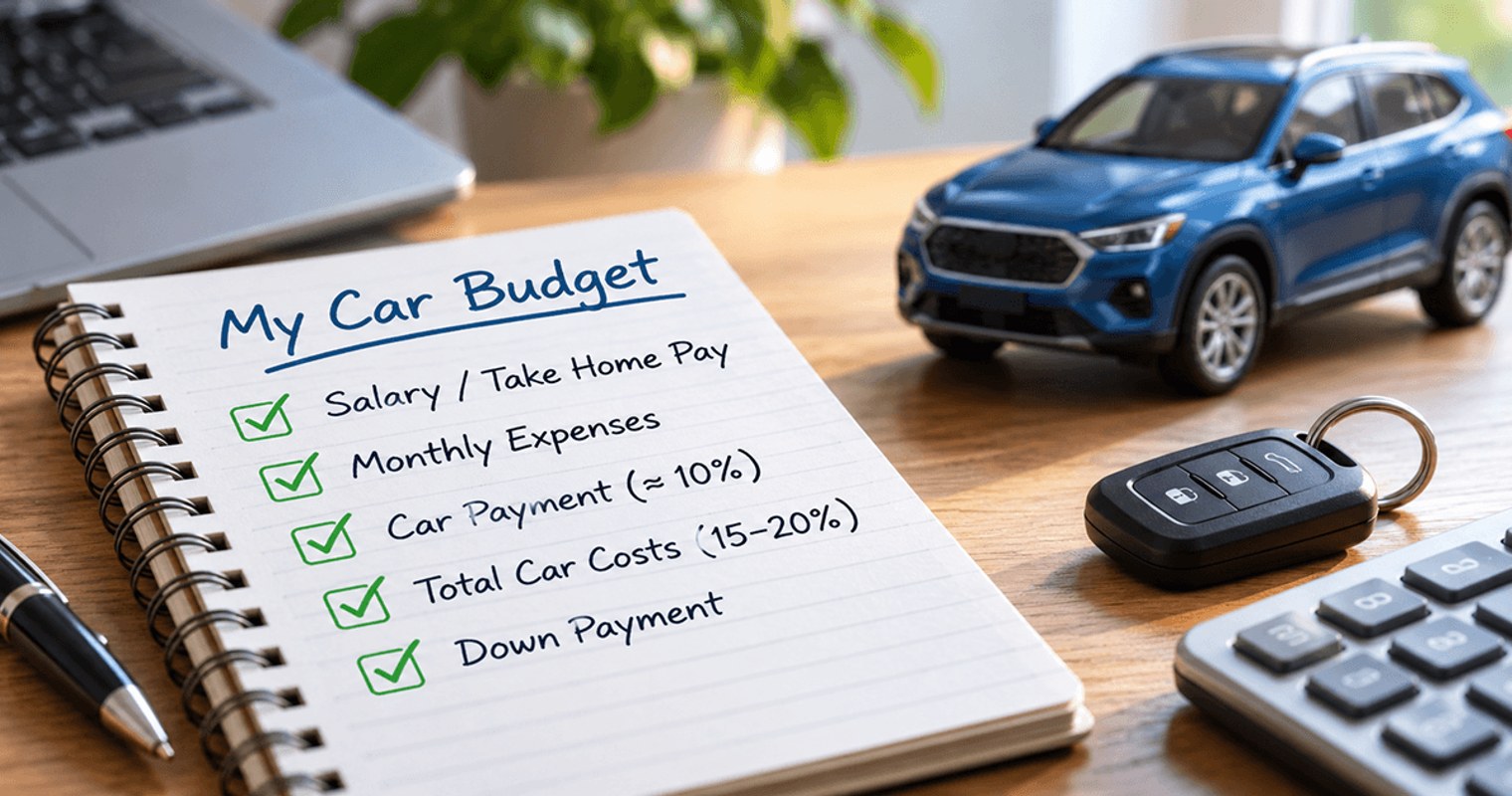
A commonly suggested budgeting target is 20% down on a new car or 10% on a used car. These are rules of thumb, not lender requirements, and they may not be realistic for every buyer. The Consumer Financial Protection Bureau (CFPB) does not prescribe a universal down payment percentage. Instead, it explains that putting more money down reduces the amount borrowed and may improve financing terms.
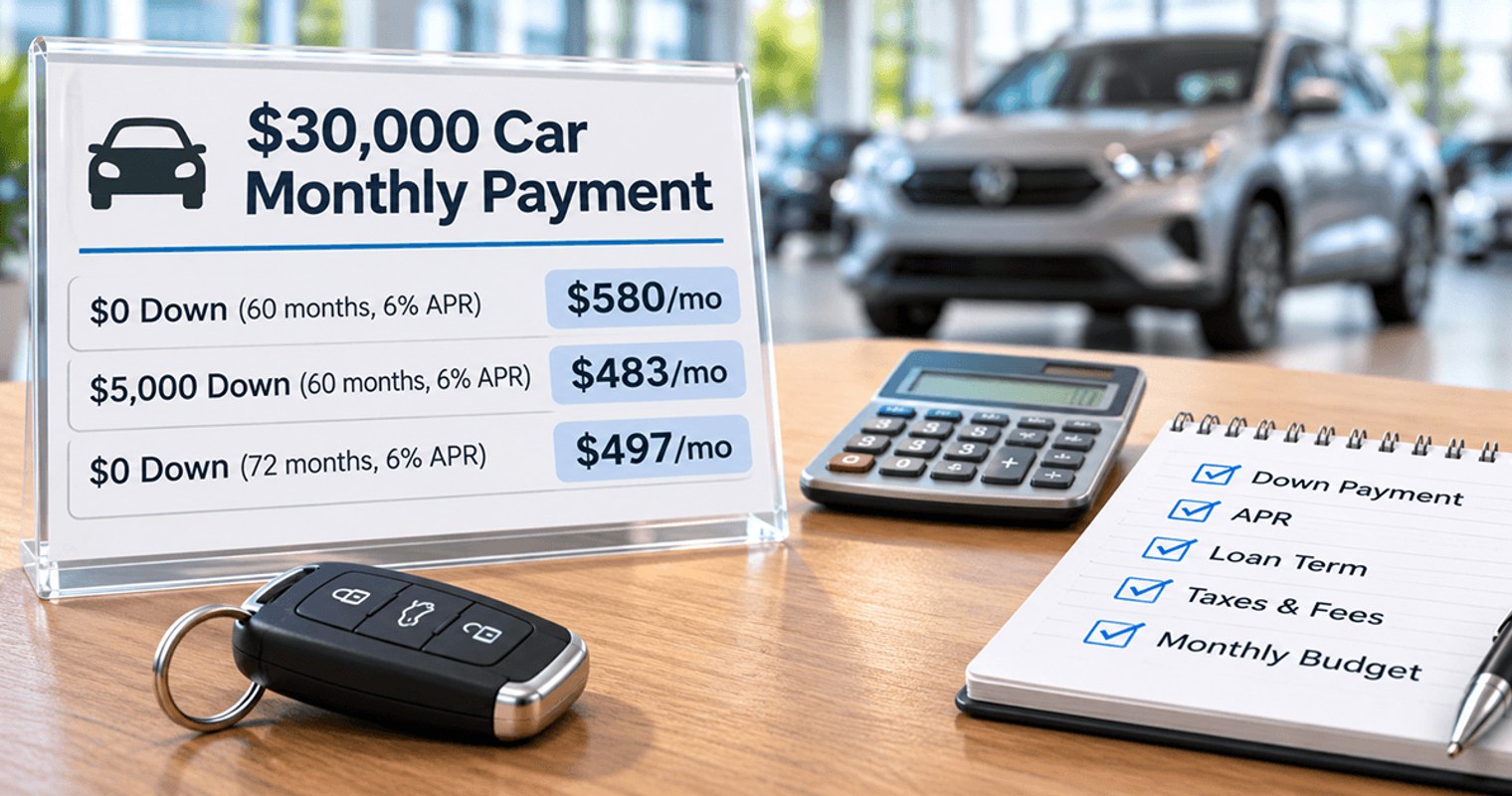
For a $30,000 vehicle, 20% would be $6,000, while 10% would be $3,000.
You may qualify with considerably less. Some lenders offer zero-down financing, while others require an upfront payment based on your credit profile and the vehicle being purchased.
But you don't need to reach a particular percentage for your savings to make a difference. Even $500 or $1,000 can reduce your loan balance. A down payment may also help you meet a lender's financing requirements.
The important question is how much you can comfortably put down without using money needed for other expenses. Buying a car usually brings immediate costs beyond the loan payment, including insurance, registration, fuel, maintenance, and unexpected repairs.
If putting $4,000 down would leave you with no emergency savings, a smaller down payment may be more practical, provided the financing remains affordable.
How Does Your Down Payment Affect Your Monthly Car Payment?
The less money you put down, the more you generally need to finance. That increases your monthly payment and total interest when the APR and repayment period remain the same.
Consider a $25,000 vehicle financed at an illustrative 7% APR over 60 months.
Example: Financing a $25,000 Car
| Down Payment | Amount Financed | Monthly Payment | Total Interest | Initial LTV |
|---|---|---|---|---|
| $0 | $25,000 | $495.03 | $4,701.80 | 100% |
| $1,000 | $24,000 | $475.23 | $4,513.73 | 96% |
| $2,500 (10%) | $22,500 | $445.53 | $4,231.62 | 90% |
| $5,000 (20%) | $20,000 | $396.02 | $3,761.44 | 80% |
Illustrative calculations assume a $25,000 purchase price, 7% fixed APR, and 60 monthly payments. Taxes, fees, optional products, and other financed charges are excluded. Initial loan-to-value ratios assume the lender values the vehicle at $25,000. Monthly payments and total interest are calculated using unrounded values, with displayed results rounded to cents. Actual financing terms and vehicle valuations may differ.
Putting $1,000 down instead of nothing reduces the monthly payment by approximately $20. Increasing the down payment to $5,000 lowers the payment by approximately $99 per month and saves about $940 in interest compared with financing the full purchase price.
What Is Loan-to-Value Ratio?
Loan-to-value ratio, or LTV, compares how much you borrow with the vehicle's value. If a lender values a car at $25,000 and you borrow $25,000, the LTV is 100%. Borrowing $20,000 against that same vehicle produces an 80% LTV.
Lenders use this ratio when evaluating risk. A higher LTV can affect approval and available financing terms. Your actual LTV may be higher than the examples because lenders can value vehicles differently from their selling prices. Financing taxes, fees, or optional products also increases the loan amount.
Can You Buy a Car With No Money Down?
Yes. Banks, credit unions, finance companies, and dealership lending partners may offer zero-down financing to qualified borrowers. However, an advertisement for zero-down financing doesn't guarantee approval.
Lenders typically evaluate your credit history, income, current financial obligations, and the vehicle you're purchasing. Someone with strong credit, stable income, and manageable debt may have more financing options than someone with recent missed payments or significant existing obligations.
The vehicle matters, too. A lender may be willing to finance the full price of one car but require money down on another because of its price, age, mileage, or value.
Does Zero Down Mean You Pay Nothing Upfront?
Not necessarily. A lender may approve the full vehicle purchase price without agreeing to finance taxes, registration, or other charges. You might also need to arrange insurance before taking delivery.
For example, a buyer could qualify for a $20,000 loan on a $20,000 vehicle but still need money for taxes and fees. Before agreeing to a purchase, ask the dealership for the exact amount due at signing and a written out-the-door quote.
What Credit Score Do You Need for Zero-Down Financing?
There is no universal minimum credit score for a zero-down auto loan. Each lender establishes its own requirements, and lenders may use different credit scoring models.
For general context, FICO considers scores from 670 to 739 good, but that range is not a zero-down financing requirement. A score above 670 does not guarantee approval. A lower score does not automatically prevent someone from qualifying.
Lenders also consider your income, payment history, existing debt, requested loan amount, and the vehicle's value. Experian explains that stronger credit generally improves access to competitive auto financing, although individual offers depend on the lender.
If you're unsure where you stand, review your credit reports before applying. You can obtain free reports through AnnualCreditReport.com.
You can also compare lenders that offer prequalification with a soft credit inquiry, which does not affect your credit score. Confirm the type of inquiry before submitting an application.
7 Ways to Buy a Car With Little or No Money Down
1. Choose a Lower-Priced Vehicle
Start with the vehicle price rather than trying to make an expensive car fit your monthly budget. A $17,000 used car will generally require a smaller loan than a $27,000 vehicle, assuming similar financing conditions.
That difference may make approval easier and leave more money available for insurance, maintenance, and other expenses. Compare vehicles based on condition, mileage, reliability, and total ownership costs, not price alone.
2. Use Your Trade-In as the Down Payment
Your current vehicle may provide the money you need. Suppose a dealership offers $9,000 for your trade-in and you owe $6,000 on the existing loan. You have $3,000 in positive equity. That amount can potentially be applied toward your next purchase without requiring an additional cash down payment.
However, if you owe $11,000 on a vehicle worth $9,000, you have $2,000 in negative equity. Rolling that balance into another loan increases the amount you owe and can make the new financing more expensive.
Before trading in a financed vehicle, request its payoff amount and compare it with the vehicle's trade-in value. If you're still making payments on your current vehicle, read AutoFinder's guide to trading in a car with a loan to understand how positive or negative equity can affect your next purchase.
3. Get Preapproved and Compare Lenders
Getting preapproved can help you understand your potential APR, loan amount, and repayment options before visiting a dealership. Compare offers from banks, credit unions, and other lenders.
Then ask the dealership whether its lending partners can provide competitive terms. Dealerships often work with multiple lenders and may have access to manufacturer financing promotions for qualified buyers.
A preapproval gives you a useful starting point for comparing those offers. Read AutoFinder's guide to getting preapproved for a car loan.
4. Consider a Creditworthy Cosigner
A cosigner may help if you have limited credit history or difficulty qualifying independently. The lender may consider the cosigner's credit and financial information when reviewing the application.
However, a cosigner is legally responsible for the debt if you fail to make payments. Missed payments can damage both borrowers' credit. This option makes sense only when both people understand the obligation and the loan is affordable.
5. Improve Your Credit Before Applying
If you don't need a vehicle immediately, improving your credit may give you more financing choices. Review your credit reports for errors, make payments on time, and work on reducing outstanding debt.
Avoid taking on unnecessary new credit obligations while preparing for an auto loan. Credit improvements take time, and no specific action guarantees a particular score increase. Even so, qualifying for a more competitive APR can reduce the total cost of financing.
6. Compare Manufacturer and Dealer Incentives
Some automakers offer customer cash, promotional financing, or other incentives on eligible new vehicles. Dealerships may also discount certain vehicles. These offers can lower the purchase cost, but they don't automatically eliminate a lender's down payment requirement.
Some promotions also cannot be combined. Ask the dealership to compare the final price and total financing cost under each available option. A larger cash rebate isn't always better than a lower interest rate.
7. Save a Little More if You Can Wait
If your transportation situation allows it, waiting a few months may improve your options. Saving another $1,000 or $2,000 reduces the amount you need to borrow. It can also provide money for taxes, registration, or unexpected expenses.
Waiting isn't practical for everyone. If you need transportation for work or family responsibilities, a carefully chosen affordable vehicle may be the better solution.
What Are the Risks of Buying a Car With No Down Payment?
Negative Equity
Vehicles generally lose value over time. When you finance the entire purchase price, you may owe more than the vehicle is worth if its value declines faster than you repay the loan. Financing taxes, fees, or additional products can increase that risk.
Negative equity becomes especially important if you need to sell or trade the vehicle before paying off the loan.
Higher Monthly Payments
Borrowing more increases your payment when the APR and term stay the same. A higher payment can make it harder to manage insurance, maintenance, and other living expenses.
Longer Loan Terms
Some buyers choose 72-month or 84-month financing to lower their monthly payments. That may make the payment easier to manage, but extending the repayment period generally increases total interest at the same APR.
It can also leave you owing money on the vehicle for longer. Compare the total loan cost before choosing an extended term.
GAP Coverage
Guaranteed Asset Protection, commonly called GAP, may cover certain differences between your loan balance and the insurance settlement if your vehicle is stolen or declared a total loss. Coverage depends on the contract and may have exclusions or limits.
GAP is generally optional for a financed purchase. It does not replace standard auto insurance or guarantee that every remaining expense will be covered. If you're financing most or all of the vehicle's value, review whether GAP coverage makes sense for your situation and compare its cost before purchasing.
How Much Car Can You Afford With a Small Down Payment?
Instead of beginning with the vehicle price, start with a monthly payment you can comfortably afford. Suppose you have $1,000 saved and want to keep your car payment around $400 per month.
At an illustrative 7% APR over 60 months, a $400 payment supports a loan of approximately $20,200. Adding your $1,000 down payment gives you a vehicle price ceiling of approximately $21,200 before taxes and fees.
That doesn't mean you should immediately shop for a $21,200 car. If taxes and fees must be financed, you'll need to reduce the vehicle price to stay near the same monthly payment. You also need to budget for insurance, fuel, maintenance, and other ownership expenses.
A lower target price may provide more financial flexibility. The example shows why working backward from your budget is useful. You can narrow your vehicle search before spending time on cars that would require an uncomfortable payment.
How to Buy a Car With a Small Down Payment: Step by Step
Step 1: Set Your Total Transportation Budget
Determine what you can afford for the car payment, insurance, fuel or charging, maintenance, and other expenses. Don't base your decision solely on the payment a lender is willing to approve.
Step 2: Review Your Credit
Check your credit reports and correct inaccurate information where possible. Understanding your credit profile helps you evaluate financing offers.
Step 3: Compare Preapproval Options
Ask lenders about available APRs, loan terms, and down payment requirements. Confirm whether taxes and fees can be financed and whether any cash will be required at signing.
Prequalification often provides estimated terms using a soft credit inquiry, while preapproval may involve a hard inquiry and a more detailed review. Neither guarantees final financing approval. Ask each lender which type of inquiry it uses before applying.
Step 4: Calculate a Vehicle Price Ceiling
Use your affordable monthly payment, estimated APR, preferred loan term, and available down payment to estimate how much vehicle you can afford. Allow room for taxes, fees, and other costs.
Step 5: Search for Vehicles Within Your Budget
Compare vehicles that meet your price ceiling. For used cars, pay attention to mileage, age, condition, and service history. Consider certified pre-owned options when warranty coverage is important.
Step 6: Request Written Out-the-Door Quotes
Ask dealerships for the complete price, including taxes, fees, discounts, and applicable incentives. Use AutoFinder's out-the-door price calculator to estimate the total purchase cost.
Step 7: Compare the Financing Offers
Review the APR, amount financed, monthly payment, repayment period, and total interest. Compare any dealership financing offer with your preapproval. A lower monthly payment isn't necessarily a better deal if it requires a substantially longer loan.
Step 8: Review the Contract Before Signing
Confirm that the final figures match what you agreed to. Check for optional products, unexpected charges, and changes to the financing terms. Make sure the financing arrangement is final before taking delivery.
Find Cars That Fit Your Budget on AutoFinder
Once you know your price ceiling, you can begin comparing vehicles that fit it. Start with AutoFinder's vehicle marketplace to explore new and used cars from dealerships.
Focus on vehicles within your target price range. For used vehicles, compare mileage, age, equipment, and condition. You can also look for certified pre-owned options when available.
After identifying a few vehicles, contact participating dealerships to confirm availability and request written out-the-door quotes. Ask about financing options, down payment requirements, and any incentives that may apply.
Comparing several vehicles and financing offers gives you a better chance of finding a purchase that fits your budget without stretching your finances.
Is Buying a Car With No Money Down a Good Idea?
It can be reasonable if you need transportation, have stable income, qualify for affordable financing, and want to preserve cash for emergencies. But it may be a poor choice if the loan requires a high APR, an unusually long repayment period, or financing substantially more than the vehicle is worth.
A small down payment isn't automatically a problem. The more important question is whether the vehicle and financing terms make sense together. If the payment is too high, consider a less expensive vehicle before extending the loan.
You don't need a perfect down payment to make a responsible purchase. You need a realistic budget, a vehicle that meets your needs, and financing you understand.
Disclaimer: This article provides general educational information and does not guarantee financing approval or specific loan terms. Rates, down payment requirements, vehicle eligibility, and lender policies vary. Payment examples are illustrative and exclude taxes, fees, and optional products.
Want More Car Buying Advice?
Add AutoFinder as a preferred source on Google to help you discover more of our automotive guides and research.