Car Financing
How to Get Preapproved for a Car Loan: 7 Steps Before You Buy
KEY TAKEAWAYS
What preapproval means: A lender reviews your financial information and provides a preliminary offer showing how much you may borrow, your APR, and repayment term. You can usually apply before choosing a car.
How to get preapproved: Check your credit, set a budget, gather your documents, compare lenders, apply, review your offers, and finalize financing after choosing a vehicle.
Check the credit inquiry: Prequalification often uses a soft inquiry, while preapproval may involve a hard inquiry. Ask your lender before applying.
Know when your offer expires: Some preapprovals remain valid for around 30 days, although the exact period varies by lender.
Compare loan terms: On a $25,000 loan at 7% APR, choosing 72 months instead of 48 months adds approximately $1,953 in total interest.
Final approval isn't guaranteed: The lender may still need to verify your information and approve the vehicle.
Compare dealership financing: A dealership may offer a better rate or manufacturer promotion, so compare the total cost before deciding.
What Does It Mean to Be Preapproved for a Car Loan?
Getting preapproved for a car loan means a lender has reviewed your credit and financial information and determined how much it may be willing to lend you, along with a potential interest rate and repayment term. You can get preapproved through a bank, credit union, or other auto lender before choosing a vehicle. Preapproval gives you a financing offer to compare while shopping, but it doesn't guarantee final loan approval.
The lender may review your credit history, income, existing debts, and the amount you want to borrow. If you qualify, you'll typically receive an offer outlining how much you can finance and the terms available to you.
For example, a lender might preapprove you for a loan of up to $30,000 with a specified APR and repayment period.
That doesn't mean you have to borrow the entire $30,000. You can choose a less expensive vehicle and borrow less, provided the vehicle and transaction meet the lender's requirements.
Preapproval also doesn't mean the money has already been paid to a dealership. The lender generally completes additional steps after you select a vehicle.
Is Car Loan Preapproval the Same as Prequalification?
Not exactly. Both can help you understand your financing options, but they may involve different levels of review.
| Feature | Prequalification | Preapproval |
|---|---|---|
| Purpose | Estimate potential eligibility | Provide a more specific financing offer |
| Credit check | Often uses a soft inquiry | May involve a hard inquiry |
| Financial review | May rely on limited information | Typically involves a more detailed review |
| Loan terms | Usually estimates | May provide a specific APR, term and borrowing limit |
| Final approval guaranteed? | No | No |
| Best use | Early research | Preparing to purchase a vehicle |
Lenders don't all use these terms the same way. Either process may involve a soft or hard credit inquiry, depending on the lender. Before applying, confirm what information will be reviewed and whether your credit score could be affected.
How to Get Preapproved for a Car Loan in 7 Steps
You can start the process before visiting a dealership. Having a financing offer gives you a useful starting point when you're ready to compare vehicles.
Step 1: Check Your Credit Before Applying
Your credit history plays an important role in determining whether you qualify for financing and what interest rate a lender may offer.
Start by reviewing your credit reports for inaccurate information, unfamiliar accounts or payments incorrectly reported as late.
You can request free credit reports through AnnualCreditReport.com.
If you find an error, consider disputing it with the appropriate credit reporting company before applying.
You don't need perfect credit to qualify for an auto loan. However, borrowers with stronger credit histories generally have access to more competitive financing terms.
Checking your own credit report does not hurt your credit score.
Step 2: Determine How Much You Can Afford
Before applying, decide what monthly payment fits comfortably within your budget.
Your lender may approve you for more than you actually want to spend. Treat the approved amount as a borrowing limit, not a spending target.
Think about the full cost of owning the vehicle, including:
- Monthly loan payment
- Auto insurance
- Fuel or charging
- Maintenance and repairs
- Registration and applicable taxes
- Parking or other recurring expenses
You should also consider how much you can contribute toward a down payment.
A larger down payment can reduce the amount you need to borrow and may improve the financing terms available to you.
For example, if you're purchasing a $30,000 vehicle and putting $5,000 down, the amount you need to finance starts at $25,000 before accounting for taxes, fees and other adjustments.
When you're comparing vehicles, AutoFinder's Out the Door Price Calculator can help you estimate the total purchase price, including taxes and fees.
Step 3: Gather the Information Lenders May Request
Having your information ready can make the application process easier.
Requirements vary by lender, but you may need:
- Personal information: Full legal name, date of birth, address and contact details.
- Identification: Driver's license or another accepted form of identification.
- Social Security number or other accepted identification: Used for identity and credit verification.
- Employment details: Employer name, job status and employment history.
- Income information: Gross monthly or annual income, and supporting documentation if requested.
- Housing information: Monthly rent or mortgage payment.
- Loan preferences: Desired borrowing amount, down payment and repayment term.
- Vehicle details: Information about the vehicle, if you've already selected one.
Some lenders can make an initial decision without requiring every supporting document upfront.
Others may request recent pay stubs, tax returns or additional verification before completing the financing process.
If you're self employed or have income from multiple sources, ask what documentation the lender accepts.
Step 4: Compare Banks, Credit Unions and Other Auto Lenders
You don't have to use the first lender you contact.
Banks, credit unions and auto finance companies may offer different rates, repayment terms and eligibility requirements.
Start with your existing financial institution if you have one, but consider checking other lenders as well.
A credit union may have competitive financing options, although membership requirements can apply.
Banks and other lenders may offer online applications and convenient ways to manage your loan.
You can also explore financing through a dealership. Many dealerships work with multiple lenders and can help shoppers compare available offers.
Getting an outside preapproval first gives you a useful point of comparison.
Step 5: Submit Your Preapproval Applications
Once you've selected a few lenders, complete their applications.
You'll typically provide information about your income, employment, housing expenses and the amount you want to borrow.
Some lenders offer online applications that can be completed in a few minutes. Others may require additional documentation or a conversation with a loan representative.
Pay attention to whether the application involves a soft or hard credit inquiry.
A hard inquiry can affect your credit score, although the impact is often relatively small.
According to the Consumer Financial Protection Bureau, multiple auto loan inquiries made within a 14 to 45 day period are generally treated as a single inquiry for credit scoring purposes, depending on the scoring model.
The exact window varies, so completing applications within 14 days is a conservative approach that can help keep your rate shopping within the shortest commonly used window.
Each hard inquiry may still appear separately on your credit report, even when qualifying inquiries are grouped for scoring purposes.
Step 6: Review Your Preapproval Offers
Once lenders respond, compare the financing terms rather than choosing solely based on the monthly payment.
Pay particular attention to:
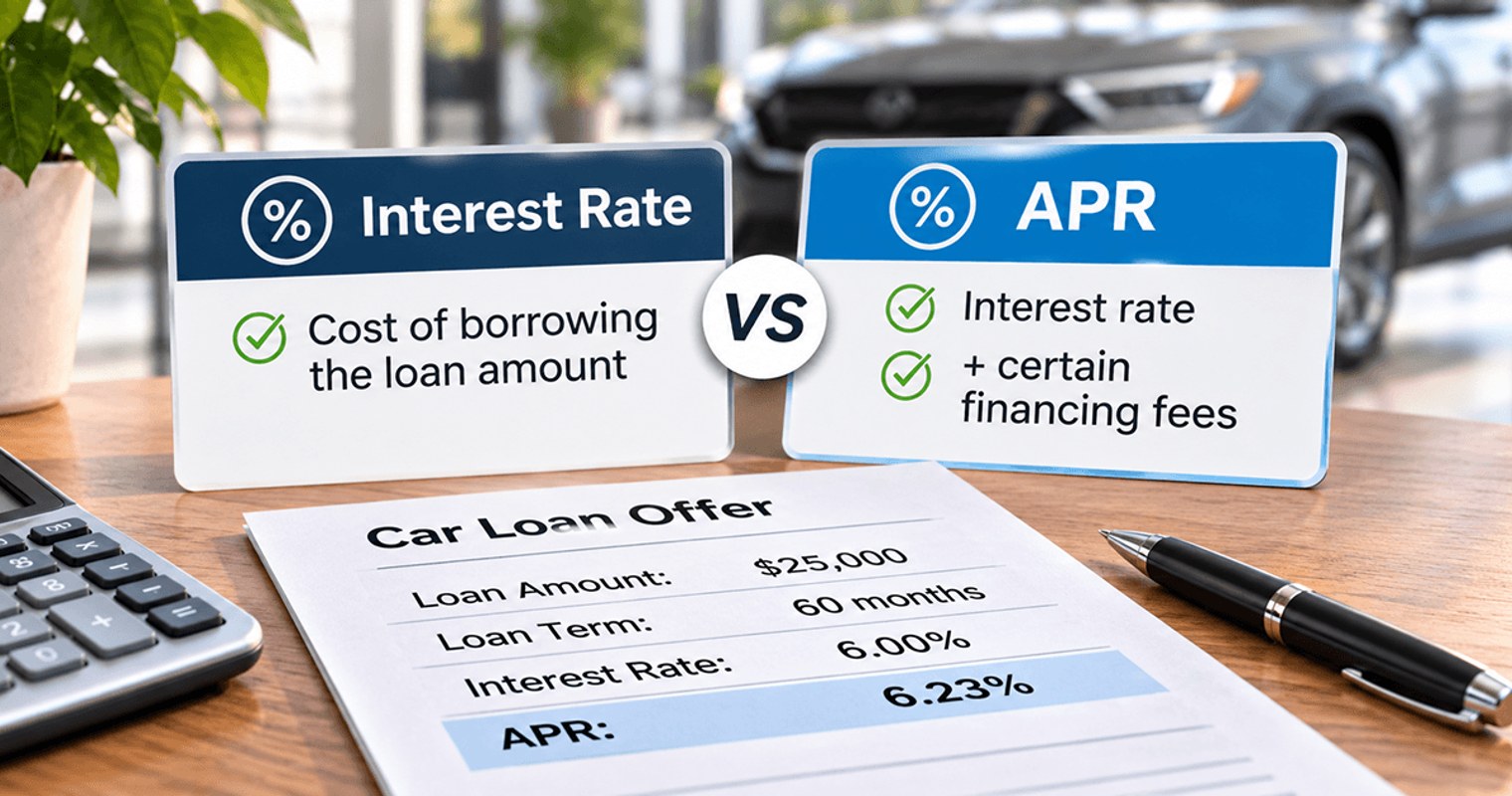
- APR: The annual cost of borrowing, including interest and certain financing charges.
- Loan term: The number of months you'll have to repay the loan.
- Maximum loan amount: How much the lender is willing to finance.
- Down payment requirements: How much money you may need upfront.
- Fees: Any applicable loan origination or other financing charges.
- Offer expiration: How long the preapproval remains valid.
- Vehicle restrictions: Requirements involving vehicle age, mileage, purchase source or other characteristics.
A longer loan term can make the monthly payment more affordable, but it may increase the total interest paid.
For example, consider a $25,000 auto loan at a hypothetical 7% APR.
| Loan Term | Estimated Monthly Payment | Total Interest |
|---|---|---|
| 48 months | $599 | $3,735 |
| 60 months | $495 | $4,702 |
| 72 months | $426 | $5,688 |
Estimates are rounded to the nearest dollar and assume a fixed 7% APR, equal monthly payments and no additional financed fees. Total interest is calculated using unrounded payments.
Example reviewed November 10, 2026. Calculations are illustrative and do not represent current lender offers or average market interest rates.
The 72 month loan has the lowest monthly payment, but it also costs approximately $1,953 more in interest than the 48 month loan.
If your budget allows, a shorter repayment term can reduce the overall cost of borrowing.
Step 7: Shop for a Car and Finalize Your Financing
With preapproval in hand, you can start shopping for vehicles that fit your budget.
With more than 3 million new and used vehicle listings, AutoFinder makes it easy to explore available cars, compare advertised prices and connect with dealerships. Use your preapproved amount as a spending limit rather than a target, and compare each vehicle's total out the door price before making a decision.
Compare available cars, review pricing and contact dealerships about vehicles you're interested in.
When you find the right car, request the complete out the door price, including applicable taxes and fees.
This helps you determine how much you actually need to finance.
Let the dealership know you have a preapproval and would like to compare financing options.
The dealership may be able to offer competitive financing through its lending partners, including manufacturer promotional programs for eligible vehicles and buyers.
If you prefer your existing preapproval, confirm that the dealership can complete the purchase using that lender.
Before signing, review the final APR, loan term, monthly payment, amount financed and total cost.
Your lender may also need to verify the vehicle identification number (VIN), purchase price and other transaction details before releasing funds.
What Credit Score Do You Need to Get Preapproved for a Car Loan?
There isn't one minimum credit score that applies to every auto lender.
Some lenders focus on borrowers with strong credit, while others offer financing to shoppers with limited or less established credit histories.
Your credit score is important, but lenders may also consider:
- Income and employment stability
- Existing monthly debt obligations
- Down payment amount
- Requested loan amount
- Vehicle age and mileage
- Length of the repayment term
- Overall credit history
Someone with a lower credit score may still qualify for financing, although the APR or down payment requirements could be higher.
If you have limited credit history, a qualified cosigner may help in some situations. However, a cosigner becomes legally responsible for the debt if the primary borrower doesn't make the required payments.
The most reliable way to understand your options is to compare actual lender offers rather than assuming you will or won't qualify based on a particular score.
Does Getting Preapproved for a Car Loan Hurt Your Credit?
It can, depending on the type of credit inquiry the lender performs.
A soft inquiry does not affect your credit score. A hard inquiry can have an impact.
The CFPB explains that qualifying auto loan inquiries within a 14 to 45 day window are generally counted as one inquiry for credit scoring purposes, depending on the scoring model.
You may still see each lender's inquiry listed separately on your credit report.
If you're comparing several lenders, completing your applications within a relatively short period can help limit the potential scoring impact.
Before applying, ask whether the lender will perform a hard inquiry and whether additional credit checks may occur later.
How Long Does It Take to Get Preapproved for a Car Loan?
Some lenders provide decisions within minutes, particularly when you apply online and your information can be verified electronically.
Others may take several hours or a few business days.
The process may take longer if the lender needs additional income documentation, has questions about your credit history or requires a manual review.
You can help avoid delays by checking your application for accuracy and responding promptly to requests for additional information.
If you're planning to visit a dealership soon, applying several days beforehand can give you time to compare offers without feeling rushed.
How Long Is a Car Loan Preapproval Good For?
Preapproval offers have expiration dates, and the exact period depends on the lender.
Some offers may remain valid for around 30 days, while others may last longer or have different conditions.
Always check the expiration date on your approval documents.
If your offer expires before you purchase a vehicle, the lender may require updated information, another application or a new credit review.
Your financing terms can also change if your credit profile, income or other relevant circumstances change.
If you're still researching vehicles, consider waiting until you're reasonably close to buying before submitting multiple formal applications.
Can You Get Preapproved for a Car Loan Before Choosing a Car?
Yes. Many lenders allow you to obtain preapproval before selecting a specific vehicle.
This can be especially useful if you're comparing several makes, models or dealerships.
For example, you might receive preapproval for up to $35,000 and then shop for vehicles priced between $25,000 and $30,000.
Once you choose a vehicle, the lender may review its age, mileage, price and other details.
Not every vehicle will necessarily qualify under your preapproval.
Some lenders restrict financing for older vehicles, high mileage vehicles, private party purchases or certain vehicle types.
Check these requirements before making a purchase commitment.
Can You Get Preapproved for a Car Loan With Bad Credit?
Yes, some lenders offer preapproval options for borrowers with less established or challenged credit.
Approval isn't guaranteed, and your financing terms may be less favorable than those available to borrowers with stronger credit histories.
If you're having difficulty qualifying, there are several steps worth considering:
- Save for a larger down payment.
- Look for a less expensive vehicle.
- Review your credit reports for errors.
- Reduce outstanding debt when possible.
- Consider a qualified cosigner if appropriate.
- Compare lenders that serve different credit profiles.
Be cautious about focusing exclusively on getting approved for a particular monthly payment.
A loan with a high APR and a long repayment term can become expensive, even when the monthly payment initially appears manageable.
The goal is to find financing that fits your budget throughout the entire repayment period.
Should You Get Preapproved Before Going to a Dealership?
For many shoppers, yes.
Preapproval helps you understand your borrowing options before you start comparing vehicles. It can also make conversations about financing more productive because you already have an offer to reference.
You aren't required to use your preapproved lender. A dealership may be able to offer competitive financing through its lending partners, and you can compare those terms before deciding.
Can a Dealership Beat Your Preapproved Interest Rate?
Yes. Dealerships work with multiple lenders, and some manufacturers offer promotional financing on eligible new vehicles. Depending on your credit profile and the vehicle you're buying, a dealership may be able to offer a lower APR than your existing preapproval.
Your preapproval gives you a rate to compare against, but you aren't required to use that lender. The goal is to find the financing option that works best for your budget.
Here's how the two options compare:
| Bank or Credit Union | Dealership Financing | |
|---|---|---|
| How it works | Apply directly with a lender, often before shopping. | The dealership submits your application to one or more financing partners. |
| When you get a rate | Before visiting the dealership, if preapproved. | During the vehicle purchase process. |
| Best when | You want a financing offer to compare, or you're shopping for a used vehicle. | The dealership offers a manufacturer promotion or beats your preapproved rate. |
| What to check | Offer expiration dates, vehicle restrictions, and loan fees. | APR, loan terms, optional products and available incentives. |
A lower APR doesn't always mean a lower overall cost. Some manufacturer financing promotions require buyers to choose between special financing and a cash rebate.
For example, consider a $30,000 vehicle financed over 60 months. These hypothetical scenarios assume no down payment, taxes or additional fees.
| Financing Option | Amount Financed | APR | Monthly Payment | Total Paid |
|---|---|---|---|---|
| Dealer promotional financing without a rebate | $30,000 | 0% | $500 | $30,000 |
| $4,000 rebate with bank financing | $26,000 | 4% | $479 | $28,730 |
| $2,000 rebate with bank financing | $28,000 | 6% | $541 | $32,479 |
In the third example, the 0% promotional financing saves approximately $2,479 compared with taking the smaller rebate and financing at 6%.
The better choice depends on the rebate amount, the APR you qualify for and the repayment term.
Before deciding, ask the dealership for the APR, loan term, amount financed and total repayment cost with and without the manufacturer incentive. Then compare those figures with your preapproved offer.
For more information about your financing options, see the Federal Trade Commission's Financing or Leasing a Car guide and the Consumer Financial Protection Bureau's guidance on dealer arranged and bank financing.
What Happens After You Get Preapproved for a Car Loan?
Once you've chosen a vehicle, the lender reviews the final purchase details before completing the financing.
That may include the vehicle's VIN, age, mileage, purchase price and title status. The lender could also request proof of insurance or updated financial documentation.
Before signing, confirm that the APR, loan term, amount financed and monthly payment match the terms you've agreed to.
If you're financing through a dealership, confirm whether the financing is final before taking delivery.
Common Mistakes to Avoid When Getting Preapproved
Preapproval can make car shopping easier, but a few decisions can create unnecessary costs.
Borrowing the maximum amount approved
Being approved for $40,000 doesn't mean a $40,000 vehicle is the right fit for your budget. Leave room for insurance, maintenance and other expenses.
Comparing only monthly payments
A longer loan term can lower the monthly payment while increasing total interest costs. Review the APR, loan term and total repayment amount.
Applying too early
If you aren't planning to purchase for several months, your preapproval may expire before you're ready.
Ignoring the out the door price
Taxes, fees and optional products can affect the final amount financed. Compare the complete purchase price, not just the advertised vehicle price.
Assuming preapproval guarantees financing
The lender may still need to approve the vehicle and verify your information.
Not comparing dealership financing
Your outside preapproval is a starting point. A dealership may have access to competitive financing offers or manufacturer incentives worth considering.
Want More Car Buying Advice?
Add AutoFinder as a preferred source on Google to help you discover more of our automotive guides and research.