Car Financing
How Much Is a Car Payment on a $30,000 Car?
OVERVIEW
What Is the Monthly Payment on a $30,000 Car?
If you're financing $30,000, your monthly payment changes depending on the APR and repayment period.
Here's what you could expect with common loan terms.
| APR | 48 Months | 60 Months | 72 Months |
|---|---|---|---|
| 4% | $677 | $552 | $469 |
| 6% | $705 | $580 | $497 |
| 8% | $732 | $608 | $526 |
| 10% | $761 | $637 | $556 |
| 12% | $790 | $667 | $587 |
Estimates assume a $30,000 fixed rate loan with equal monthly payments. APR equals the interest rate, with no additional finance charges. Figures are rounded and exclude taxes, registration, dealer fees and optional products.
For example, a shopper financing $30,000 at 6% APR for 60 months would pay approximately $580 each month. At 10% APR, that payment increases to about $637.
That's roughly $57 more every month for the same vehicle.
The difference becomes more noticeable when you look at the total interest paid over the loan.
AutoFinder $30,000 Car Payment Example
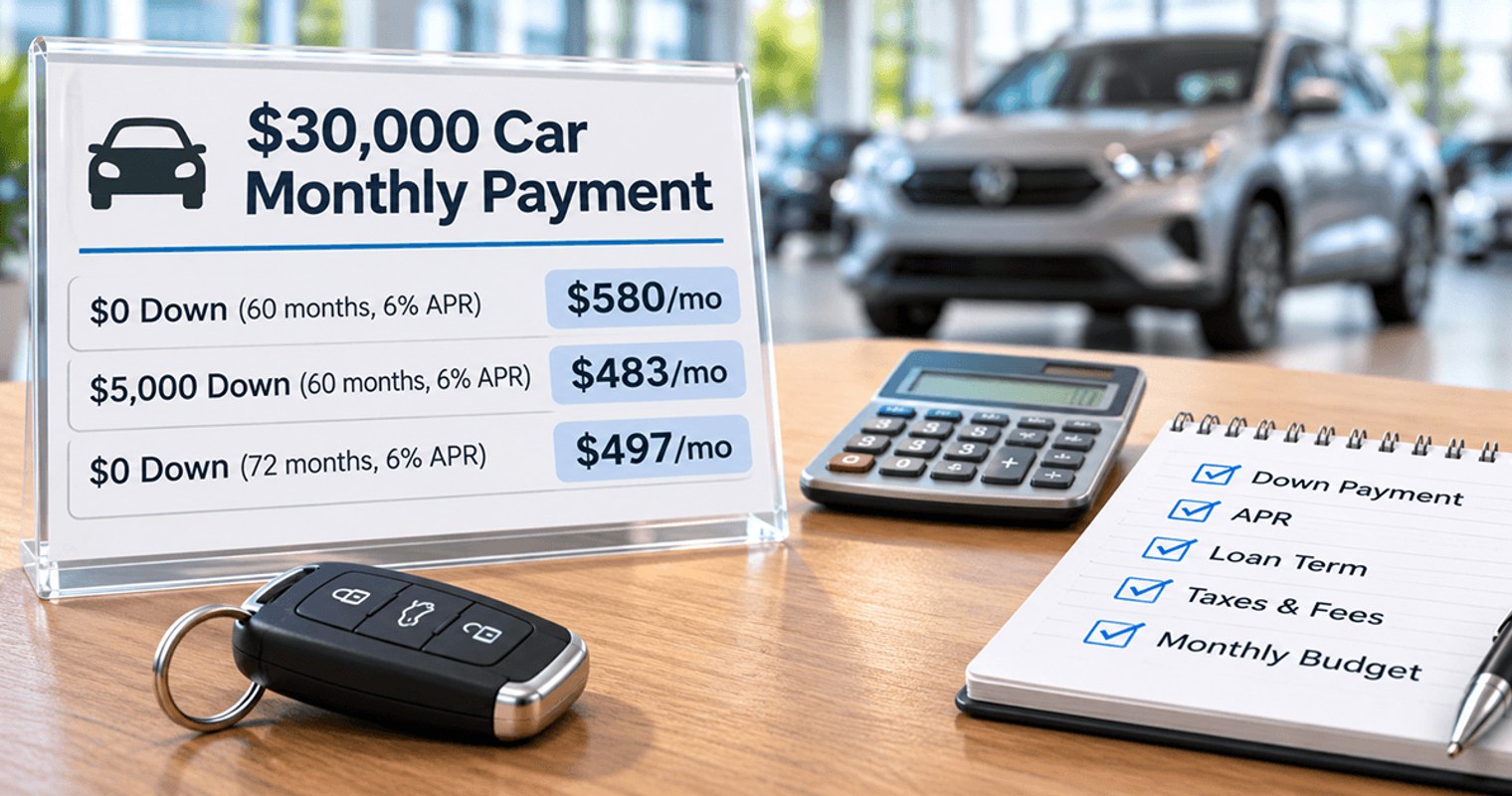
Here are 3 ways the same $30,000 vehicle could fit into a monthly budget.
- Standard financing: $580 per month with $0 down, 6% APR and 60 months.
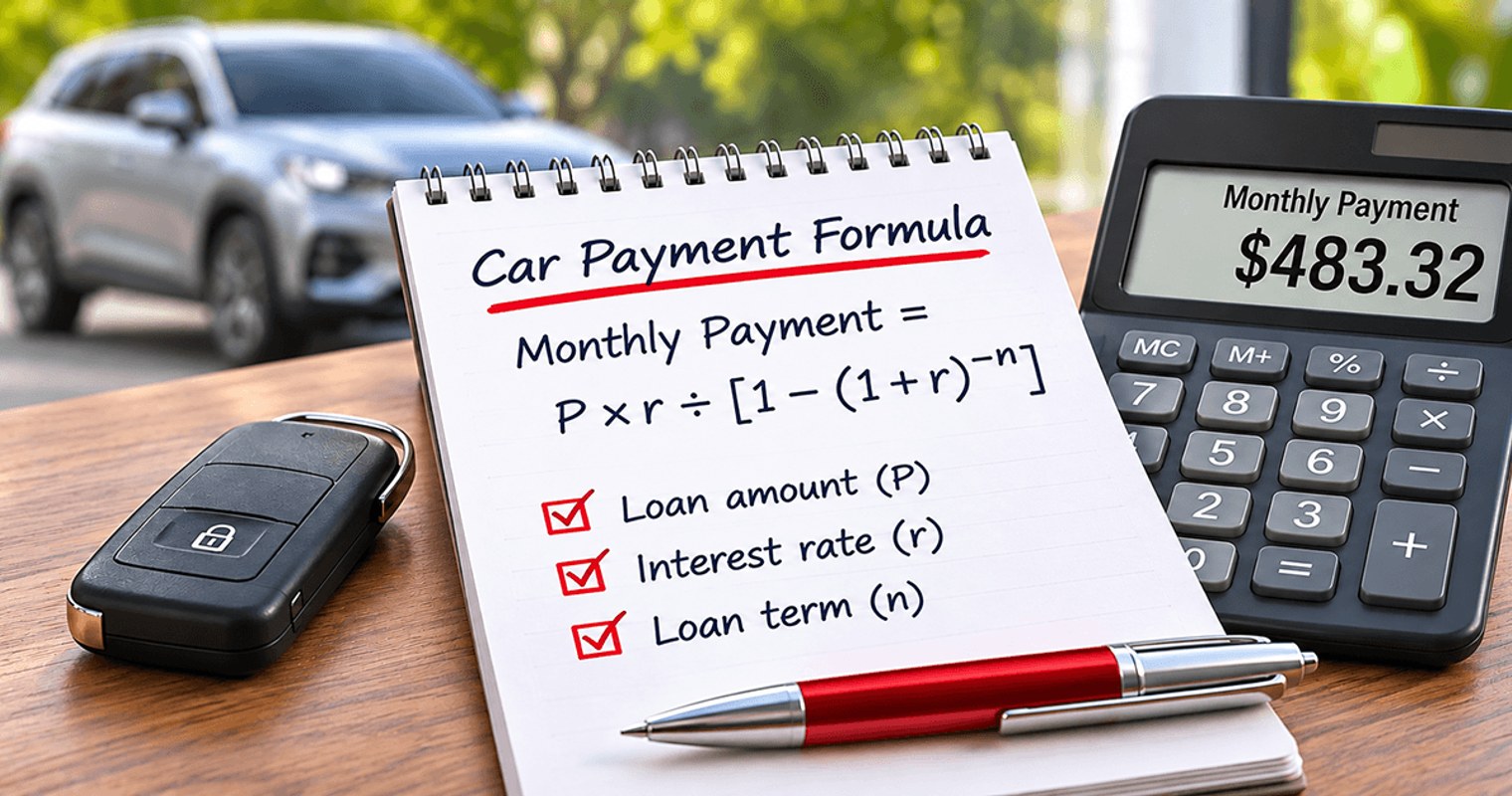
- Larger down payment: $483 per month with $5,000 down, 6% APR and 60 months.
- Longer repayment term: $497 per month with $0 down, 6% APR and 72 months.
These are illustrative payment calculations, not current financing offers. They assume no additional taxes, fees or finance charges.
The examples show why the monthly payment alone doesn't tell the full story. A larger down payment reduces what you borrow, while a longer term spreads the same debt over more time.
How Much Is a $30,000 Car Payment With a Down Payment?
Putting money down reduces the amount you finance. That typically lowers your monthly payment and the interest you'll pay over the loan.
For a $30,000 vehicle financed at 6% APR over 60 months, here's how different down payments affect the numbers.
| Down Payment | Amount Financed | Monthly Payment |
|---|---|---|
| $0 | $30,000 | $580 |
| $1,500 | $28,500 | $551 |
| $3,000 | $27,000 | $522 |
| $5,000 | $25,000 | $483 |
| $6,000 | $24,000 | $464 |
Estimates exclude taxes and fees and assume a fixed 6% APR over 60 months.
With $5,000 down, your estimated payment drops by approximately $97 per month compared with financing the full $30,000.
That can make a noticeable difference in your monthly budget.
However, putting more money down isn't always the best choice if it leaves you without enough savings for insurance, maintenance or unexpected expenses.
A reasonable down payment is one you can afford without stretching the rest of your finances.
Can You Buy a $30,000 Car With No Money Down?
Yes. Some lenders offer financing with no down payment to qualified borrowers.
Whether you qualify depends on your credit, income, existing debts and the vehicle you're purchasing.
Without a down payment, you'll generally have a larger loan balance and higher monthly payment. You may also be more likely to owe more than the vehicle is worth during the early part of the loan.
If you're trading in a vehicle with positive equity, that value may help reduce the amount financed without requiring additional cash.
How Does APR Affect the Payment on a $30,000 Car?
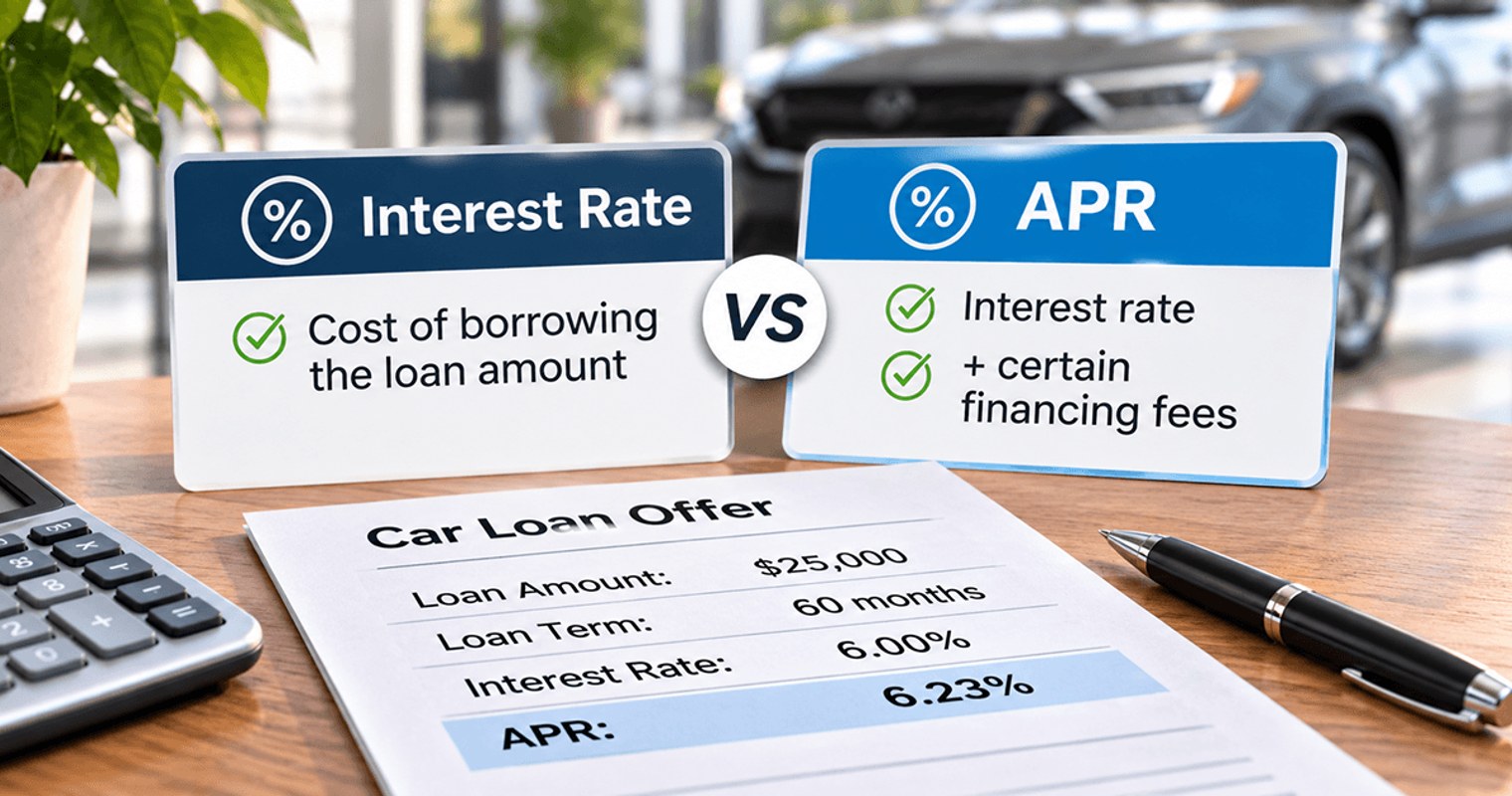
APR represents the annual cost of borrowing, including interest and certain additional finance charges.
When the loan amount and repayment period stay the same, a lower APR generally reduces both the monthly payment and total financing cost.
Consider a $30,000 loan over 60 months.
| APR | Monthly Payment | Total Interest |
|---|---|---|
| 4% | $552 | $3,150 |
| 6% | $580 | $4,799 |
| 8% | $608 | $6,498 |
| 10% | $637 | $8,245 |
| 12% | $667 | $10,040 |
Estimates assume a fixed rate loan with no additional finance charges. Figures are rounded.
At 4% APR, you'd pay approximately $3,150 in interest over 5 years.
At 12% APR, that increases to approximately $10,040.
That's nearly $6,900 more in interest, even though you're financing the same $30,000.
The difference is significant enough that it's worth getting financing quotes before choosing a vehicle.
What Is a Good APR for a $30,000 Car?
A competitive APR depends on your credit profile, the type of vehicle and the financing programs available.
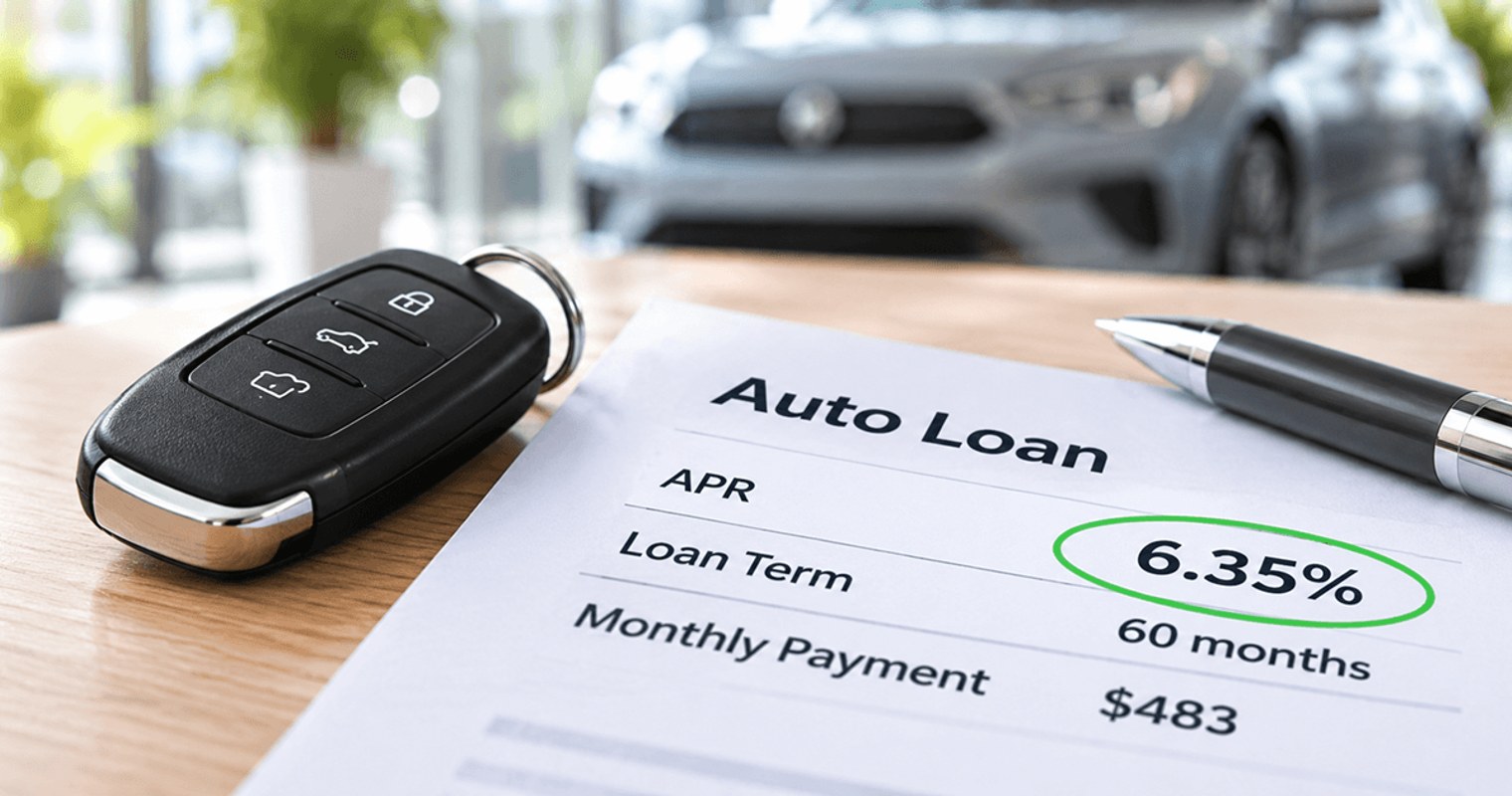
According to Experian's Q2 2026 data, the average interest rate was 6.35% for new car loans and 11.19% for used car loans.
Borrowers with excellent credit generally received lower rates.
These are reported interest rate averages rather than guaranteed APR offers, so use them as a starting point when comparing lenders.
For a more detailed breakdown by credit score, see What Is a Good APR for a Car Loan?.
Is a 60 or 72 Month Loan Better for a $30,000 Car?
A longer loan term lowers the monthly payment, but it generally increases the total amount of interest you pay.
Here's how the numbers change when you finance $30,000 at 6% APR.
| Loan Term | Monthly Payment | Total Interest |
|---|---|---|
| 36 months | $913 | $2,856 |
| 48 months | $705 | $3,818 |
| 60 months | $580 | $4,799 |
| 72 months | $497 | $5,797 |
| 84 months | $438 | $6,814 |
Estimates assume a fixed 6% APR with no additional finance charges. Figures are rounded. Actual lender rates may vary by term.
Choosing 72 months instead of 60 months reduces the payment by approximately $83.
That extra breathing room may be useful if you're trying to stay below $500 per month.
The tradeoff is about $998 more in total interest and another year of payments.
An 84 month loan lowers the payment further, to approximately $438, but leaves you paying for the vehicle over 7 years.
If you plan to trade in your car after 3 or 4 years, a longer loan could leave you with less equity than you expected.
Is a 72 Month Car Loan Too Long?
A 72 month loan isn't necessarily too long, particularly if you plan to keep the vehicle for several years.
What matters is whether the payment fits your budget and whether you're comfortable with the total borrowing cost.
A shorter loan generally builds equity faster and costs less in interest, assuming the same APR. A longer loan provides more room in your monthly budget but keeps the debt around longer.
Before signing, compare both options using the same amount financed.
How Much Are Taxes and Fees on a $30,000 Car?
A $30,000 advertised price doesn't necessarily mean your total purchase price will be $30,000.
Depending on your location and purchase agreement, you may also pay:
- State and local sales taxes
- Title and registration fees
- Dealer documentation fees
- Optional protection products
- Other applicable government charges
Suppose you buy a $30,000 car in an area with a 6% sales tax.
Sales tax would add $1,800.
If title, registration and dealer fees total another $500, the estimated purchase price becomes $32,300.
Financing the entire $32,300 at 6% APR for 60 months would produce a payment of approximately $624.
That's about $44 more per month than financing $30,000.
This is why it's helpful to request an itemized out the door price before comparing monthly payments. Some charges may need to be paid upfront rather than financed.
You can use AutoFinder's Out the Door Price Calculator to estimate the full purchase cost based on your location.
How Much Should You Make to Afford a $30,000 Car?
There isn't a specific salary that automatically makes a $30,000 car affordable.
A lender may approve you for financing, but that doesn't necessarily mean the payment fits comfortably within your household budget.
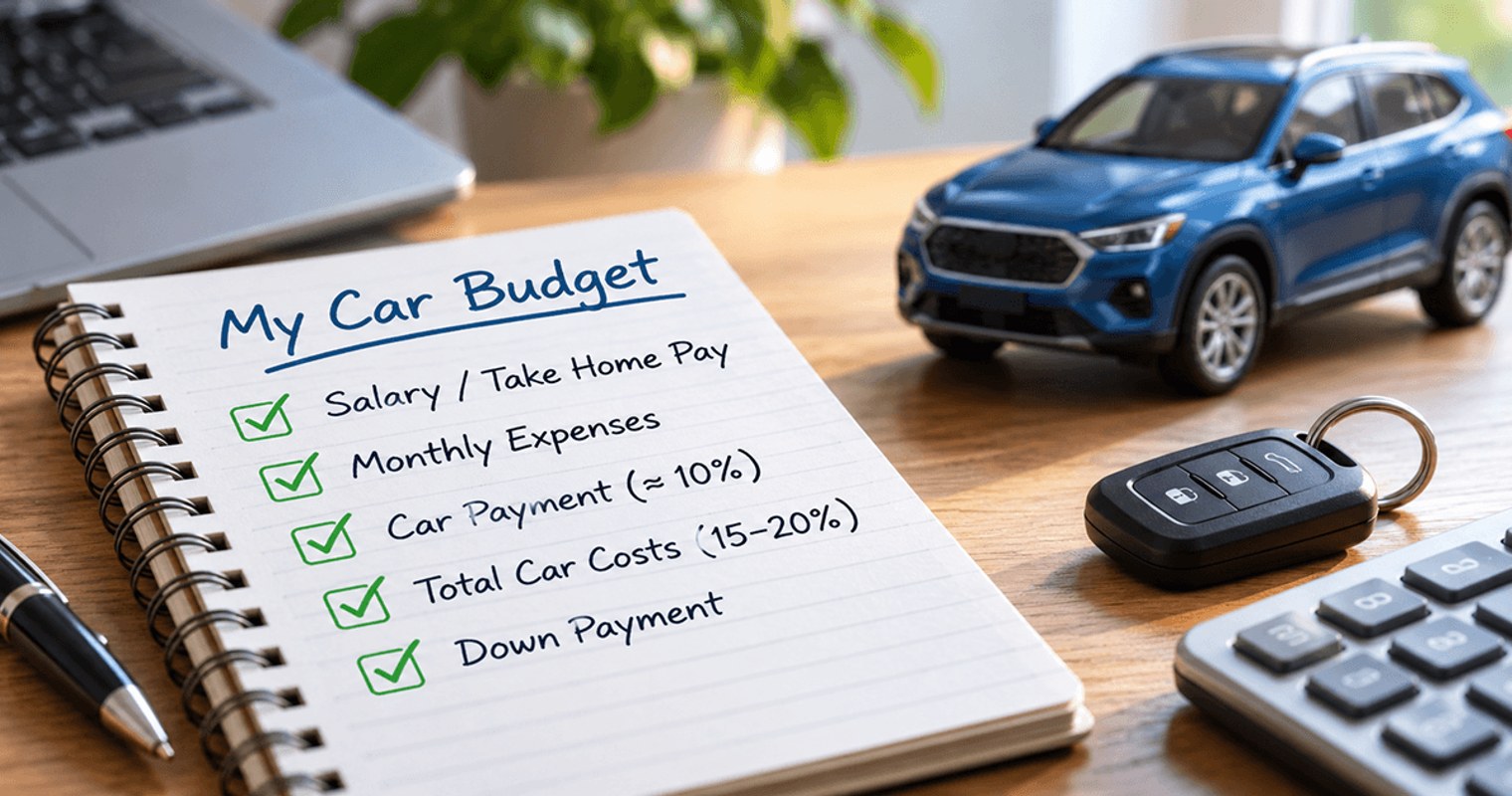
Start with your monthly take home pay, then account for housing, existing debt, savings and other necessary expenses.
For example, consider someone bringing home $5,000 per month who finances a $30,000 car at 6% APR over 60 months.
Their estimated vehicle expenses might look like this:
| Expense | Estimated Monthly Cost |
|---|---|
| Car payment | $580 |
| Insurance | $175 |
| Fuel | $150 |
| Maintenance savings | $75 |
| Total | $980 |
Insurance, fuel and maintenance figures are illustrative budgeting assumptions, not national averages or personalized quotes.
In this example, transportation would account for approximately 19.6% of monthly take home pay, before parking, tolls and other potential expenses.
That may be manageable for someone with low housing costs and little existing debt. It could be difficult for someone with a high mortgage payment, childcare expenses or other financial obligations.
A useful approach is to decide what you can comfortably spend on transportation each month before deciding how expensive a vehicle to buy.
If you want to evaluate affordability based on income, see AutoFinder's article How Much Should I Spend on a Car Based on My Salary?
Is $600 a Month Too Much for a Car Payment?
A $600 payment isn't automatically too expensive, but it needs to make sense alongside your other financial responsibilities.
If your budget comfortably covers the payment, insurance, fuel, maintenance and savings, it may be reasonable.
If making the payment would leave little room for unexpected expenses, consider a lower vehicle price or a larger down payment.
Remember that the payment is only one part of owning a car.
Is It Better to Put More Money Down or Choose a Longer Loan?
Both options can lower your monthly payment, but they work differently.
A larger down payment reduces the amount you borrow. You generally pay less interest and can pay off the loan sooner.
A longer loan term spreads the debt across additional months. Your payment drops, but the total interest usually increases.
Consider 2 ways to finance a $30,000 vehicle at 6% APR.
With $5,000 down and a 60 month loan, the payment is approximately $483.
With no down payment and a 72 month loan, the payment is approximately $497.
The monthly payments are close, but the first option requires $5,000 upfront and pays off the debt a year sooner.
If you have the savings available, putting more down may be appealing. If keeping cash available is a higher priority, a longer term may be worth considering.
The key is understanding what each choice costs over the full loan.
Can You Get a $30,000 Car Payment Under $500?
Yes. A monthly payment below $500 is possible on a $30,000 vehicle, depending on the amount financed, APR and repayment period.
Here are 3 examples:
- $497 per month: $30,000 financed at 6% APR for 72 months.
- $483 per month: $25,000 financed at 6% APR for 60 months.
- $464 per month: $24,000 financed at 6% APR for 60 months.
These estimates exclude taxes and fees.
Notice that 2 of the examples involve borrowing less money rather than extending the loan.
If your target is $500 per month, consider leaving some room in your budget for changes in the final purchase price.
A $497 estimated payment before taxes and fees could easily exceed $500 once those costs are included in the financing.
How Can You Lower the Monthly Payment on a $30,000 Car?
If your estimated payment is higher than you'd like, you have several options.
Compare financing offers. Banks, credit unions and dealership lending partners may offer different APRs. Even a modest rate improvement can reduce borrowing costs.
Increase your down payment. Putting more money down reduces the amount financed without extending the loan.
Apply trade in equity. If your current vehicle is worth more than the remaining loan balance, the positive equity can help reduce the next loan.
Consider a lower purchase price. A vehicle priced at $27,000 instead of $30,000 could give you more flexibility without requiring a longer term.
Ask about manufacturer incentives. Some new vehicles qualify for promotional financing or cash rebates. A dealership can help you review available offers and eligibility requirements.
Review the loan term. A longer term can lower your payment, but compare the additional interest before choosing it.
If you haven't arranged financing yet, our guide on How to Get Preapproved for a Car Loan explains how to prepare and compare offers before visiting a dealership.
How Can AutoFinder Help You Find a Car Within Your Budget?
Once you have a comfortable monthly payment in mind, you can work backward to estimate how much vehicle you can afford.
On AutoFinder, you can explore new and used vehicles from participating dealerships, compare advertised prices and narrow your options based on your preferences.
For example, if your goal is to stay around $500 per month, you might start by comparing vehicles priced below $30,000 or looking at how a down payment could affect your financing.
You can then connect with local dealerships to confirm availability, review pricing and discuss financing options.
If you're new to auto loans, How Does Financing a Car Work? explains the process from application through repayment.
The Bottom Line: How Much Is a Car Payment on a $30,000 Car?
For a $30,000 car, a reasonable starting estimate is $580 per month with a 6% APR over 60 months, before taxes and fees.
But don't stop at the payment estimate.
A $5,000 down payment could lower that payment to approximately $483. Financing for 72 months could bring it to about $497, although you'd pay more interest over time.
Before buying, decide what you can comfortably spend each month, request the full purchase price and compare financing terms.
A car payment should fit your life, not force you to rearrange everything else around it.
Disclaimer
This article provides general educational information and does not constitute financial, lending or legal advice. Payment examples assume fixed rate, fully amortizing loans and are rounded to the nearest dollar. Unless otherwise noted, calculations exclude taxes, registration, dealer fees, optional products and additional finance charges. Actual financing offers, APRs and payments depend on creditworthiness, lender requirements, vehicle eligibility and applicable laws.
Want More Car Buying Advice?
Add AutoFinder as a preferred source on Google to help you discover more of our automotive guides and research.