Car Financing
How to Calculate a Car Payment (Formula and Examples)
KEY TAKEAWAYS
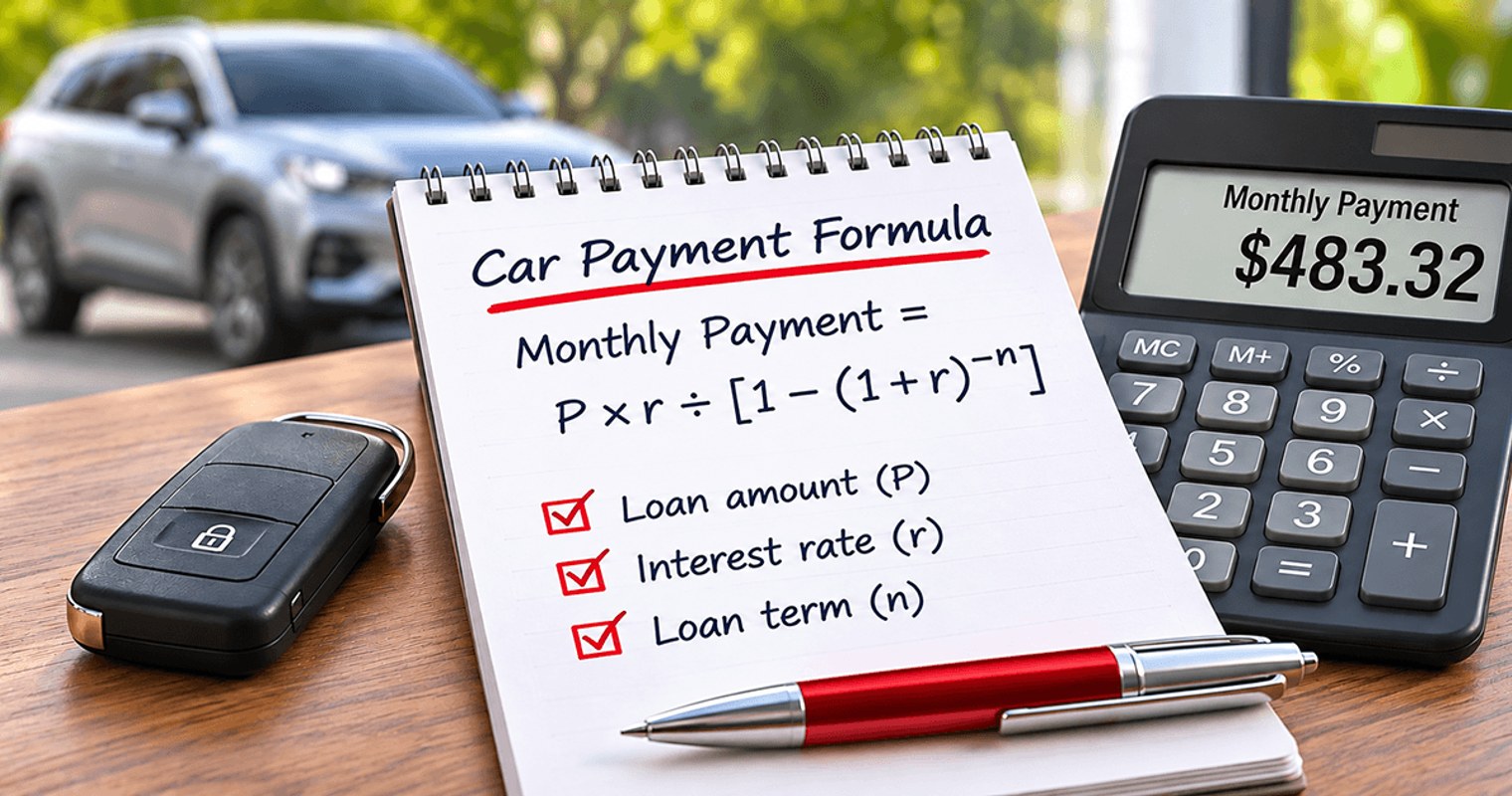
- Car payment formula: Monthly Payment = P × r ÷ [1 − (1 + r)⁻ⁿ], where P is the amount financed, r is the monthly interest rate and n is the number of payments.
- Example: Financing $25,000 at 6% interest over 60 months results in an estimated payment of $483.32.
- Down payment: Putting more money down reduces the amount borrowed and generally lowers the payment.
- Interest rate: A higher rate increases both the monthly payment and total interest.
- Loan term: A longer loan generally lowers the monthly payment but increases the total interest paid.
- Taxes and fees: Any purchase charges included in the financing increase the amount borrowed.
To calculate a monthly car payment, you need 3 numbers: the amount you're borrowing, the interest rate, and the number of months you'll take to repay the loan. For example, a $25,000 auto loan at 6% interest over 60 months has an estimated payment of $483.32 per month. The standard car payment formula accounts for both principal and interest. It can help you estimate payments before visiting a dealership, compare loan offers, and understand how much a vehicle will actually cost to finance. You can also use a car payment calculator to do the math. But knowing how the calculation works is useful, especially when you're comparing a lower monthly payment against the total amount you'll pay over the life of the loan.
What Is the Formula for Calculating a Car Payment?
The standard formula for a fixed-rate auto loan with equal monthly payments is:
Monthly Payment = P × r ÷ [1 − (1 + r)⁻ⁿ]
Here's what each variable means:
- P: Principal, or the total amount financed.
- r: Monthly interest rate, calculated by dividing the annual interest rate by 12.
- n: Total number of monthly payments.
For example, if your loan has a 6% annual interest rate, divide 0.06 by 12.
0.06 ÷ 12 = 0.005
Your monthly interest rate is 0.005, or 0.5%.
If you're financing the vehicle for 5 years, you'll make 60 monthly payments.
The formula uses those numbers to calculate a payment that covers the loan balance and interest over the repayment period.
What if the interest rate is 0%?
You don't need the full formula for a 0% interest loan. Simply divide the amount financed by the number of monthly payments.
For example, financing $25,000 at 0% for 60 months results in a payment of approximately $416.67.
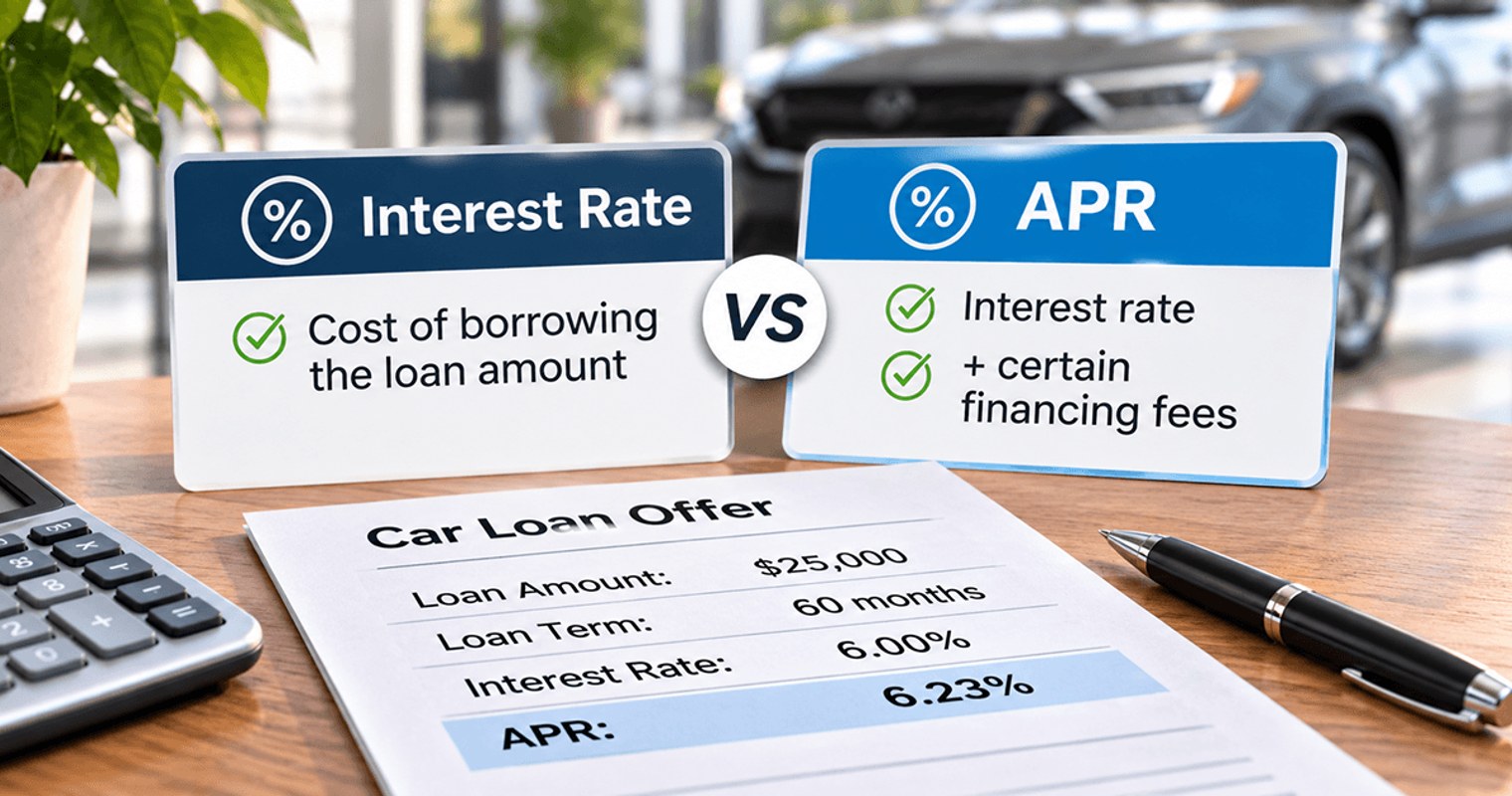
Should You Use APR or the Interest Rate?
For the most accurate calculation, use the loan's contractual interest rate.
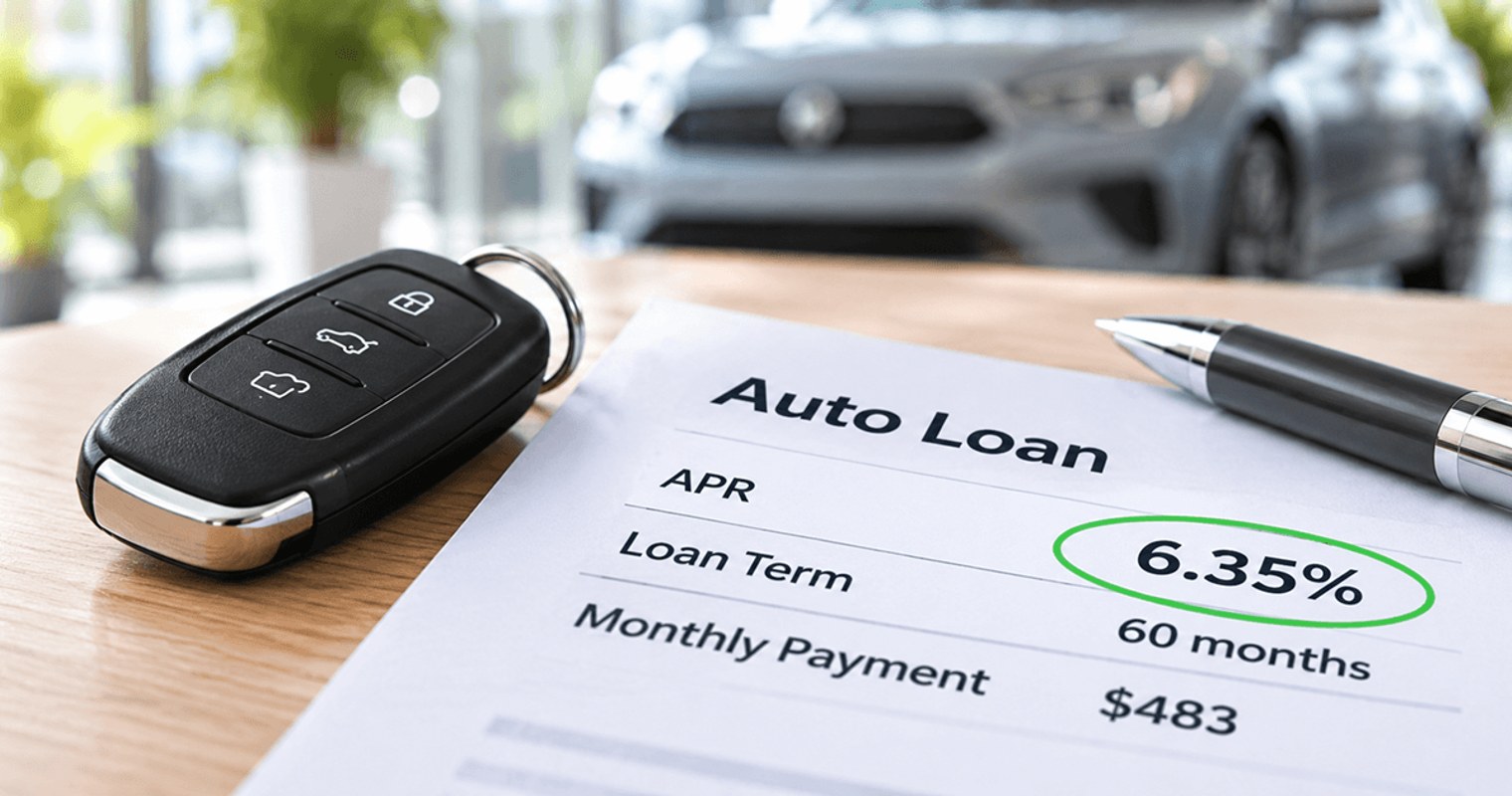
APR represents the annual cost of borrowing and may include certain additional finance charges. The interest rate is the rate used to calculate interest on the outstanding loan balance.
When there are no additional finance charges, APR and the interest rate may be equal.
If they differ, entering the APR directly into the payment formula may not reproduce the lender's exact monthly payment.
This distinction matters when comparing financing offers. APR is useful for comparing borrowing costs, while the contractual interest rate and amount financed are used to determine the scheduled payment.
How Do You Calculate the Amount Financed?
Before calculating the monthly payment, determine how much you need to borrow.
Start with the vehicle's selling price, add applicable taxes and fees, then subtract your down payment, eligible rebates, and any positive trade-in equity applied to the purchase.
For example:
| Purchase Detail | Amount |
|---|---|
| Vehicle selling price | $28,000 |
| Taxes and fees | $2,000 |
| Down payment | −$3,000 |
| Amount financed | $27,000 |
In this example, the amount financed is $27,000.
The amount financed isn't always the same as the vehicle's advertised price. If you include taxes, registration fees, or optional products in the loan, you'll be borrowing more than the selling price.
A trade-in can also change the calculation. Positive equity may reduce the amount you need to finance, while negative equity included in the new loan increases it.
To estimate your full purchase cost before financing, use AutoFinder's Out the Door Price Calculator.
How to Calculate a Car Payment Step by Step
Let's calculate the monthly payment on a $25,000 auto loan at a fixed 6% annual interest rate over 60 months.
This example assumes there are no additional finance charges and the loan has equal monthly payments.
Step 1: Identify the Loan Amount
The first number is the amount financed.
For this example:
P = 25,000
If you're buying a vehicle for $28,000 and putting $3,000 down, the amount financed would be $25,000 before any additional taxes, fees, or other adjustments.
Step 2: Convert the Annual Interest Rate to a Monthly Rate
Divide the annual interest rate by 100 to convert it to a decimal. Then divide by 12.
6 ÷ 100 ÷ 12 = 0.005
The monthly interest rate is 0.005.
In the formula:
r = 0.005
Step 3: Determine the Number of Payments
Multiply the number of years by 12.
5 × 12 = 60
In the formula:
n = 60
Step 4: Enter the Numbers Into the Formula
Now insert the values into the monthly payment formula.
Monthly Payment = 25,000 × 0.005 ÷ [1 − (1.005)⁻⁶⁰]
The result is approximately $483.32.
That means a $25,000 loan at 6% interest over 60 months would require monthly payments of approximately $483.32.
The exact contractual payment may vary slightly due to rounding or differences in the loan's interest calculation method.
Step 5: Calculate the Total Interest
You can estimate the total interest by multiplying the unrounded monthly payment by the number of payments and subtracting the original loan amount.
For this example:
- Monthly payment: approximately $483.32
- Number of payments: 60
- Total loan payments: approximately $28,999
- Total interest: approximately $3,999
The total interest is the additional amount paid to borrow the $25,000 over 5 years, excluding any other finance charges.
How Much of Each Car Payment Goes Toward Interest?
Your monthly payment generally includes both principal and interest.
Principal is the money you borrowed. Interest is the cost of borrowing that money.
On a $25,000 loan with a 6% annual interest rate, the first month's interest under a monthly interest calculation would be:
$25,000 × 0.005 = $125
Of your approximately $483.32 payment:
- $125 goes toward interest.
- $358.32 reduces the principal balance.
After that payment, your remaining principal would be approximately $24,641.68.
The next month's interest would be calculated using that lower balance.
As the loan balance decreases, less of each scheduled payment goes toward interest, and more goes toward principal.
This process is called amortization.
Some auto loans calculate interest daily rather than monthly, so the exact interest portion of a payment can depend on the number of days between payments.
Car Payment Examples at Different Interest Rates
Even a few percentage points can make a noticeable difference in the cost of financing a vehicle.
Here's what happens when you finance $25,000 over 60 months at different fixed interest rates.
| Annual Interest Rate | Monthly Payment | Total Interest |
|---|---|---|
| 0% | $416.67 | $0 |
| 4% | $460.41 | $2,625 |
| 6% | $483.32 | $3,999 |
| 8% | $506.91 | $5,415 |
Estimates assume a $25,000 fixed rate loan over 60 months, with no additional finance charges. Total interest is rounded.
At 4%, the estimated monthly payment is $460.41. At 8%, it increases to $506.91.
That's approximately $47 more each month.
Over 60 months, the 8% loan also costs approximately $2,790 more in interest.
A lower interest rate can make a meaningful difference, particularly when you're financing a larger purchase.
The rate you're offered depends on factors such as your credit history, income, loan term, lender and vehicle.
For more context, read AutoFinder's guide to What Is a Good APR for a Car Loan?.
How Does the Loan Term Affect Your Car Payment?
The loan term is the amount of time you have to repay the money borrowed.
A longer term spreads the principal across more monthly payments. That usually makes each payment smaller, but you'll generally pay more interest because the loan balance takes longer to repay.
Consider a $25,000 loan at a fixed 6% interest rate.
| Loan Term | Monthly Payment | Total Interest |
|---|---|---|
| 48 months | $587.13 | $3,182 |
| 60 months | $483.32 | $3,999 |
| 72 months | $414.32 | $4,831 |
Calculations assume a fixed 6% annual interest rate, equal monthly payments, and no additional finance charges. Total interest is rounded.
A 48-month loan has an estimated payment of $587.13. Extending the loan to 72 months reduces the payment to $414.32.
That frees up approximately $173 per month.
However, the longer loan adds approximately $1,649 in interest.
If you're comparing vehicles and need to stretch the loan term to make the payment affordable, it's worth checking whether a less expensive vehicle would provide more flexibility.
Is a 60- or 72 Month Car Loan Better?
A 60-month loan generally costs less in interest than a 72-month loan when the amount financed and interest rate are the same.
A 72-month loan may be more manageable for someone who needs a lower monthly payment.
The tradeoff is that you'll make payments for an additional year and may build equity in the vehicle more slowly.
Also, lenders may offer different interest rates depending on the repayment term. Compare the actual financing offers rather than assuming the rate will remain the same.
How Does a Down Payment Change Your Car Payment?
A down payment reduces the amount you borrow.
The more you pay upfront, the less principal you'll need to repay through monthly installments.
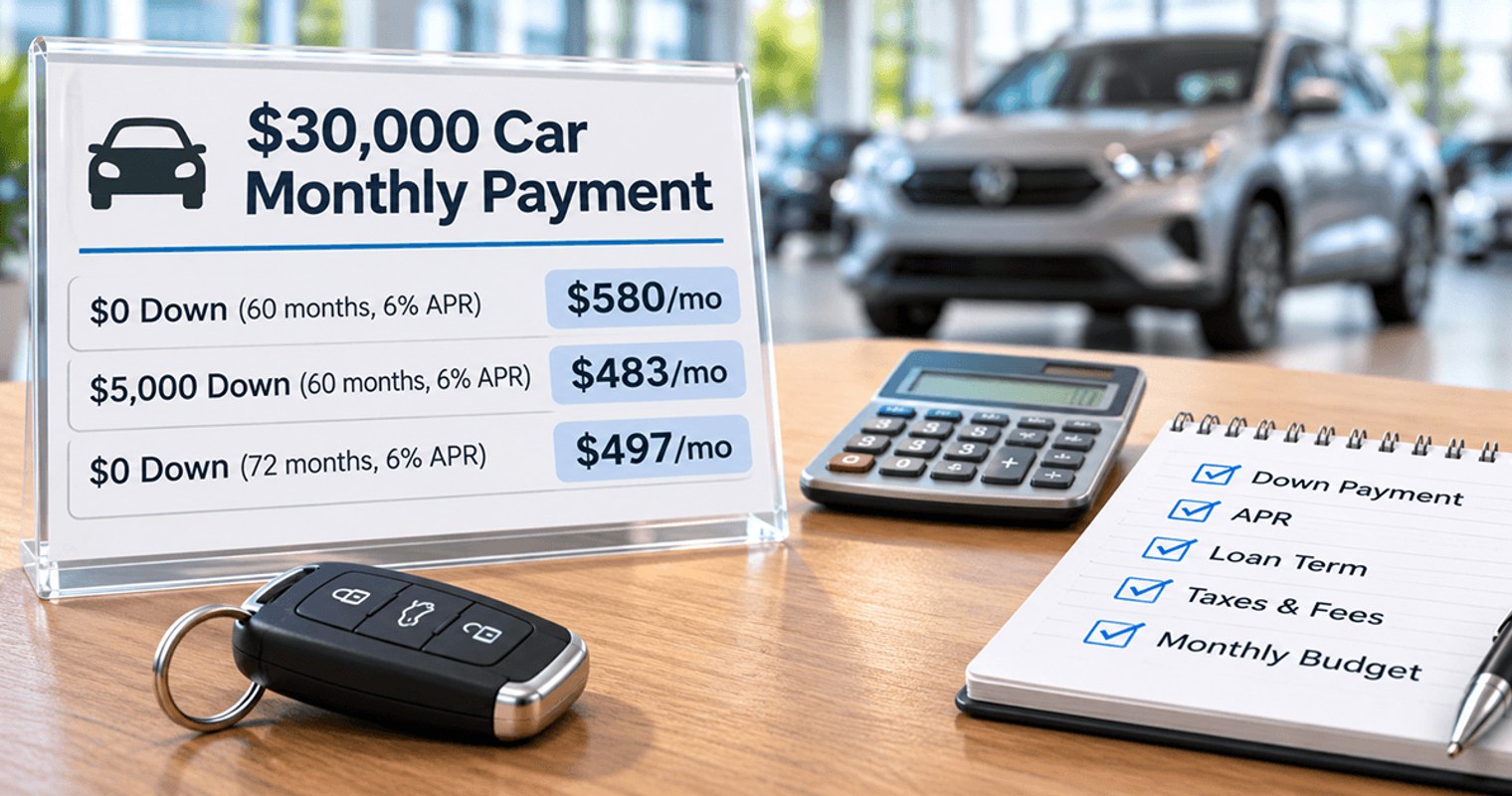
Consider a $30,000 vehicle financed at 6% interest over 60 months, excluding taxes and fees.
| Down Payment | Amount Financed | Monthly Payment |
|---|---|---|
| $0 | $30,000 | $579.98 |
| $3,000 | $27,000 | $521.99 |
| $5,000 | $25,000 | $483.32 |
| $10,000 | $20,000 | $386.66 |
Estimates assume a fixed 6% annual interest rate, 60 monthly payments and no additional finance charges.
Putting $5,000 down instead of $0 reduces the estimated monthly payment by approximately $97.
A larger down payment can also reduce the risk of owing more than the vehicle is worth.
That doesn't mean you should use all your savings to lower the payment.
You'll still need money for insurance, maintenance, registration and unexpected expenses after buying the car.
Choose a down payment that fits both your purchase budget and your available savings.
How Do Taxes and Fees Affect Your Monthly Car Payment?
Taxes and fees increase the monthly payment when they're included in the amount financed.
Suppose you're buying a vehicle for $25,000.
The purchase includes another $2,000 in applicable taxes and fees, and you decide to finance those charges.
Instead of borrowing $25,000, you're borrowing $27,000.
At 6% interest over 60 months:
- Financing $25,000 results in an estimated payment of $483.32.
- Financing $27,000 results in an estimated payment of $521.99.
That's approximately $39 more per month.
You'll also pay interest on the additional $2,000.
If you pay the taxes and fees upfront, they won't increase your loan balance, although you'll need more cash at purchase.
The exact charges depend on your state, dealership, and vehicle.
Ask for an itemized out-the-door quote so you can calculate the payment using the full amount you expect to finance.
How Do You Calculate a Car Payment With a Trade-In?
A trade-in can reduce the amount you need to borrow, but the calculation depends on whether you still owe money on your current vehicle.
Example 1: Trading In a Car With Positive Equity
Suppose you're buying a $30,000 vehicle.
Your current car has a trade-in value of $12,000, and you owe $8,000 on the loan.
Your equity is:
$12,000 − $8,000 = $4,000
If you apply that $4,000 toward the new vehicle, the amount financed becomes $26,000 before taxes, fees and other adjustments.
At 6% interest over 60 months, the estimated payment would be approximately $503.
Example 2: Trading In a Car With Negative Equity
Now suppose the same vehicle is worth $12,000, but you owe $15,000.
You have $3,000 in negative equity.
If a lender allows that amount to be included in your next loan, the amount financed on the $30,000 replacement vehicle would increase to $33,000 before taxes and fees.
At 6% interest over 60 months, the estimated monthly payment would be approximately $638.
Financing negative equity increases the loan balance and may make it harder to build equity in the replacement vehicle.
Before trading in, ask your lender for the current payoff amount and review the dealership's trade-in offer.
Can You Calculate a Car Payment Without a Calculator?
You can calculate a car payment by hand using the amortization formula, but you'll need to work with exponents.
If you only need a rough starting point, divide the amount financed by the number of months.
For example:
$25,000 ÷ 60 = $416.67
That tells you how much principal you would repay each month on a 60-month loan with no interest.
It doesn't account for borrowing costs.
At 6% interest, the actual calculated payment is approximately $483.32.
The difference is substantial enough that dividing the purchase price by the number of months shouldn't be used as your final payment estimate.
For a more accurate number, use the full formula or an auto loan calculator.
How to Use a Car Payment Calculator
A car payment calculator lets you compare financing scenarios without entering the formula manually.
You'll typically need:
- Vehicle purchase price
- Down payment
- Trade-in value and remaining payoff, if applicable
- Estimated taxes and fees
- Interest rate
- Loan term in months
Once you've entered the information, the calculator estimates your monthly payment.
Try adjusting one variable at a time.
For example, if you're considering a $30,000 vehicle, compare the payment with $3,000 down and $5,000 down.
Then keep the down payment the same and compare a 60 month loan with a 72 month loan.
You'll see how much each choice changes the payment and, where the calculator provides it, the total interest.
For a real purchase price example, read How Much Is a Car Payment on a $30,000 Car?.
You can also use AutoFinder's Car Payment Calculator to explore different loan amounts, rates and terms.
Why Might Your Actual Car Payment Be Different?
The payment you calculate before visiting a dealership may not match the final financing offer.
A few common reasons include:
- Different interest rate: Your approved rate may be higher or lower than your estimate.
- Taxes and fees: The final amount financed may include charges you didn't account for.
- Optional products: Additional coverage or services included in the loan increase the balance.
- Trade-in adjustments: The final trade-in value or loan payoff may differ from your estimate.
- Loan structure: Additional finance charges, payment timing, and the lender's interest calculation method can affect the result.
Some auto loans calculate interest daily, meaning the amount of interest charged between payments depends on the outstanding principal and the number of days that pass.
When reviewing a financing offer, check the amount financed, APR, finance charge, total of payments, and payment schedule.
Those figures should give you a complete picture of the loan rather than just the monthly payment.
The Bottom Line
Calculating a car payment starts with 3 numbers: how much you're borrowing, the interest rate, and how long you have to repay the loan.
The standard amortization formula gives you a useful estimate, but the amount financed is just as important as the calculation itself.
Include taxes and fees you plan to finance, subtract your down payment, and account for any trade-in equity. Then compare different interest rates and loan terms to understand the monthly payment and total cost.
Before signing a financing agreement, confirm the final numbers with your lender or dealership.
Understanding how the payment is calculated makes it easier to compare offers and choose a vehicle that fits your budget.
Disclaimer
This article provides general educational information and does not constitute financial, legal, or lending advice. All calculations are illustrative and assume fixed-rate, fully amortizing loans with equal monthly payments and no additional finance charges unless otherwise stated. Actual payments, interest charges, eligibility, taxes, and fees depend on the lender, vehicle, location, and financing agreement. Review your loan documents before making a financial commitment.
Want More Car Buying Advice?
Add AutoFinder as a preferred source on Google to help you discover more of our automotive guides and research.