Car Financing
What Is the Best Way to Borrow Money for a Car?
KEY TAKEAWAYS
- A secured auto loan is generally a good starting point because interest rates are often lower than those on unsecured personal loans.
- Compare offers from at least 2 or 3 lenders, including banks and credit unions.
- Getting pre-approved before shopping gives you a financing offer to compare at the dealership.
- Dealerships may offer competitive financing through their lending partners or manufacturer promotions.
- Compare APR, loan term, fees, incentives, and total payments before choosing a loan.
The best way to borrow money for a car is usually to get pre-approved for a secured auto loan through a bank or credit union, then compare that offer with financing available through the dealership. A secured auto loan often has a lower interest rate than an unsecured personal loan, and comparing multiple lenders can help you find more favorable terms.
You don't have to choose your lender before finding a vehicle. A bank or credit union can provide a starting offer, while a dealership may be able to improve on it through its lending partners or manufacturer financing programs.
The goal is to find a car you can comfortably afford and a loan that keeps your total costs manageable.
Should You Use an Auto Loan or a Personal Loan to Buy a Car?
A secured auto loan is usually a good starting point for buying a car. Because the vehicle serves as collateral, these loans often offer more competitive interest rates than unsecured personal loans, although the actual cost depends on your qualifications and lender.
The main difference is collateral.
With a secured auto loan, the vehicle serves as collateral. If you fail to make payments and default on the loan, the lender may have the right to repossess it.
An unsecured personal loan generally doesn't use the vehicle as collateral. That gives the lender less direct security, which can result in higher interest rates or different approval requirements. Defaulting on a personal loan can still damage your credit and lead to collection activity.
| Secured auto loan | Unsecured personal loan | |
|---|---|---|
| Collateral | Vehicle | Usually none |
| Interest rates | Often lower | Often higher |
| Vehicle restrictions | Age, mileage or seller restrictions may apply | Often more flexible |
| Loan purpose | Vehicle purchase | Broader borrowing purposes |
| Main consideration | Vehicle may be repossessed after default | Potentially higher borrowing cost |
A personal loan might make sense when purchasing an older vehicle that doesn't meet an auto lender's requirements or buying from a private seller that the lender won't finance.
However, some auto lenders finance older vehicles and private-party purchases, so compare those options before assuming you need a personal loan.
For most shoppers purchasing a new or used vehicle from a dealership, a traditional auto loan is the logical starting point.
Where Can You Borrow Money to Buy a Car?
You can finance a vehicle through a bank, credit union, online lender, dealership, or automaker's financing company.
Each option has advantages. The best one depends on the terms available to you and the vehicle you're buying.
| Financing source | Potential advantage | What to consider |
|---|---|---|
| Bank | Direct financing and established lending services | Rates and approval requirements vary |
| Credit union | Often competitive rates and member services | Membership may be required |
| Online lender | Convenient applications and comparisons | Check fees, eligibility and lender reputation |
| Dealership | Access to multiple financing partners | Compare the actual offer with direct financing |
| Manufacturer financing | Promotional APR programs on eligible vehicles | Credit and vehicle restrictions may apply |
Banks
Banks offer auto loans directly to consumers. You can often apply before choosing a vehicle and receive a conditional approval for a certain amount.
Your existing bank is a reasonable place to start, particularly if it offers relationship discounts. However, you don't necessarily need an account at a bank to apply for its auto loan.
Credit unions
Credit unions are member-owned financial institutions that often offer competitive auto financing.
Some have membership requirements based on your employer, location, or other affiliations. Others have broader eligibility.
Even if you've used the same bank for years, comparing a credit union's offer may be worthwhile.
Online lenders
Online lenders can make it convenient to compare financing without visiting a branch.
Some offer prequalification tools that provide estimated terms before a formal application.
Review the lender's fees, vehicle requirements, and final loan terms rather than choosing based on convenience alone.
Dealership financing
Dealerships help buyers arrange loans through banks, credit unions, and automotive finance companies.
A dealership's finance department may have relationships with several lenders, allowing it to compare available financing options and coordinate the loan with the vehicle purchase.
This can be especially useful for shoppers who want to complete the purchase and financing in one place.
Dealerships may also provide access to special financing programs offered by automakers.
Is It Better to Borrow From a Bank, Credit Union or Dealership?
A bank or credit union is a good place to start because it gives you an independent financing offer. However, dealership financing may be the better choice if the dealer can provide a lower rate or a manufacturer promotion that reduces your overall cost.
Neither option is automatically cheaper.
When bank or credit union financing makes sense
Direct financing allows you to compare loan terms before visiting a dealership.
The Consumer Financial Protection Bureau explains that when a dealership arranges financing, a lender may provide a rate called the buy rate. The dealership may offer the buyer a higher rate, with the difference compensating the dealership for arranging the financing.
Obtaining an independent loan offer can help you evaluate the rate you're offered at the dealership.
Not every dealer-arranged loan includes a markup, and a dealership may still offer the most competitive terms available to you.
When dealership financing makes sense
Dealership financing can be a strong option when the dealership has access to a lender offering better terms than your existing preapproval.
Some automakers also offer promotional financing on eligible vehicles, including low or 0% APR programs for qualified buyers.
These promotions may be particularly attractive when purchasing a new vehicle.
The dealership's finance team can explain the available programs, eligibility requirements, and whether certain cash incentives can be combined with special financing.
Which option should you choose?
Choose a bank or credit union when: Its offer provides the lowest total borrowing cost for the vehicle you want, with comparable purchase terms.
Choose dealership financing when: The dealer beats your independent offer or a manufacturer promotion lowers your total purchase cost.
Compare both when: You want to understand all available financing options before signing.
Getting preapproved independently doesn't prevent you from financing through the dealership. It simply gives you another offer to consider.
For a broader explanation of how lenders, loan payments, and dealership financing fit together, read AutoFinder's How Does Financing a Car Work?
How Do You Get Preapproved for a Car Loan?
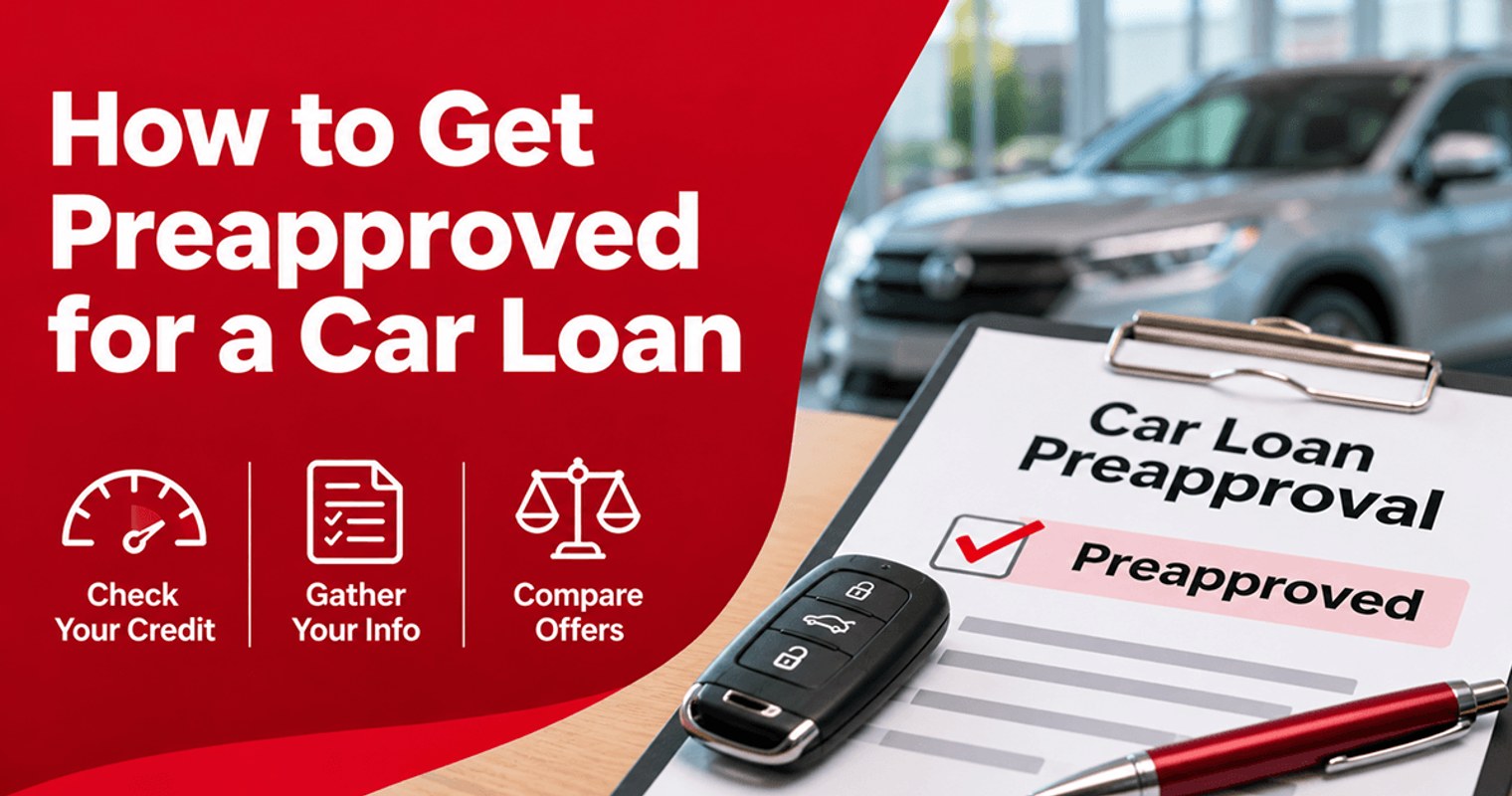
You can get preapproved by reviewing your credit, setting a budget, gathering basic financial information, and applying with several lenders.
Preapproval means a lender has reviewed your information and provided conditional financing terms. It isn't a guarantee of final approval.
The process generally involves these steps:
- Check your credit. Review your credit reports for inaccuracies that could affect approval or interest rates.
- Set your budget. Consider the monthly payment alongside insurance, fuel, maintenance, taxes, and fees.
- Gather your information. Lenders commonly request identification, income, employment, address, and existing debt information.
- Apply with 2 or 3 lenders. Compare a bank, credit union, and potentially an online lender.
- Review your offers. Look at APR, loan term, amount financed, fees, and approval conditions.
- Keep your preapproval details. Bring the offer to the dealership so you can compare financing options.
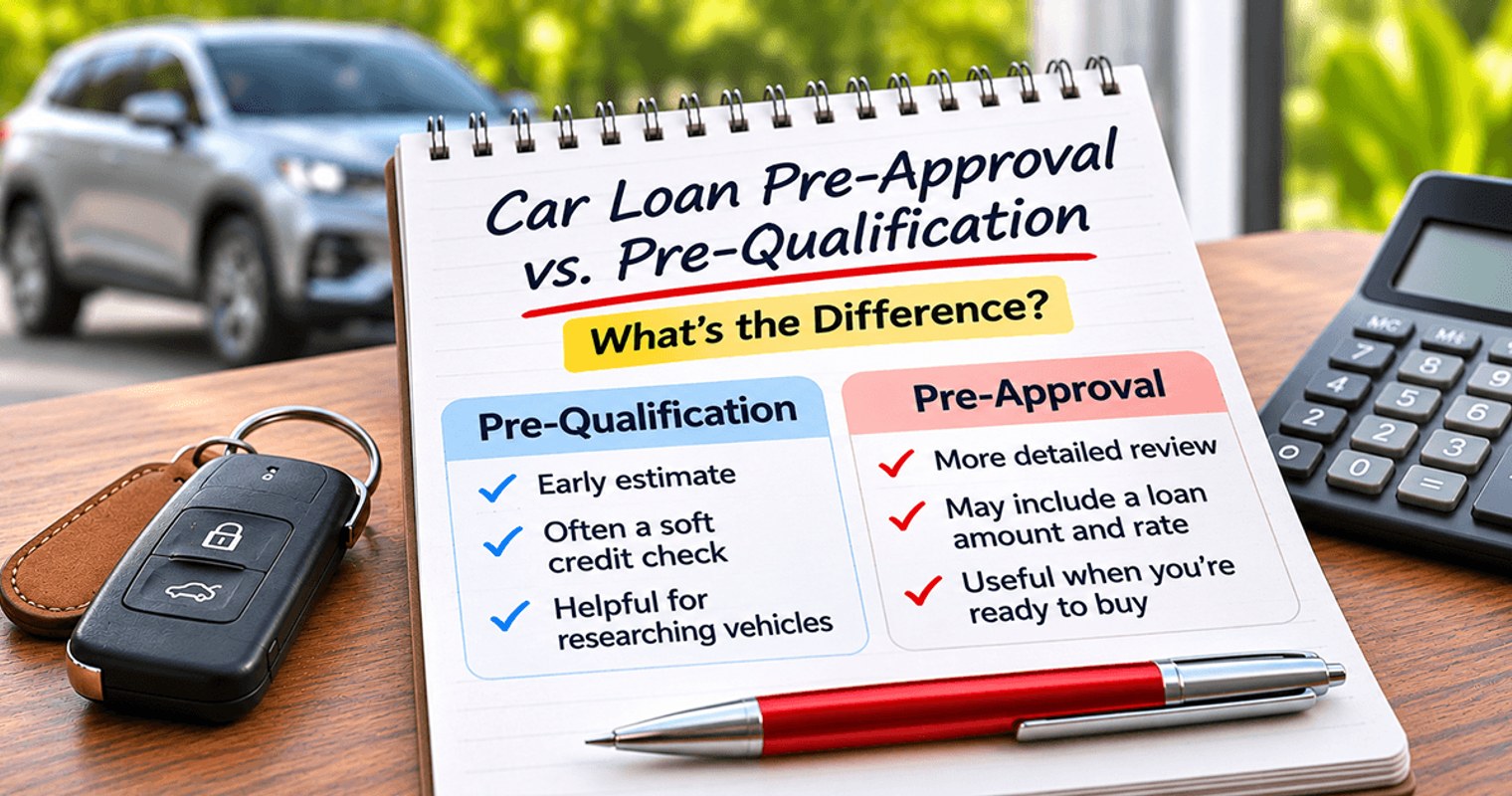
Some lenders offer prequalification using a soft credit inquiry, while formal applications may involve a hard inquiry. Ask which type of credit check the lender will perform.
For a more detailed walkthrough, read AutoFinder's How to Get Preapproved for a Car Loan.
How Should You Compare Car Loan Offers?
Compare car loans using the APR, repayment period, amount financed, fees, and total amount you'll repay.
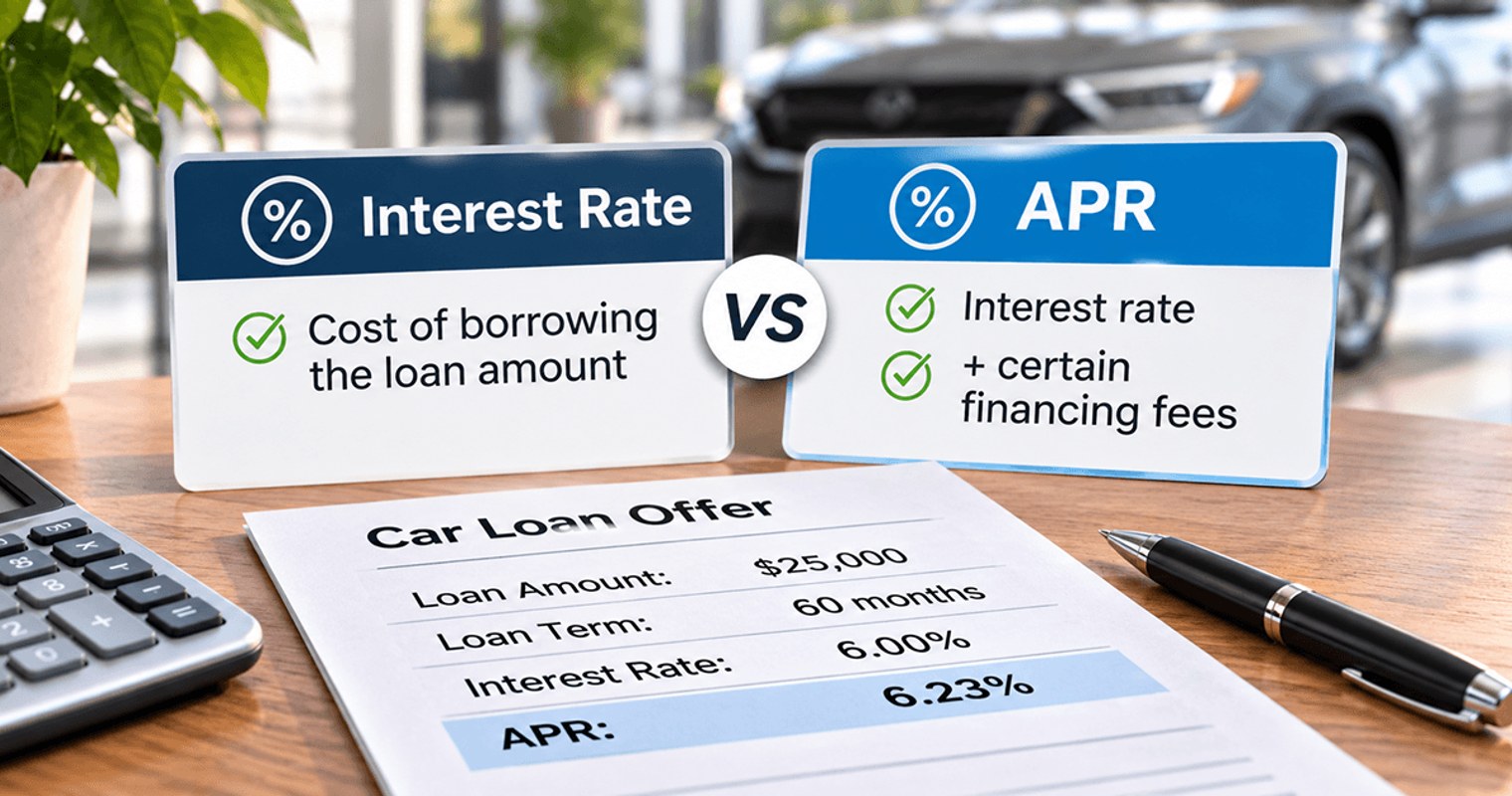
APR stands for annual percentage rate. It represents the annual cost of borrowing, including interest and certain fees.
The loan term is how long you have to repay the loan. The amount financed is the money you're borrowing after accounting for your down payment and other applicable amounts.
A lower monthly payment doesn't always mean a cheaper loan.
What should you check before choosing?
Use this checklist when reviewing offers:
- APR: What is the annual cost of borrowing?
- Loan term: How many months will you make payments?
- Amount financed: How much are you actually borrowing?
- Monthly payment: Does the payment fit your budget?
- Total interest and fees: How much will borrowing cost?
- Total payments: How much will you repay over the full term?
- Prepayment penalties: Is there a charge for paying the loan off early?
- Promotional restrictions: Does choosing a special rate affect cash rebates or other incentives?
Ask for written terms so you're comparing the same information across lenders.
For help evaluating an offered rate, see AutoFinder's What Is a Good APR for a Car Loan?
Why the loan term matters
The CFPB provides an example showing how repayment length affects a $20,000 loan at a 4.75% interest rate.
| Loan term | Monthly payment | Total interest |
|---|---|---|
| 36 months | $597 | $1,498 |
| 48 months | $458 | $1,999 |
| 60 months | $375 | $2,508 |
| 72 months | $320 | $3,024 |
Source: Consumer Financial Protection Bureau, “How do I compare auto loan offers?” Figures are rounded.
The 72-month loan has a lower monthly payment than the 36-month loan, but costs approximately $1,526 more in interest.
Longer terms can make a vehicle easier to fit into a monthly budget, but they also increase the time you're making payments and may increase the risk of owing more than the vehicle is worth.
Can a Dealership Offer a Better Deal Even With a Higher APR?
Yes. A dealership financing offer with a higher APR can still result in a lower total purchase cost if it includes a qualifying vehicle discount that isn't available with the other financing option.
Consider a hypothetical vehicle purchase with two different financing offers.
| Loan detail | Bank financing | Dealer financing |
|---|---|---|
| Vehicle purchase amount | $30,000 | $30,000 |
| Financing-specific discount | $0 | $2,000 |
| Amount financed | $30,000 | $28,000 |
| APR | 5.9% | 6.9% |
| Loan term | 60 months | 60 months |
| Monthly payment | ~$579 | ~$553 |
| Total interest | ~$4,715 | ~$5,187 |
| Total loan payments | ~$34,715 | ~$33,187 |
Hypothetical illustration assuming no down payment, trade-in, taxes, additional fees, or financed optional products. The $2,000 discount is assumed to be available only with the dealer financing offer. APR equals the interest rate in each example, with no additional finance charges. Amounts are rounded. This is not a current manufacturer promotion or financing quote.
The bank offers the lower APR, but the dealership's hypothetical discount reduces the amount financed.
Despite the higher rate, the dealership option results in approximately $1,529 less in total loan payments, based on the unrounded calculations.
This doesn't mean dealership financing is always cheaper. It shows why buyers should compare the full transaction instead of looking only at the interest rate.
In a real purchase, the discount may be available regardless of lender, or special financing may exclude certain rebates. Ask the dealership to explain which incentives apply to each offer.
How does the out-the-door price fit into this comparison?
The out-the-door price is the total vehicle purchase price, including applicable taxes and fees, before subtracting the down payment or accounting for financing costs.
For example:
| Purchase detail | Amount |
|---|---|
| Advertised vehicle price | $27,000 |
| Estimated taxes and fees | $2,500 |
| Out-the-door price | $29,500 |
| Down payment | $5,000 |
| Amount financed | $24,500 |
The buyer is shopping for a $27,000 vehicle but needs a loan for $24,500 after accounting for the complete purchase price and down payment.
This distinction matters because a lender may approve you for a certain amount, but taxes and fees can affect how much of that approval is available for the vehicle itself.
AutoFinder's out-the-door price calculator can help you estimate these costs before comparing loan offers.
Does Shopping for a Car Loan Hurt Your Credit?
Applying for auto loans can affect your credit score, but multiple qualifying auto loan inquiries made within a short period are generally treated as one inquiry for credit-scoring purposes.
According to the CFPB, the applicable shopping window is typically 14 to 45 days, depending on the scoring model.
This means you can compare several lenders without necessarily having each inquiry counted separately in your credit score.
However, the inquiries may still appear individually on your credit report, and a hard inquiry can have some impact.
To limit potential effects, complete your loan shopping within a relatively short period and ask lenders whether their applications require a hard credit check.
Checking your own credit report doesn't lower your score.
What Should You Do at the Dealership Once You're Preapproved?
Once you have a preapproval, confirm the vehicle's selling price and out-the-door cost, then ask the dealership to compare its available financing offers with your existing loan.
You can negotiate the vehicle purchase and still consider dealership financing.
Start with the vehicle price
Ask for a written breakdown of the selling price, taxes, required fees, and optional products.
If you're trading in a vehicle, review its trade-in value and any remaining loan balance.
This helps you understand the total transaction before deciding how to finance it.
Give the dealership an opportunity to compete
You can say:
"I've already been preapproved through my bank, but I'm open to financing through the dealership. If you can offer a better rate or lower overall cost, I'd be happy to compare the options."
A dealership's finance department may have access to lenders or promotional programs that aren't available through your bank.
Ask for written terms so you can compare offers fairly.
Review optional products
Dealership finance departments may also offer products such as extended warranties, GAP coverage, and vehicle protection plans.
These products can provide value for certain buyers, depending on the coverage and circumstances.
However, adding their cost to the loan increases the amount financed and may increase total interest.
Ask what each product covers, whether it's optional, and how it affects your payment before agreeing.
What Could Prevent Your Car Loan From Being Finalized?
Preapproval is conditional, and final financing may depend on the vehicle, purchase details, and verification of your financial information.
Common issues include:
- Vehicle eligibility: Some lenders restrict the age, mileage, condition, or type of vehicle they'll finance.
- Loan amount changes: Taxes, fees, optional products, or a different purchase price may increase the amount you need to borrow.
- Income verification: A lender may request pay statements or additional employment information.
- Credit changes: New debt or changes to your credit profile may affect the terms available.
- Approval expiration: A preapproval may expire before you complete the purchase.
- Dealer participation: Some lenders require purchases through participating dealerships.
Before taking delivery, confirm whether financing has received final approval or remains conditional.
If the dealership explains that financing is still pending, review the written agreement and understand what happens if the lender doesn't approve the original terms.
This helps both the buyer and dealership avoid misunderstandings about the transaction.
How Much Money Should You Borrow for a Car?
Borrow an amount that comfortably fits your budget rather than automatically using the maximum loan amount a lender approves.
For example, someone approved for $35,000 might decide that a $25,000 vehicle is more appropriate after accounting for insurance, maintenance, and household expenses.
A larger down payment can reduce the amount financed and total interest when other terms remain unchanged. However, it's also important to maintain savings for emergencies and unexpected expenses.
If a payment feels too high, consider a less expensive vehicle before extending the repayment term.
AutoFinder's guide to how much you should spend on a car based on your salary can help you work through a realistic budget.
How Do You Find a Car Within Your Preapproved Budget?
Once you know your comfortable borrowing limit, use it to establish a vehicle shopping budget.
Remember that the lender's approval amount may need to cover more than the advertised price.
For example, if you have a $25,000 financing limit and expect $2,000 in taxes and fees, you may want to focus on vehicles priced around $23,000 or less, assuming no down payment, trade-in, or additional financed costs.
That leaves room for the expenses involved in completing the purchase.
Compare vehicles based on price, mileage, equipment, condition, and location.
AutoFinder helps shoppers explore new and used vehicles from dealerships nationwide, compare available options, and connect with local dealers.
You can explore vehicles on AutoFinder and narrow your search to your preferred price range.
Once you find a vehicle that fits your budget, contact the dealership to confirm availability, request an out-the-door quote, and discuss the financing options available.
The Bottom Line
Start by comparing secured auto loans from banks and credit unions. Once you have a competitive offer, give the dealership an opportunity to match or improve on it.
Review the full purchase price, financing terms, and any applicable incentives before deciding. The best financing option is the one that fits your budget and provides the lowest overall cost for the vehicle you want.
Want More Car Buying Advice?
Add AutoFinder as a preferred source on Google to help you discover more of our automotive guides and research.