Car Pricing & Value
Trade In vs. Sell Privately: Which Is Better?
OVERVIEW
Selling your car privately may get you more money for it, while trading it in is usually the easier route. Which one is better comes down to the real difference in dollars and what you are willing to do to get them.
Start with an actual trade-in offer and a realistic private sale price. Then consider your loan payoff, how quickly you need to sell, the paperwork involved, and what it will take to find a private buyer.
A potential $2,000 difference could easily be worth pursuing. But if selling privately means weeks of listings, messages, test drives, and coordinating a loan payoff, you may decide otherwise. A smaller difference could make a competitive dealer offer especially attractive.
The highest number alone does not tell you which option is better. What matters is what you realistically walk away with and what is required to get there.
Is It Better to Trade In a Car or Sell It Privately?
There is no single answer for every car owner.
Trading in may make more sense if you:
Want a simple transaction
Need to replace your vehicle quickly
Still have a loan on the car
Do not want to advertise the vehicle or meet private buyers
Receive a competitive trade-in offer
Prefer to handle the sale and purchase through one dealership
Selling privately may make more sense if you:
Have time to find a buyer
See a meaningful difference between your trade offer and realistic private sale price
Are comfortable handling inquiries, test drives, and paperwork
Can coordinate the payoff if you still owe money
Have a vehicle that may be particularly attractive to private buyers
Neither route is automatically better. The right comparison starts with what each option actually looks like for your car.
If you are still learning how the trade process works, How Does Trading In a Car Work? A Complete Guide covers appraisals, equity, loan payoffs, paperwork, and what happens when you trade your current vehicle toward another one.
What Is the Difference Between Trading In and Selling Privately?
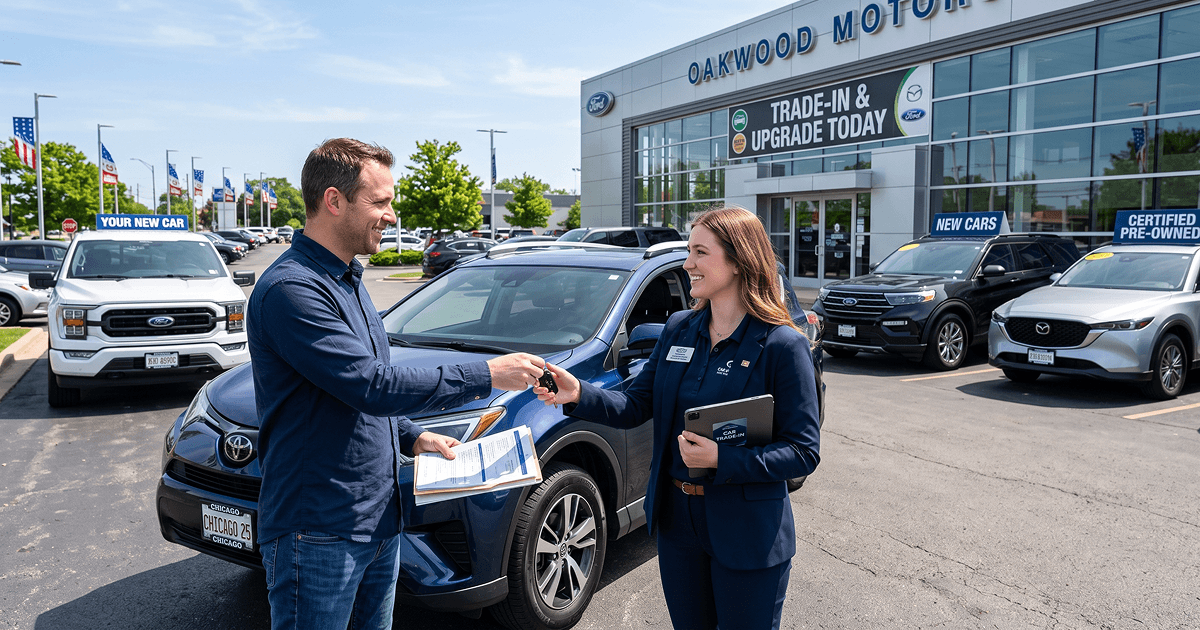
When you trade in a vehicle, a dealership appraises it and makes an offer to acquire it. If you accept, the trade can become part of your next vehicle transaction, with any existing loan payoff accounted for along the way.
Once the transaction is complete, the dealership takes responsibility for the vehicle. Depending on the car and the dealership, it might be reconditioned and offered for retail sale, moved elsewhere or sold through another channel.
Selling privately puts that process in your hands.
You find the buyer, agree on the price, and complete the sale directly. Removing the dealer from the middle may give you an opportunity to get more for the car, but you also take responsibility for finding the buyer and completing the transaction.
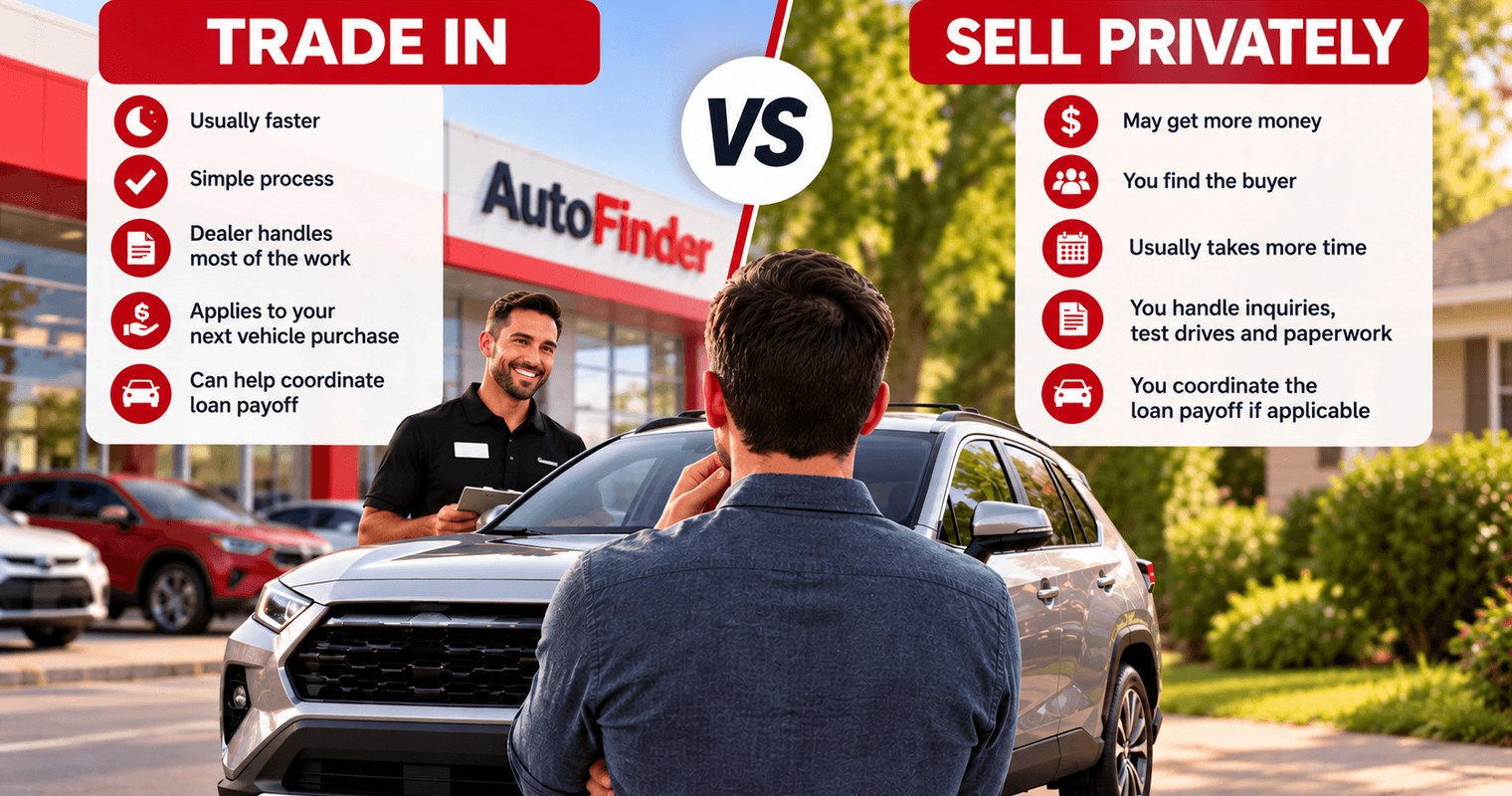
Trade-In vs. Private Sale at a Glance
| Factor | Trade in | Sell privately |
|---|---|---|
| Potential selling price | May be lower | May be higher |
| Time required | Usually lower | Usually higher |
| Advertising | Dealer handles resale | You handle it |
| Buyer communication | Minimal | You handle inquiries |
| Test drives | Not your responsibility after trade | You coordinate them |
| Loan payoff | Dealer generally coordinates as part of transaction | You and the buyer coordinate with lender |
| Paperwork | Usually simpler for seller | More seller involvement |
| Timing | Can happen with next purchase | Depends on finding a buyer |
| Convenience | Higher | Lower |
| Price certainty | Actual dealer offer | Final price unknown until sold |
One comparison to avoid is putting a real trade-in offer next to an optimistic private sale asking price.
An asking price does not tell you what someone will actually pay.
For a useful comparison, put your best real trade offer next to a private sale price you realistically believe you can get.
Do You Get More Money Selling a Car Privately?
You may.
A private buyer can sometimes pay more than a dealership offers because they are buying the vehicle to drive rather than acquiring it for resale.
But the entire difference should not be viewed as extra money with no trade-offs.
When a dealer acquires your vehicle, it takes on the next part of the process. That can include inspecting the car, reconditioning it, carrying it in inventory, marketing it, and eventually finding another buyer.
With a private sale, much of that responsibility stays with you.
So instead of asking:
“Could I list my car for more than the dealer offered?”
ask:
“What could I realistically sell my car for, and is the difference worth what I have to do to get it?”
That is the number that matters.
How Should You Compare a Trade-In Offer With a Private Sale?
Use real numbers whenever possible.
Suppose a dealer offers $18,500 for your vehicle.
After researching similar vehicles, you believe you could realistically sell it privately for $20,500.
That creates a potential $2,000 difference.
Now compare what is required to get each amount.
| Question | Trade in | Private sale |
|---|---|---|
| Expected amount | $18,500 | $20,500 |
| Difference | $2,000 more | |
| Buyer already available | Yes | Not necessarily |
| Advertising required | No | Yes |
| Buyer communication | No | Yes |
| Test drives | No | Yes |
| Sale timing known | Usually | Not until buyer commits |
| Loan payoff coordination | Dealer generally handles as part of transaction | Seller coordinates with lender and buyer |
For one person, the extra $2,000 could easily justify selling privately.
Someone else may prefer to complete the trade and next vehicle purchase in one transaction.
There is no universal dollar amount that makes either choice correct. What matters is how much more you can realistically get and what that difference is worth to you.
Why Can a Dealer's Trade-In Offer Be Lower Than Retail Price?
A dealership is acquiring your vehicle for a different reason than a private buyer.
Suppose similar vehicles are advertised for $25,000. That does not mean a dealer should also pay $25,000 for your trade.
Before the vehicle reaches another shopper, the dealership may need to inspect it, perform maintenance or repairs, detail it, market it and carry it in inventory. The business also needs room between what it pays to acquire a vehicle and what it may eventually sell for.
A private buyer has a different calculation because they are purchasing the car to use themselves.
That is why advertised retail prices can help you understand the market without serving as a direct substitute for trade-in value.
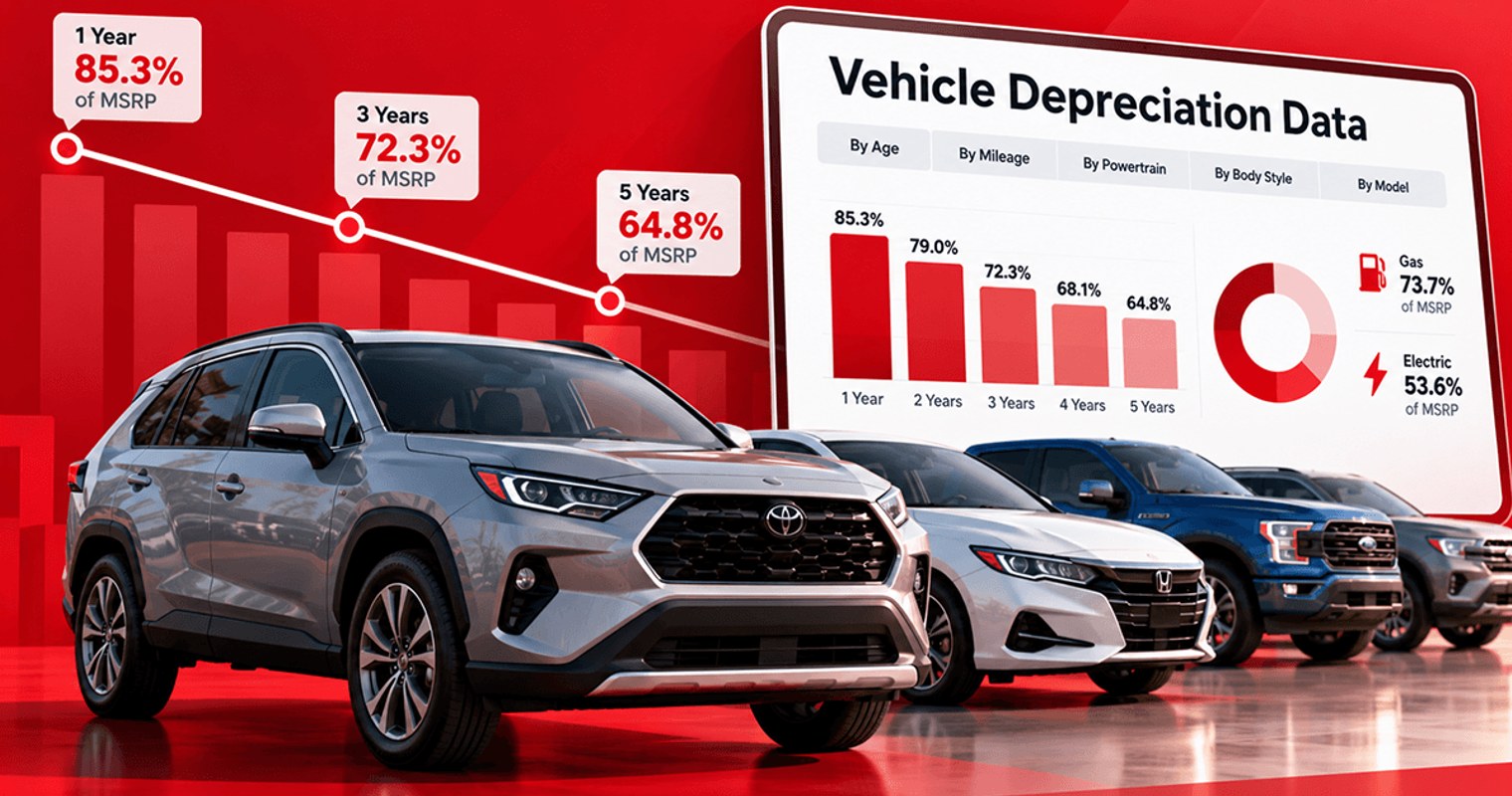
AutoFinder's Trade-In Market and Vehicle Depreciation Data 2026 looks more closely at advertised used vehicle pricing across more than 1.7 million listings, including differences by age, mileage, powertrain, body style, and model.
How Do You Know If the Trade-In Offer Is Good Enough?
Research gives you a starting point. Actual offers give you better evidence.
Make sure your vehicle information is accurate, get an appraisal and, when practical, compare it with another real offer.
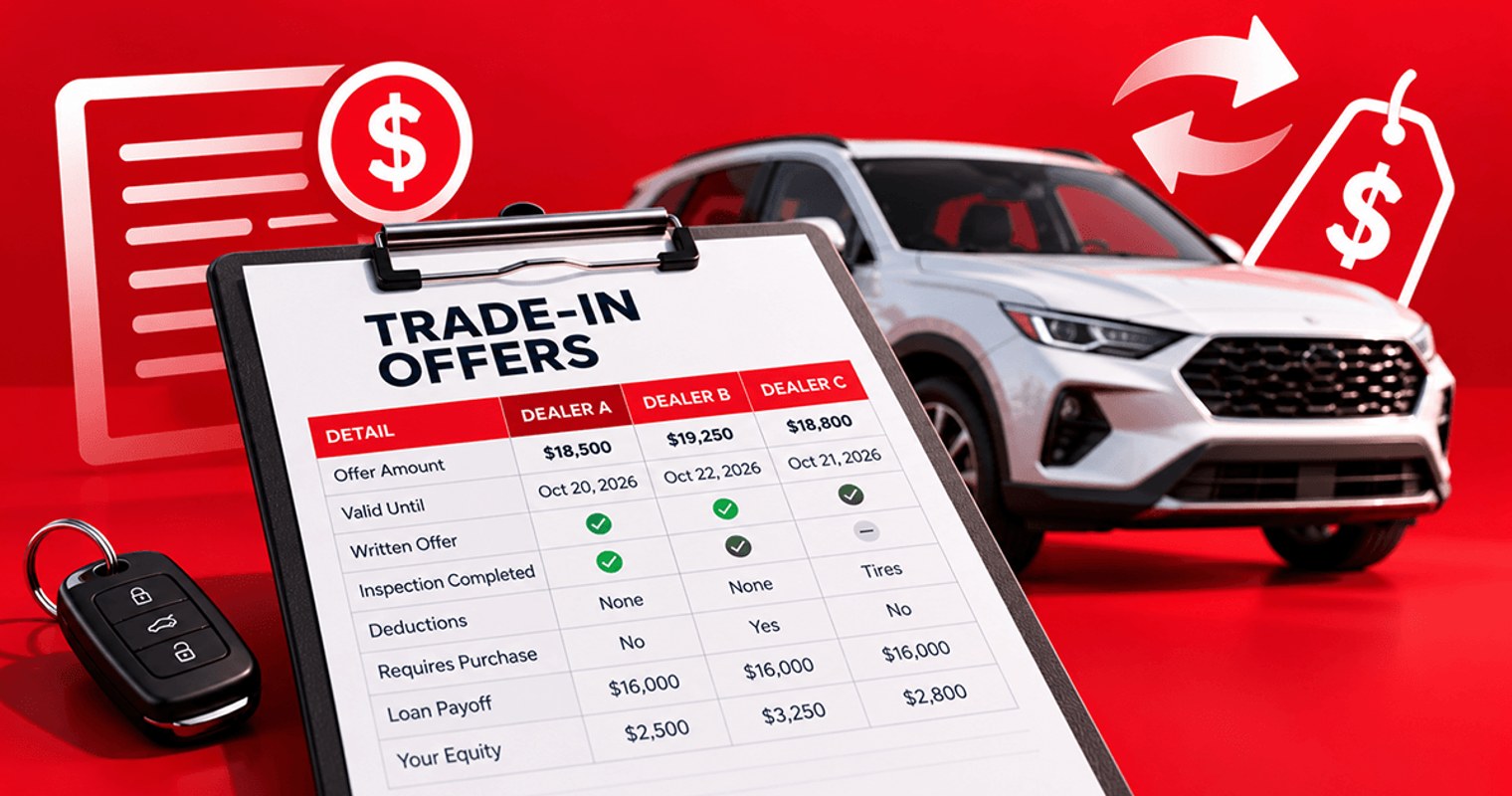
If one dealership offers $18,500 and another offers $18,800, the two appraisals are relatively close.
If one offers $16,000 and another offers $19,000 for the same vehicle, it is worth understanding why the gap is so large.
The amount is not the only thing to compare. Look at whether the vehicle has already been inspected, how long the offer is valid, whether there are remaining conditions, and whether the offer depends on another purchase.
How to Know If a Dealer's Trade-In Offer Is Fair includes a side-by-side scorecard for comparing dealer offers on equal terms.
Should You Get a Trade-In Offer Before Trying to Sell Privately?
A trade-in offer can give you a useful baseline even if you are leaning toward a private sale.
Imagine you would be happy to sell your car privately for $21,000.
Then you receive a $20,500 trade-in offer.
Would finding a buyer, managing test drives, and completing the transaction yourself be worth another $500?
Maybe not.
If your best trade offer were $17,500 instead, you might reach a completely different conclusion.
Once you have a real dealer offer, you know what the convenient option is worth. From there, you can decide how much more a private buyer would need to pay before doing the extra work becomes worthwhile.
Which Option Is Faster?
Trading in is generally the faster route.
The appraisal can often happen as part of the same process as shopping for your next vehicle. Once you agree to the transaction and complete the paperwork, your current vehicle can be handed over to the dealership.
A private sale has a less predictable timeline.
You might find a serious buyer quickly. You might also spend time creating a listing, answering messages, scheduling meetings, and waiting for someone ready to complete the purchase.
Timing becomes particularly important if you need your current vehicle until the day you replace it.
Selling first could temporarily leave you without a car. Buying the replacement first could leave you responsible for two vehicles until the old one sells.
Convenience is not only about doing less work. Sometimes it solves a timing problem too.
Which Option Requires More Work?
Selling privately puts more of the transaction on you.
Depending on the sale, that may include:
Preparing the vehicle
Taking photos
Creating and managing a listing
Responding to potential buyers
Screening inquiries
Scheduling meetings
Coordinating test drives
Negotiating the price
Arranging payment
Completing required ownership paperwork
Working through a loan payoff if one exists
Exact requirements vary by location and situation.
A trade removes much of that responsibility from the seller. The dealership evaluates the car, makes an offer and takes responsibility for the vehicle once the transaction is completed.
That convenience has value. The question is how much value it has to you compared with the additional money a private sale might produce.
What If You Still Owe Money on the Car?
A financed vehicle can be traded or sold privately, but the loan makes the transaction more complicated.
Start by getting the current payoff amount from your lender.
Then compare it with the vehicle's value.
| Vehicle value | Loan payoff | Position |
|---|---|---|
| $22,000 | $17,000 | $5,000 positive equity |
| $22,000 | $22,000 | Break even |
| $22,000 | $25,000 | $3,000 negative equity |
When you trade a financed vehicle, the dealership generally works with the lender to account for the payoff as part of the transaction.
With a private sale, you and the buyer need to work through the lender's payoff and title process. The exact steps depend on the lender and how the title is held.
Selling privately is still possible. It simply takes more coordination than selling a vehicle you own outright.
If you are upside down on the loan, Can You Trade In a Car With a Loan? Negative Equity Explained walks through the options before you decide how to proceed.
What If You Have Negative Equity?
Negative equity means your loan payoff is higher than the value of the vehicle.
Suppose your payoff is $24,000 and a dealer offers $20,000 for the trade.
You are $4,000 upside down.
If you could realistically sell the vehicle privately for $22,000, the higher selling price could reduce that difference to $2,000.
That may make a private sale more attractive, but there is still a remaining loan balance to resolve with the lender.
A higher selling price can reduce negative equity. It cannot erase debt that is still owed.
Does Trading In a Car Save You Money on Sales Tax?
It can, depending on where you live and how the transaction is structured.
Some states allow a qualifying trade in to reduce the portion of the next vehicle purchase that is subject to sales tax. Other states handle vehicle taxes differently.
That can matter when comparing a trade offer with a private sale.
For example, a private buyer might offer more for your vehicle, but any tax treatment available through a qualifying trade could narrow the financial difference between the two choices.
Do not assume a particular tax benefit applies to your transaction. Verify the current rules where you live before including potential tax savings in your comparison.
Should You Fix Your Car Before Trading It In or Selling It?
Start with the easy things.
A clean interior and exterior, maintenance records, all available keys and accurate information about the trim and equipment can help either a dealer or private buyer evaluate the vehicle.
Major repairs require more thought.
Putting $2,000 into a repair does not guarantee another $2,000 in your trade offer or private selling price.
A private buyer may put more weight on certain cosmetic or mechanical problems because they intend to drive the vehicle immediately. A dealer may evaluate the same problem based on its own reconditioning process and costs.
Before paying for a major repair, compare what it costs with how much it is realistically likely to change the selling price.
How to Maximize Your Trade-In Value in 2026 covers the preparation steps worth considering before an appraisal.
Is Selling Privately Worth the Extra Work?
Start with a simple calculation:
Expected private sale price minus best trade-in offer
That gives you the potential financial advantage of selling privately before accounting for other differences that may apply to your transaction.
Then put that number in practical terms.
Would you manage listings, buyer messages, meetings, test drives, and paperwork for another $500?
What about $2,000?
What about $4,000?
The answer will be different for everyone, which is why a blanket rule does not help much here.
Get the numbers first. Then decide what the convenience of a trade is worth to you.
When Does Trading In Make More Sense?
A trade can be especially attractive when:
The dealer offer is close to what you realistically expect from a private buyer
You want to replace the vehicle quickly
You still owe money and prefer having the dealership work through the payoff
You do not want to manage listings, inquiries and test drives
Transaction timing matters
You place a high value on convenience
The closer the two prices are, the easier the trade can be to justify.
If you realistically expect $20,000 from a private buyer and receive a $19,500 dealer offer, you are deciding whether the extra work is worth pursuing another $500.
When Does Selling Privately Make More Sense?
A private sale becomes more attractive when the financial gap is large enough to justify taking on the sale yourself.
It can make sense when:
Your best trade offer is meaningfully below a realistic private sale price
You have time to find a buyer
You are comfortable managing the transaction
You own the vehicle outright or can coordinate the loan payoff
Your vehicle may appeal strongly to an individual buyer
Maximizing the selling price matters more than convenience
Keep the comparison grounded in what someone is likely to pay, not simply what similar vehicles are listed for online.
How Can You Decide Between Trading In and Selling Privately?
Before choosing, write down five numbers:
Your best actual trade-in offer
Your realistic private sale price
Your loan payoff, if you have one
Your equity under each option
Any transaction costs or applicable tax differences
Then make the practical comparison.
| If this matters most | Consider |
|---|---|
| Getting the highest possible selling price | Private sale |
| Completing the transaction quickly | Trade in |
| Minimizing paperwork and coordination | Trade in |
| Avoiding private buyer inquiries and test drives | Trade in |
| Pursuing a meaningful gap above the trade offer | Private sale |
| Simplifying a vehicle loan payoff | Trade in |
| Having time and flexibility to find a buyer | Private sale |
You do not need to decide based on the assumption that one method is always better.
Get a real trade-in offer. Estimate a realistic private sale price. Compare what you would walk away with and what each route requires.
Then choose the one that makes sense for you.
AutoFinder provides vehicle shopping information for educational purposes. Vehicle values, dealer offers, private sale prices, taxes, financing terms, and transaction requirements vary. Confirm current requirements and transaction details with the appropriate dealer, lender, and state agency.

Get a real offer in 2 minutes
Sell or trade your car 100% online. No haggling, no headaches.

Continue to Carvana to enter your vehicle and get your offer.