Car Buying Guides
How Does Trading In a Car Work? A Complete Guide
OVERVIEW
Trading in a car means selling your current vehicle to a dealership and using its value toward your next vehicle purchase. The dealer appraises your car, makes an offer, and handles the ownership transfer if you decide to accept.
If you still have a loan, the process includes one more step. The dealer compares the trade-in offer with the amount needed to pay off your existing loan. The difference determines whether you have positive equity to put toward your next car or negative equity that still needs to be paid.
The process itself is not especially complicated. The part worth understanding is how the numbers fit together.
How Does Trading In a Car Work?
Most trades follow the same basic process:
Research what your car may be worth.
Get your current loan payoff if the car is financed.
Bring the vehicle to a dealership for an appraisal.
Review the dealer's trade-in offer.
Compare the offer with your loan payoff, if applicable.
Decide whether to accept the offer.
Apply your available trade value or equity toward your next vehicle.
Complete the purchase, payoff, title, and financing paperwork.
If you own your car outright, there is no loan to settle first. If the dealer offers $15,000 for your car, that $15,000 can generally be applied as part of the transaction.
A financed car works differently. The existing lender must be paid before any remaining equity belongs to you.
That distinction is one of the most important parts of understanding a trade.
What Happens When a Dealer Appraises Your Car?
The appraisal determines what the dealership is willing to pay for your vehicle.
An appraiser may consider:
Model year
Make and model
Trim and equipment
Mileage
Interior and exterior condition
Mechanical condition
Tire condition
Accident and vehicle history
Local market conditions
Current demand
The dealership's existing inventory
The dealer may inspect the VIN, review vehicle history information, look for previous damage, and drive the car.
The dealership also has to consider what happens after it buys your vehicle. Some trades can be reconditioned and sold by that dealership. Others may be better suited for a wholesale channel.
That is one reason two dealerships can look at the same car and make different offers.
Why Is a Trade-In Offer Lower Than Similar Cars Listed for Sale?
A retail asking price and a trade-in offer measure two different things.
If vehicles similar to yours are advertised for $25,000, that does not mean a dealership can pay $25,000 for yours.
After acquiring a trade, a dealership may need to inspect it, perform maintenance, make repairs, replace worn parts, detail it, market it, and keep it in inventory until another shopper buys it. The dealership also needs room between its total investment in the vehicle and the eventual selling price.
Retail listings are still useful when researching your car because they show how similar vehicles are positioned in the market. They simply should not be treated as trade-in offers.
How Do You Know If a Dealer's Trade-In Offer Is Fair?
There is no single trade-in value that every dealership has to offer.
A useful way to judge an offer is to compare several pieces of information rather than relying on one online estimate.
Start with vehicles that actually resemble yours. Match the model year, trim, drivetrain, mileage, major equipment, and condition as closely as possible.
Then get real offers.
An online estimate can give you a range. An actual appraisal tells you what someone is willing to pay for the vehicle today.
Getting more than one offer is particularly useful. If three buyers are relatively close and one offer is far below the others, you have more context for evaluating the difference.
Keep the trade offer separate from the price of the vehicle you are buying too. A larger trade allowance is less meaningful if another part of the transaction becomes more expensive.
For a deeper comparison process, see How to Know If a Dealer's Trade In Offer Is Fair.
Can You Trade In a Car If You Still Have a Loan?
Yes. You generally do not need to finish paying off your car before you can trade it.
The dealership will need your loan payoff amount, which is the amount required to satisfy the existing loan. Your payoff may differ slightly from the balance shown on a recent statement because interest and other applicable amounts can affect the final figure.
The dealer then compares your payoff with its trade-in offer.
| Trade situation | Example | What happens |
|---|---|---|
| Positive equity | $18,000 offer and $13,000 payoff | You have $5,000 in equity |
| Break even | $18,000 offer and $18,000 payoff | The trade covers the loan |
| Negative equity | $18,000 offer and $22,000 payoff | You still have a $4,000 difference |
What Is Positive Equity?
Positive equity means your car is worth more than you owe.
If the dealer offers $18,000 and your payoff is $13,000, the existing loan is paid off and $5,000 remains.
That $5,000 can generally be applied toward your next vehicle as part of the transaction.
What Is Negative Equity?
Negative equity means you owe more than the car is worth.
If your payoff is $22,000 and your trade-in offer is $18,000, you have $4,000 in negative equity.
The $4,000 does not disappear when the vehicle is traded.
Depending on the transaction and lender approval, you may pay the difference yourself or include some or all of it in the financing for the next vehicle. Adding old debt to the next loan increases the amount you are borrowing and can make it harder to build positive equity in the replacement vehicle.
If you are in this situation, read Can You Trade In a Car With a Loan? Negative Equity Explained before deciding what to do with the remaining balance.
Does a Trade-In Count as a Down Payment?
A trade can reduce how much you need to pay or finance, but your full trade-in allowance is not necessarily available as equity.
If you own the car outright, there is no loan payoff to subtract.
If the vehicle is financed, use this calculation:
Trade-in offer minus loan payoff equals trade equity
For example, a $20,000 offer on a car with a $12,000 payoff leaves $8,000 in positive equity.
That $8,000 is the important number when determining how much value from the trade can go toward the next purchase.
How Does a Trade In Affect the Cost of Your Next Car?
It is easy for the numbers to blur together when you are buying, trading, and financing at the same time.
Keep the major parts of the transaction visible:
Vehicle purchase price
Trade-in allowance
Loan payoff
Positive or negative equity
Taxes
Dealer and registration fees
Cash down payment
Optional products
Amount financed
APR
Loan term
Suppose your next vehicle has an out-the-door price of $35,000.
Your current car receives a $17,000 trade-in offer, but you owe $12,000 on it. That leaves $5,000 in positive equity.
The useful number is not simply the $17,000 trade allowance. You need to know how that $5,000 in equity is being applied and what you will ultimately need to pay or finance.
Looking at the complete transaction also makes it easier to compare offers from different dealerships.
Does Trading In a Car Reduce Sales Tax?
It can, but this depends on where the vehicle is registered.
Some states allow the value of a trade to reduce the amount of the next vehicle purchase that is subject to sales tax. Other states handle trade credits differently or do not provide the same benefit.
That can matter when comparing a dealership trade with a private sale.
A private buyer might offer more for your vehicle, but the difference between the two options can narrow if the trade creates a tax benefit.
Check the current rules that apply where you will register the vehicle rather than assuming a trade automatically reduces your taxes.
What Do You Need to Trade In a Car?
Exact requirements vary by dealership, lender, and state, but it helps to gather the basics before your appraisal or purchase.
You may need:
Driver's license or other required identification
Vehicle registration
Vehicle title if you hold it
Loan account and lender information if financed
Current payoff information
All keys and key fobs
Maintenance records if available
Information or signatures from other owners listed on the title
If your lender holds the title because the vehicle is financed, that is normal. The dealership can explain what it needs to work with the lender and complete the payoff and title process.
Should You Fix Your Car Before Trading It In?
Small fixes and basic cleanup can make sense. Expensive repairs are less clear.
A $1,500 repair does not automatically increase a trade-in offer by $1,500.
Before spending heavily on a vehicle you already plan to trade, consider getting an appraisal in its current condition. You can then compare the cost of the repair with how much the issue appears to be affecting the offer.
Basic preparation is simpler.
Remove your belongings, clean out trash, vacuum the interior, and make sure the dealer can easily inspect the vehicle. Find the extra keys and gather maintenance records you already have.
You do not need to make a used car look new before asking what it is worth.
How Can You Maximize Your Trade In Value?
You do not need an elaborate strategy to put yourself in a better position.
Start with the basics:
Know your exact model, trim, drivetrain, and major equipment.
Research similar vehicles before the appraisal.
Be realistic about your car's condition.
Know your loan payoff before discussing equity.
Bring your keys, records, and required documents.
Get more than one offer when practical.
Compare the trade and vehicle purchase as separate numbers.
The goal is not to turn the appraisal into a fight. It is to arrive with enough information to recognize a competitive offer and ask useful questions when something does not line up.
For the full preparation and comparison process, see How to Maximize Your Trade In Value in 2026.
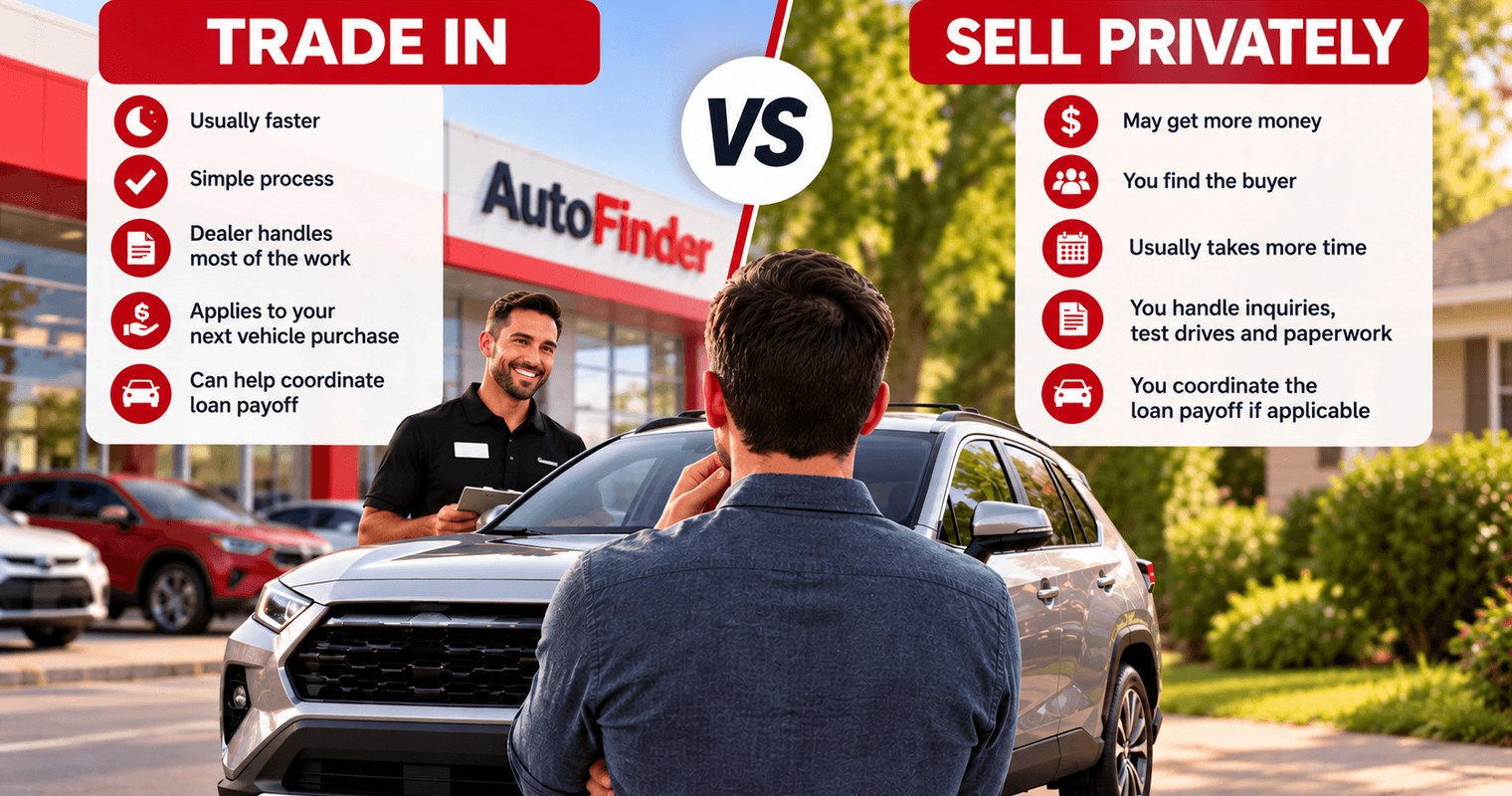
Is It Better to Trade In Your Car or Sell It Privately?
A private sale may bring a higher selling price because you are selling directly to another buyer. A trade gives up some of that potential upside in exchange for a simpler transaction.
| Trading in | Selling privately |
|---|---|
| Dealership handles much of the transaction | You manage the sale |
| Can be completed with your next purchase | May require separate timing |
| Dealer can coordinate an existing loan payoff | A loan can make the private sale more complicated |
| May provide a sales tax benefit depending on your state | Usually does not receive the same trade tax treatment |
| Less time spent finding a buyer | Potential for a higher selling price |
Pros & Cons of Trading In
Pros
- Faster process
- Fewer sale logistics
- Loan payoff assistance
- Possible tax benefit
- One transaction
Cons
- May receive less than a private sale
- Offers vary by dealership
- Less access to individual buyers
- Multiple deal numbers can be confusing
The right comparison is not simply which option produces the bigger initial offer.
Consider how much you would actually keep, any applicable tax difference, the time required to find a buyer, your current loan, and how quickly you need another vehicle.
Our Trade In vs. Sell Privately: Which Is Better? guide takes a closer look at those tradeoffs.
How Much Value Do Cars Lose Before You Trade Them In?
Vehicle depreciation is part of every trade, but cars do not all lose value at the same rate.
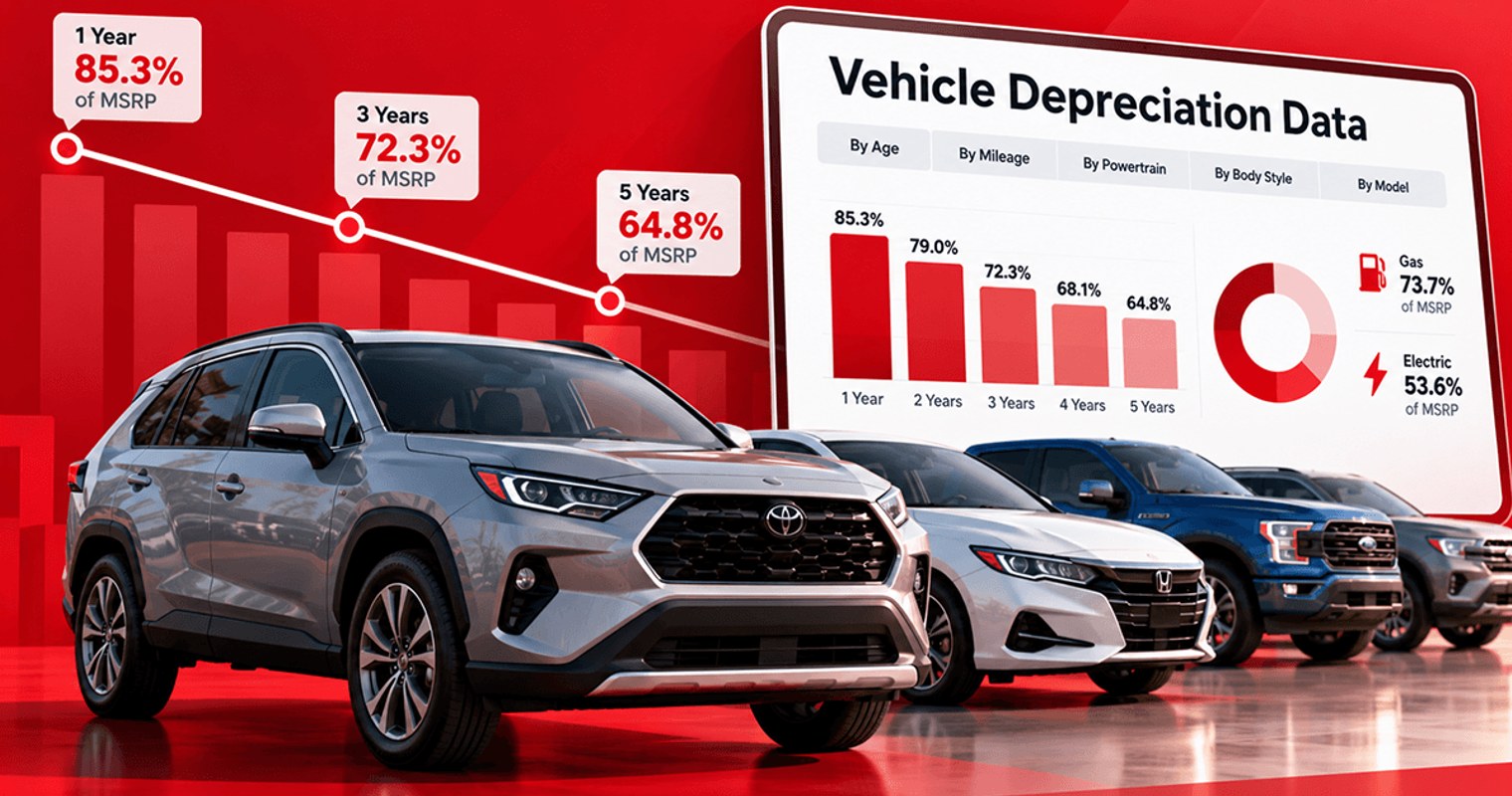
AutoFinder analyzed 1,769,621 used vehicle listings in October 2026. Among vehicles in the analysis, the median advertised retail price relative to original base MSRP was:
| Vehicle age | Advertised price vs. original base MSRP |
|---|---|
| 1 year | 85.3% |
| 2 years | 79.0% |
| 3 years | 72.3% |
| 4 years | 68.1% |
| 5 years | 64.8% |
The largest percentage point decline within that range occurred between years two and three. The decline then became smaller between years three and four and again between years four and five.
These figures are not trade-in values. They compare dealer-advertised used retail prices with original base MSRP. Options, packages, destination charges, vehicle condition, and other factors are not fully reflected in that comparison.
The data is useful because it shows the retail market surrounding a trade and why age is only part of the value question.
Our Trade-In Market and Vehicle Depreciation Data analysis goes deeper into age, mileage, powertrain, body style, and differences among common vehicles.
Does Mileage Affect Your Trade-In Value?
Yes. Mileage is one of the factors a dealer can consider when appraising a vehicle.
But a round number on the odometer does not automatically create a sudden drop in what a vehicle is worth.
As part of AutoFinder's used vehicle analysis, we compared advertised retail pricing immediately around 50,000, 75,000, and 100,000 miles while controlling for vehicle age. We did not find a consistent pricing cliff immediately after those thresholds.
That does not mean mileage is unimportant or that dealer trade-in offers behave exactly the same way. It means shoppers should be cautious about rushing to trade solely because a car is about to cross a familiar mileage milestone.
Condition, age, model, equipment, history, mileage, and current market conditions all contribute to the bigger picture.
You can see the full methodology and mileage findings in our Trade-In Market and Vehicle Depreciation Data analysis.
When Is the Best Time to Trade In a Car?
There is no single month or mileage reading that makes every car a good candidate to trade.
Start with your reason for replacing it.
Maybe your needs have changed. Maybe repairs are becoming more frequent. Maybe you want a different type of vehicle. Or perhaps you already planned to replace it and want to understand whether waiting another year makes financial sense.
Then look at the car itself:
Current trade-in offers
Remaining loan payoff
Positive or negative equity
Mileage
Condition
Upcoming maintenance or repair needs
How quickly the vehicle is depreciating
Cost of the vehicle replacing it
If your current vehicle still fits your needs and is affordable to own, trading simply because you have reached an arbitrary age or mileage threshold may not improve your financial position.
If you already intend to replace it, understanding your equity and current market position becomes much more useful.
What Should You Do Before Going to the Dealership?
A little preparation can make the trade easier.
Before your visit:
Research your approximate vehicle value.
Request your current payoff if the car is financed.
Get another offer when practical.
Gather your registration and title information.
Find all keys and key fobs.
Bring maintenance records you already have.
Remove personal belongings.
Decide what you need from your next vehicle.
You do not need to know exactly what the dealer will offer before arriving.
You should know enough about your car and your loan to understand the offer when you receive it.
The Four Numbers to Know Before You Trade In Your Car
If the transaction starts to feel complicated, come back to four numbers.
1. The Price of the Vehicle You Are Buying
Know what the next vehicle costs before the trade and financing change the amount due or monthly payment.
2. Your Trade In Offer
This is what the dealership is willing to pay for your current vehicle.
3. Your Loan Payoff
If your current car is financed, this is the amount required to satisfy that loan.
Subtract the payoff from the trade offer to understand your equity.
4. Your Amount Financed
After your trade equity, cash down payment, taxes, fees, optional products, negative equity if applicable, and other transaction amounts are accounted for, you know how much you are actually borrowing.
A monthly payment alone cannot tell you whether those individual numbers work for you.
Understanding them separately makes the entire trade easier to evaluate.
The information in this article is for general informational purposes only. Trade-in values, advertised prices, taxes, title requirements, loan payoffs, financing terms, lender requirements, and dealership policies vary by vehicle, location, lender, and individual transaction. Confirm current amounts and requirements with the appropriate dealer, lender, state agency, or other provider before completing a transaction.

Get a real offer in 2 minutes
Sell or trade your car 100% online. No haggling, no headaches.

Continue to Carvana to enter your vehicle and get your offer.