Used Car Buying
Should You Buy a Used Car With an Accident History?
OVERVIEW
Is It Bad to Buy a Used Car That Has Been in an Accident?
Not necessarily. Thousands of used vehicles have experienced some type of collision during their lifetime, and the circumstances can vary considerably.
A parking lot accident that required a replacement bumper cover is very different from a collision involving structural damage, suspension repairs, or airbag deployment.
Consider 2 used SUVs with similar mileage and equipment.
The first has no reported accidents but limited maintenance records. The second has 1 reported minor accident, documented bumper repairs, and a consistent service history.
The second SUV could still be a good purchase. Its accident history is worth investigating, but it doesn't automatically outweigh the vehicle's condition, maintenance records, or asking price.
The important questions are what was damaged, how it was repaired, and whether any problems remain.
A dealership may be able to provide available repair records, explain its inspection process, and help you compare the vehicle with other options in its inventory.
What Types of Accident Damage Should You Look For?
Accident severity is one of the most important factors when evaluating a previously damaged vehicle.
Some repairs are primarily cosmetic. Others involve components that affect steering, braking, crash protection, or overall vehicle performance.
| Type of Damage | What It May Involve | What to Check |
|---|---|---|
| Minor cosmetic damage | Scratches, dents, bumper covers or exterior trim | Repair quality, paint finish and underlying components |
| Moderate collision damage | Doors, body panels, wheels or suspension components | Alignment, steering, suspension and repair documentation |
| Structural damage | Frame, unibody or other structural components | Manufacturer repair procedures, measurements and specialist inspection |
| Airbag deployment | Airbags, sensors, seat belt pretensioners and related components | Replacement records, appropriate parts and safety system verification |
These are general descriptions rather than official accident severity classifications. A vehicle history report may use different terminology, and the actual condition must be evaluated individually.
Minor Cosmetic Damage
Minor damage often involves exterior parts such as bumper covers, doors, or body panels.
For example, a used sedan may have had a rear bumper cover replaced after a low-speed collision. If the damage was limited and the repair was completed properly, the car may drive and perform just as expected.
Ask which parts were repaired or replaced. If documentation is available, compare it with the reported accident and the vehicle's current appearance.
Even when the damage appears minor, an inspection can help identify problems that aren't visible from the outside.
Moderate Collision Damage
Moderate damage may involve mechanical components in addition to exterior panels.
A collision near a front wheel, for example, could affect suspension components, steering parts, or alignment.
A repair facility may have replaced the damaged components correctly, but you'll want to verify the results.
Ask for available repair invoices and have a mechanic check the affected area. Uneven tire wear, unusual steering behavior, or persistent vibrations are reasons for additional investigation.
Structural Damage
Structural damage requires more careful evaluation because modern vehicles rely on engineered structures to manage crash forces.
Repairs to a frame or unibody can involve specialized equipment, measurements, replacement components, and manufacturer procedures.
A vehicle with documented structural repairs isn't automatically unsuitable, but a general mechanical inspection may not be enough.
Consider having a qualified collision repair specialist review the vehicle and any available repair records.
If the quality of the structural repairs cannot be established, choosing another vehicle is generally the more cautious decision.
Airbag Deployment
Airbag deployment is an important part of a vehicle's accident history.
Airbags are designed for 1 deployment and must be replaced after they activate. Depending on the collision, related components such as seat belt pretensioners, sensors, and control modules may also require repair or replacement.
The National Highway Traffic Safety Administration recommends having deployed airbags replaced by an authorized repair professional before the vehicle is driven again.
Before purchasing, confirm that the repairs were completed using appropriate components and manufacturer procedures.
This is especially important because NHTSA has warned about dangerous replacement airbag inflators found in some previously repaired used vehicles.
If the vehicle has a history of airbag deployment, ask a qualified technician to verify the replacement components and restraint system condition. Do not attempt to inspect or disassemble airbag components yourself.
A clean VIN recall search doesn't necessarily rule out a dangerous replacement airbag inflator. Some unsafe aftermarket components may not appear in a vehicle's recall history. If the airbags were previously deployed, ask a qualified repair professional to inspect the replacement components and verify that the restraint system was repaired correctly.
How Can You Check a Used Car's Accident History?
Start with the vehicle identification number, commonly called the VIN.
The VIN allows you to request a vehicle history report and confirm that the information matches the specific car you're considering.
Reports from providers such as CARFAX or AutoCheck may contain reported accidents, title information, mileage records, and previous ownership details.
However, a vehicle history report is only as complete as the information available to the provider.
Some collisions are reported with considerable detail. Others may appear without an explanation of the damage. An accident that was never reported to a participating source might not appear at all.
What Should You Look for in a Vehicle History Report?
Pay attention to:
- The date of the reported accident
- Location of the reported damage
- Any available severity classification
- Airbag deployment information
- Title brands or insurance total loss records
- Mileage consistency
- Maintenance and ownership history
Look at the timeline as well.
For example, a collision followed by repair documentation and several years of ordinary service records provides more context than an accident reported shortly before the vehicle was listed for sale.
Neither situation guarantees the vehicle's condition, but the timeline can help you identify questions worth asking.
What Should You Look for in Repair Records?
If repair documentation is available, check whether it identifies:
- The repair facility and completion date
- Parts that were repaired or replaced
- Structural or mechanical work performed
- Airbag and seat belt system repairs
- Wheel alignment or electronic system calibrations
- Any remaining recommended work
Modern vehicles may require calibration of cameras, radar sensors, and other driver assistance systems after certain collision repairs.
If the vehicle has features such as automatic emergency braking or adaptive cruise control, ask whether relevant calibrations were completed when required.
Not every dealership will have records from work performed for a previous owner. When records are incomplete, a more detailed inspection becomes especially important.
Should You Get an Independent Inspection Before Buying?
Yes. An independent inspection is one of the best ways to evaluate a used car, particularly when it has reported accident damage.
The Federal Trade Commission recommends having a used vehicle inspected by an independent mechanic even if it has already been inspected or certified by a dealership.
A vehicle history report cannot tell you whether every repair was performed correctly or whether the car has an existing mechanical problem.
Ask the dealership about arranging an inspection. If taking the vehicle to another facility isn't practical, a mobile mechanic may be an option.
For a vehicle with substantial collision damage, consider a collision repair specialist in addition to a general mechanic.
What Should the Inspection Cover?
Depending on the vehicle's history, the inspection should evaluate:
- Steering and suspension
- Brakes and tires
- Wheel alignment and unusual tire wear
- Structural areas affected by the collision
- Engine and transmission operation
- Electronic systems and warning lights
- Airbag and seat belt system condition
- Previous body repairs
- Signs of fluid leaks or corrosion
Ask for written findings and an estimate for any recommended repairs.
A satisfactory inspection doesn't guarantee that nothing will ever go wrong, but it gives you much more useful information than relying on the vehicle history report alone.
What Should You Look for During the Test Drive?
A test drive gives you an opportunity to evaluate how the vehicle feels in normal driving conditions.
Before driving, ask the dealership representative whether there are any known issues or features you should be aware of.
During the drive, pay attention to:
- Steering: Does the vehicle track straight on a level road without unusual pulling?
- Braking: Does it stop smoothly without unexpected vibrations or noises?
- Suspension: Are there clunks or rattles when driving over ordinary road imperfections?
- Tires: Are there unusual vibrations that change with speed?
- Warning lights: Do any warning lights remain illuminated or appear while driving?
- Driver assistance features: Do available systems operate as expected under appropriate conditions?
- General driving feel: Does anything seem inconsistent with a similar vehicle?
Some symptoms can have causes unrelated to a previous accident. Don't assume a vibration or noise proves collision damage.
Instead, tell the dealership what you noticed and ask a qualified mechanic to evaluate it.
A test drive is useful, but it doesn't replace an independent inspection.
Is a Used Car With an Accident History Worth Less?
Often, yes. Previous accident damage can affect market value, even when repairs were completed properly.
Some shoppers prefer vehicles without reported accidents, and that difference in demand can influence asking prices and future resale value.
However, there is no universal discount that applies to every vehicle with an accident history.
The effect on value depends on the damage, repair quality, documentation, title status, mileage, and local market.
Example: Comparing 2 Used SUVs
Imagine you're shopping for 2 SUVs with the same model year, trim, similar mileage, and comparable equipment.
| Detail | SUV A | SUV B |
|---|---|---|
| Asking price | $25,000 | $22,500 |
| Accident history | No reported accidents | 1 reported minor accident |
| Repair documentation | Not applicable | Bumper repair invoice available |
| Independent inspection | Satisfactory | Satisfactory |
| Price difference | Baseline | $2,500 less |
This is a hypothetical example to illustrate how accident history may affect a vehicle comparison. The $2,500 price difference is not based on actual market data and should not be interpreted as a standard or recommended discount. Actual price differences depend on the vehicle, severity of damage, repair quality, condition and local market demand.
SUV B is priced $2,500 lower, and the independent inspection hasn't identified any unresolved issues related to the collision.
That could make SUV B appealing, particularly for someone planning to keep the vehicle for several years.
However, consider whether the previous accident could also affect what you receive when you eventually sell or trade in the vehicle.
A dealership can help you compare available vehicles and explain differences in equipment, condition, and pricing.
What Are the Pros and Cons of Buying a Used Car With Accident History?
A previously damaged vehicle can offer value, but it's important to understand the trade-offs.
Pros
- Potentially lower purchase price
- More vehicles to consider
- Minor repaired damage may have limited practical impact
- Repair records may provide useful history
Cons
- Potentially lower future resale value
- Incomplete accident or repair records
- Possible additional inspection or repair costs
- Financing or insurance restrictions for certain title brands
The potential savings are worth considering only when you're comfortable with the vehicle's condition and history.
A lower price isn't enough to make up for unresolved safety concerns or major repairs that haven't been properly evaluated.
Can Accident History Affect Insurance or Financing?
It can, although accident history alone doesn't automatically prevent a vehicle from qualifying for ordinary insurance or financing.
A properly repaired vehicle with a clean title may have financing and insurance options similar to other used vehicles.
Salvage and rebuilt title vehicles can be different.
Some lenders may restrict financing for vehicles with certain title brands. Insurance companies may also limit coverage or determine vehicle value differently.
Before purchasing a vehicle with significant damage or a branded title, contact your insurer with the VIN and ask about coverage and cost.
If you plan to finance, ask the dealership's finance team about available lending options and eligibility requirements.
Dealerships often work with multiple financing partners and can help explain the choices available for a particular vehicle.
What's the Difference Between a Clean, Salvage and Rebuilt Title?
A vehicle's accident history and title status are related, but they aren't the same thing.
A car can have a clean title despite having been involved in a collision.
A salvage title generally indicates that the vehicle met a state's criteria for a salvage designation, often after substantial damage or an insurance total loss.
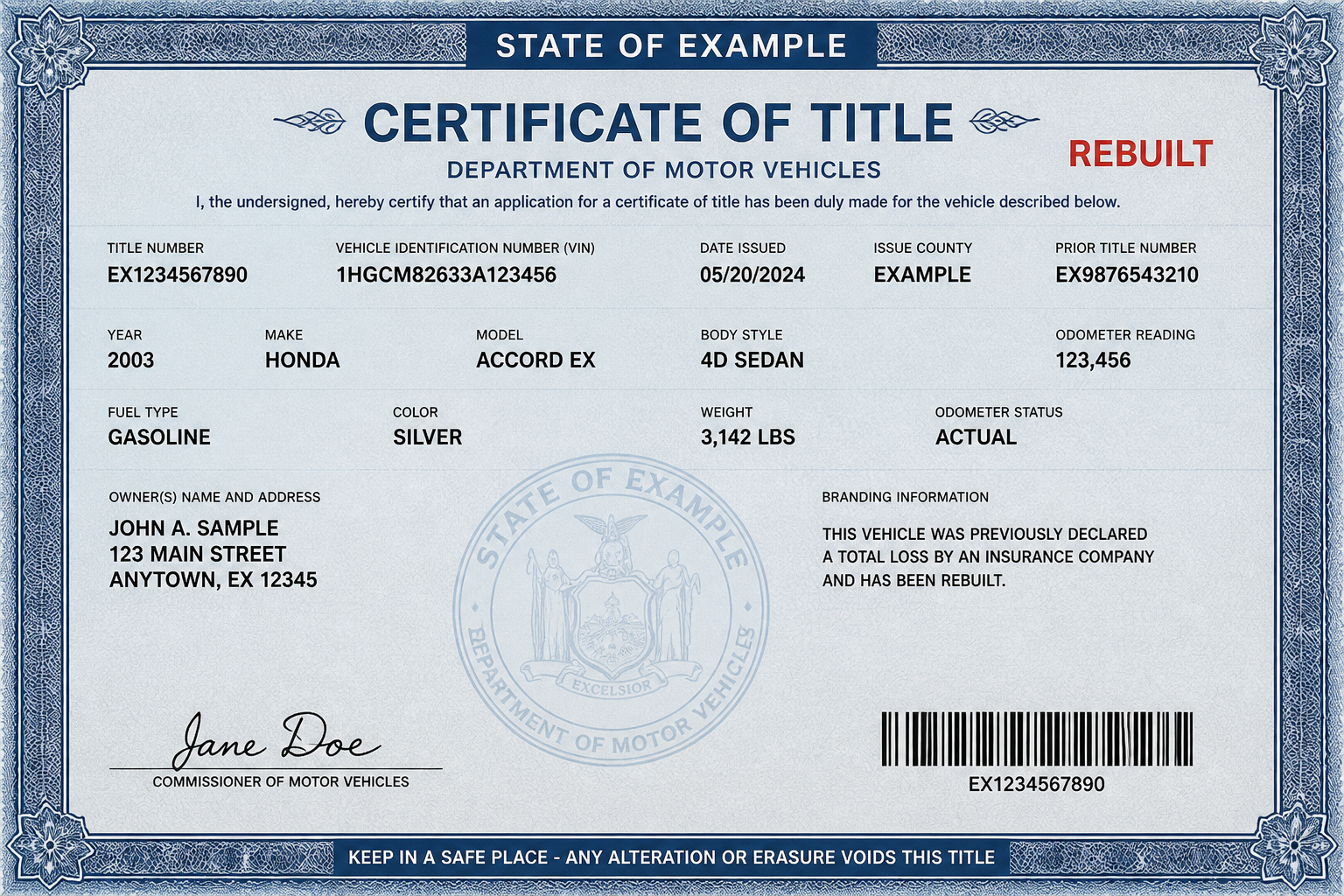
A rebuilt title generally means that a previously salvage vehicle has met applicable state requirements for a rebuilt designation.
| Title Status | General Meaning | What Buyers Should Know |
|---|---|---|
| Clean title | No salvage or rebuilt brand currently shown | Does not guarantee the vehicle has never been damaged |
| Salvage title | Vehicle has been designated salvage under applicable state rules | May have road use, registration, financing and insurance restrictions |
| Rebuilt title | Previously salvage vehicle has met applicable state requirements | Requires careful inspection and confirmation of coverage eligibility |
Title terminology and requirements vary by state.
Why Previous Title Brands Matter
A current title doesn't always tell the complete story.
The National Motor Vehicle Title Information System, or NMVTIS, maintains information about title brands reported by states and other participating sources.
That history can reveal previous salvage or other brands even when the current paper title doesn't display the same information.
For this reason, check the vehicle's title history rather than relying only on its current title status.
NMVTIS reports are available through approved providers.
Also remember that flood damage is a separate concern from ordinary collision damage. Water exposure can affect electrical systems, corrosion, and long-term reliability. A vehicle history review should consider flood and other title brands even when the original shopping question involves accidents.
What Does the FTC Buyers Guide Tell You?
When buying from a used car dealership, review the vehicle's Buyers Guide.
The Federal Trade Commission requires most used car dealers to display a Buyers Guide on vehicles offered for sale. Maine and Wisconsin have comparable state requirements.
The Guide explains important information about the vehicle's warranty status, including whether it's being sold with a dealer warranty or as is, where permitted.
It also identifies major mechanical and electrical systems and encourages shoppers to obtain an independent inspection.
You can learn more in the FTC's guide to buying a used car from a dealer.
If the dealership offers warranty coverage, review the written terms carefully.
Ask what systems are covered, how long the coverage lasts, whether a deductible applies, and who is responsible for repairs.
A service contract is different from a warranty. If you're considering additional protection, compare the coverage with any existing manufacturer or dealer warranty.
The dealership can help explain these products and determine whether they make sense for your ownership plans.
When Should You Buy a Used Car With Accident History?
The answer depends on what the available evidence tells you.
Use the following framework to decide whether a vehicle deserves further consideration.
| Vehicle Situation | Recommended Next Step |
|---|---|
| Minor documented damage, satisfactory inspection and competitive price | Worth considering |
| Moderate damage with repair records and satisfactory inspection | Compare carefully with similar vehicles |
| Structural repairs with incomplete documentation | Obtain a qualified structural inspection before proceeding |
| Airbag repairs that cannot be verified | Do not purchase until proper repairs and system condition are verified |
| Unresolved steering, braking or safety problems | Choose another vehicle unless the problems are properly repaired and verified |
| Salvage or rebuilt title | Confirm repair quality, title history, insurance and financing eligibility |
This framework is general guidance, not a substitute for a professional inspection.
When a Previously Damaged Vehicle May Be a Good Choice
A used car with accident history may be worth buying when:
- You understand the reported damage.
- Available repair records support the work performed.
- An independent inspection is satisfactory.
- The title status is clear.
- Insurance and financing options meet your needs.
- The asking price makes sense compared with similar vehicles.
For example, a 5-year-old SUV with a documented bumper repair, consistent maintenance history, and satisfactory inspection may offer good value at a competitive price.
When Another Vehicle May Be the Better Choice
Continue shopping if significant safety concerns remain unresolved, major structural repairs cannot be evaluated, or important airbag replacement work cannot be verified.
You may also prefer another vehicle if the asking price doesn't reflect its condition or if the title status creates financing or insurance restrictions you're uncomfortable with.
A good dealership can help you explore alternatives if a particular vehicle doesn't meet your expectations.
What Questions Should You Ask the Dealership?
A conversation with the dealership can help you understand the vehicle before committing to a purchase.
Here are 10 useful questions:
- What does the available vehicle history report say about the accident?
- Which parts of the vehicle were damaged?
- Are repair invoices or photographs available?
- Was any structural damage reported or repaired?
- Did the airbags deploy, and can their replacement be verified?
- Were any driver assistance systems recalibrated after the repairs?
- Can I arrange an independent inspection?
- Does the vehicle have any previous salvage or rebuilt title history?
- What warranty coverage is included, and what does the Buyers Guide say?
- How does the asking price compare with similar vehicles without reported accidents?
Not every dealership will have complete information about work performed before it acquired the vehicle.
What matters is understanding what information is available, what still needs verification and whether you're comfortable moving forward.
How Can You Find the Right Used Car on AutoFinder?
Start by comparing used vehicles that match your budget, preferred features, mileage range and location.
On AutoFinder, you can browse new and used vehicle listings from participating dealerships, compare available options and connect with dealers about vehicles that interest you.
When you find a promising used vehicle, contact the dealership to ask about its history, condition and available inspection information.
You can also use AutoFinder's Car Buying Research Checklist to organize your research before purchasing.
The goal isn't necessarily to find a vehicle with a perfect history report. It's to find a vehicle that meets your needs, has been properly evaluated, and offers good value for the price.
The Bottom Line: Should You Buy a Used Car With an Accident History?
A used car with accident history can be a good purchase when the damage was properly repaired, the vehicle's condition has been independently evaluated, and the price reflects its history.
Minor cosmetic damage is generally easier to assess than structural repairs or previous airbag deployment. For more serious damage, documentation and qualified inspections become especially important.
Compare the vehicle with similar options, review its title and warranty information, and confirm any insurance or financing requirements before buying.
A knowledgeable dealership can help you understand your options and find a vehicle that fits your priorities.
Want More Car Buying Advice?
Add AutoFinder as a preferred source on Google to help you discover more of our automotive guides and research.