Hyundai Tucson vs Kona: Is the Tucson Worth the Extra Cost?
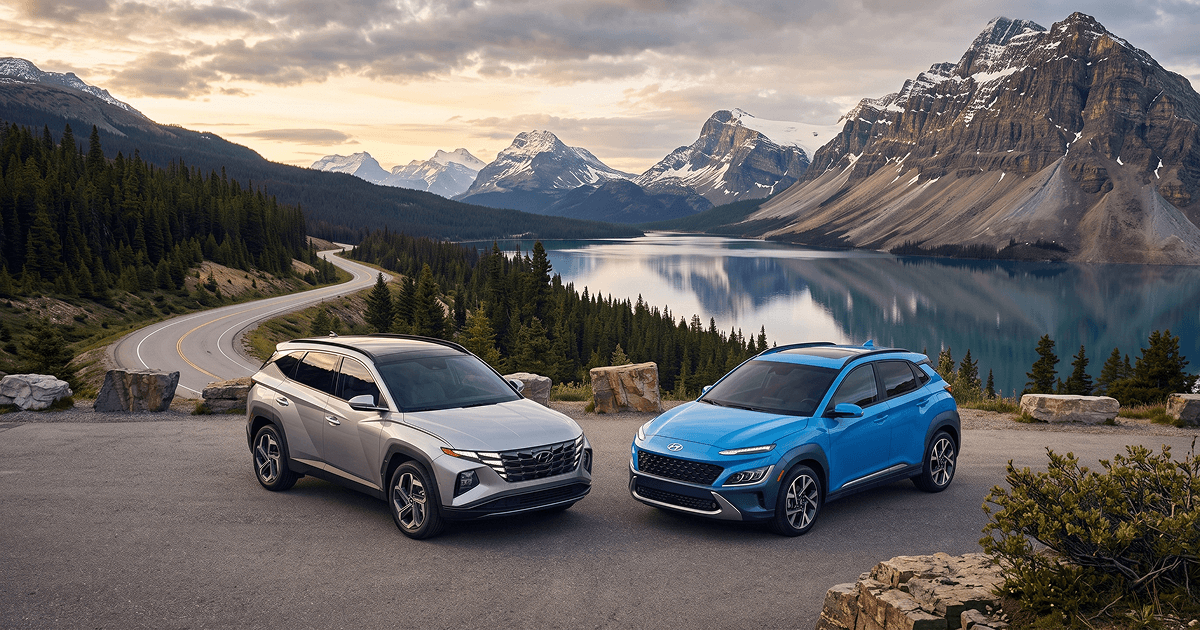
Last updated Sep 15th, 2026The 2026 Hyundai Tucson costs more than the Hyundai Kona, but the extra money buys a noticeably larger SUV.
That is really the heart of this comparison.
The Kona is the less expensive choice and works especially well for commuters, couples, city drivers, and anyone who does not need a large cargo area. It is easier to maneuver, efficient, and available with a turbocharged engine if you want a little more power.
The Tucson gives you considerably more cargo space, more room for rear passengers, and access to hybrid powertrains. It is the more natural choice for families or anyone who expects their SUV to regularly carry people and gear.
So, is the Tucson worth paying more for?
For families and shoppers who will regularly use the additional space, we think it is. If you mostly drive alone or with one passenger, the Kona may give you everything you need for less money.
The key is figuring out whether you are paying for space you will actually use.
Find Your Best Price
See what others paid and get upfront pricing from local dealers.

How Much More Does the Hyundai Tucson Cost Than the Kona?
For 2026, the Hyundai Kona SE starts at $25,500, while the Tucson SE starts at $29,700 before freight, taxes, title, license fees, options, and other applicable costs.
That puts roughly $4,200 between their starting MSRPs.
A $4,200 difference is meaningful, but it is not so large that the Tucson automatically falls into a completely different budget.
That is what makes this decision interesting.
If you are already spending around $25,000 on a new SUV, it is easy to look at the Tucson and think, "Maybe I should just spend a little more."
Sometimes that makes sense.
Sometimes it is exactly how you end up spending thousands of dollars on space you rarely use.
Instead of asking whether the Tucson is worth $4,200 more in general, ask whether its specific advantages are worth $4,200 to you.
What Does the Extra Money Get You?
Mostly, it gets you more SUV.
The Tucson is 182.7 inches long with a 108.5-inch wheelbase, while the Kona measures 171.3 inches long with a 104.7-inch wheelbase.
That makes the Tucson more than 11 inches longer.
You notice that difference most in the back half of the vehicle.
The Tucson provides more rear passenger space and a significantly larger cargo area. That makes it easier to accommodate child seats, adult passengers, luggage, strollers, sports equipment, pets, and everything else that tends to come with using an SUV as the household vehicle.
The Kona uses its smaller dimensions well. It does not feel tiny inside.
But there is no getting around the fact that the Tucson gives you more room to work with.
If that room solves an actual problem for you, the price difference becomes much easier to justify.
Is the Tucson Worth More for the Cargo Space?
This may be the strongest argument for spending more.
The Kona provides 25.5 cubic feet of cargo capacity behind its rear seats and up to 63.7 cubic feet with those seats folded.
The Tucson offers considerably more cargo room.
That difference can seem abstract until you start putting real things back there.
A grocery run probably will not expose it.
A stroller, several suitcases, sports bags, and a week's worth of family road trip gear probably will.
The same applies to dog owners. A large crate can quickly eat into the available cargo room in a smaller crossover.
If your current vehicle constantly has you rearranging things to make everything fit, the Tucson is likely worth the upgrade.
If your cargo area normally contains a backpack and a few reusable grocery bags, you probably do not need to spend thousands more just to have additional empty space.
Which Is Better for Families?
The Tucson is our pick for most families.
It gives you more room for rear passengers and more flexibility behind them.
That becomes especially noticeable when child seats enter the picture.
A rear-facing car seat can take up a surprising amount of room. Add a stroller to the cargo area and suddenly the difference between a subcompact and compact SUV feels much larger than it did on the dealership lot.
There is also the question of how long you plan to own the vehicle.
If you are buying something you hope to keep for 5, 7, or even 10 years, think about what your family might look like several years from now.
Kids get bigger. Their stuff somehow gets bigger too.
If you already suspect the Kona could feel tight in a few years, spending more on the Tucson now may save you from wanting another vehicle sooner.
Is the Kona Big Enough for Everyday Driving?
For a lot of people, absolutely.
This is where we would be careful not to treat the Tucson as automatically better because it is larger.
If most of your driving involves one or 2 people, the Kona gives you a back seat when you need one and a useful cargo area without requiring you to drive a larger vehicle every day.
That can be a great combination for commuters.
It also works well for couples, young professionals, smaller households, and drivers who want an SUV seating position without moving into something bigger than necessary.
You still get the versatility of folding rear seats.
You still get 4 doors.
You can still carry friends, groceries, luggage, or a dog.
The Kona simply asks you to be a little more realistic about how much space you actually need.
Which Is Easier to Drive and Park?
The Kona.
This is one of the benefits you give up when moving to the Tucson.
At 171.3 inches long, the Kona takes up noticeably less space than the Tucson.
That can make it easier to maneuver through crowded parking lots, parallel park, navigate tight city streets, and fit into smaller garages.
The Tucson is not a particularly difficult SUV to drive. It is still a compact crossover rather than a full size SUV.
But if you live in an apartment building with a narrow garage or regularly park downtown, the Kona's smaller footprint can be genuinely useful.
The Tucson gives you more space once you are inside.
The Kona asks for less space everywhere else.
Hyundai Tucson vs Kona Performance
The performance comparison has a small surprise.
The standard 2026 Tucson uses a 2.5 liter 4 cylinder engine producing 187 horsepower.
The standard Kona is less powerful, but Hyundai also offers a turbocharged Kona producing up to 190 horsepower.
So spending more on the Tucson does not automatically mean getting the more powerful SUV.
The standard Tucson's engine is designed more around predictable everyday performance than excitement. It has enough power for commuting, errands, highway driving, and normal family duty.
The turbo Kona is the more interesting choice if you like the smaller SUV but want stronger acceleration.
That gives the Kona another advantage for shoppers who do not need extra space.
You can spend your money moving up through the Kona lineup rather than moving into the larger Tucson.
What If You Want a Hybrid?
This is where the Tucson has a clear advantage.
The Tucson lineup gives shoppers access to electrified powertrains, including hybrid options.
The Kona does not currently give you the same gas hybrid choice.
That matters because the Tucson Hybrid is not appealing only for fuel economy.
Electric assistance can also make the SUV feel more responsive during normal driving, which addresses one of the weaker points of the standard gas powertrain.
If you specifically want a Hyundai hybrid SUV, we think the Tucson becomes much easier to justify.
You are no longer paying more simply for additional space.
You are also getting access to a powertrain the smaller Kona does not offer.
Which Gets Better Gas Mileage?
If you are comparing the standard gas models, the smaller Kona has an efficiency advantage in certain configurations.
That makes sense.
It is a smaller vehicle and can be a particularly good choice for someone who spends most of the week commuting.
The comparison changes once you introduce the Tucson Hybrid.
That is why we would decide which type of powertrain you want before comparing fuel economy.
If your goal is simply an affordable and efficient gas powered Hyundai SUV, the Kona is compelling.
If you want the additional space and prefer a hybrid, the Tucson gives you a combination the Kona cannot currently match.
Also think about how much you drive.
Fuel economy differences become much more financially important at 20,000 miles per year than they do at 5,000.
Which Has the Better Interior?
The Tucson's main interior advantage is not necessarily that it feels dramatically more expensive.
It is that there is more of it.
Both SUVs follow Hyundai's modern approach to cabin design and offer plenty of available technology.
The Tucson simply feels more substantial.
Rear passengers have more breathing room, and the larger overall cabin makes it better suited to family duty.
But there is an interesting twist once prices start overlapping.
A well-equipped Kona can cost about as much as a lower or midlevel Tucson.
At that point, the question becomes:
Would you rather have more features or more space?
That is a much better way to think about the comparison.
A shopper who loves heated seats, upgraded technology, additional convenience features, and a smaller footprint might prefer a higher trim Kona.
A shopper who needs to fit 2 kids and all their stuff may happily sacrifice a few extras for the Tucson.
Should You Buy a Loaded Kona or a Lower Trim Tucson?
This is where we think many shoppers should spend the most time.
The Kona Limited starts above $32,000, putting it directly into Tucson territory.
So you may not actually be choosing between a $25,500 Kona and a $29,700 Tucson.
You could be looking at a nicely equipped Kona and a Tucson with fewer features for similar money.
There is no universal right choice.
If you do not need the Tucson's additional space, we would rather have the Kona configuration with the features you will appreciate every day.
If space is one of the reasons you started shopping for an SUV, take the Tucson.
A panoramic roof, upgraded audio system, or extra convenience feature will not make the cargo area bigger when you are trying to fit everyone's luggage.
Which Is Better for Road Trips?
For one or 2 people, the Kona should be perfectly capable.
Start filling the seats and we would rather have the Tucson.
Long trips tend to expose space limitations faster than normal commuting.
Four people do not just take up 4 seats.
They bring suitcases, backpacks, snacks, coats, water bottles, chargers, and all the other things that seemed completely reasonable when everyone packed them.
The Tucson gives you more room for all of it.
Rear passengers also benefit from the additional space.
If road trips are something you do several times a year with family or friends, this is one area where paying more now could make ownership noticeably better.
Which Is Better for City Driving?
The Kona gets our vote.
You are giving up some interior space, but you get something valuable in return: less vehicle to deal with.
It is easier to fit into parking spaces and generally better suited to tight urban environments.
This is why buying the Tucson just because it is "more SUV for the money" can be misleading.
More vehicle is only valuable when you need more vehicle.
For someone living in a city, the Kona's smaller dimensions may actually be the more premium feature.
Which Is Better With All Wheel Drive?
Both SUVs offer available all wheel drive, so you do not have to move into the Tucson simply because you want additional traction.
That makes the Kona worth considering for shoppers dealing with snow, rain, gravel roads, or other conditions where AWD is useful.
Neither vehicle is intended to be a hardcore off roader.
For everyday poor weather driving and light recreational use, either can make sense.
Tires still matter enormously.
Choosing AWD does not eliminate the need for tires appropriate for the conditions you regularly encounter.
Which Is Better for Dogs?
For smaller dogs, either.
For a large dog or multiple dogs, we would lean Tucson.
Cargo space becomes particularly important if you use a crate.
The Tucson gives you more flexibility to carry the dog while still leaving room for luggage, groceries, or other cargo.
This is another area where we recommend thinking beyond the specification sheet.
Measure the crate you actually use.
Think about how easily your dog can get into the cargo area.
Consider whether you need the rear seats available for passengers at the same time.
Your dog does not care how many cubic feet Hyundai lists online.
You probably care whether everyone fits.
Hyundai Tucson vs Kona Safety and Technology
Both vehicles offer the kinds of driver assistance and safety technologies shoppers increasingly expect from a new Hyundai.
The exact equipment depends on trim.
Available or standard features can include technology designed to assist with forward collision situations, lane keeping, blind spots, rear cross traffic, highway driving, and parking.
This is another reason to compare specific trims.
If your budget allows either a higher trim Kona or a lower trim Tucson, look carefully at what comes with each vehicle.
Do not assume the more expensive SUV automatically has more technology.
The Tucson's additional cost is largely buying you size.
Moving higher in the Kona lineup can buy you equipment.
Which is more valuable depends on you.
What About Warranty Coverage?
Warranty coverage does not give either SUV a major advantage because both come from Hyundai.
That makes this comparison refreshingly simple.
You do not have to decide whether one brand's warranty, dealer network, or general ownership experience is preferable.
You can focus almost entirely on the vehicles themselves.
And that brings us back to the same question:
Will you use the extra room?
If yes, Tucson.
If not, Kona.
Is the Hyundai Tucson Worth the Extra Cost?
For the right shopper, yes.
The Tucson's higher starting price buys you something tangible.
It is considerably larger, particularly when it comes to cargo capacity, and gives rear passengers more room. It also opens the door to hybrid powertrains that you cannot get in the Kona.
Those are meaningful improvements for a family.
They are less meaningful for someone whose back seat is empty most of the week.
If you are buying for yourself, commute frequently, live in a city, or simply prefer smaller vehicles, we would not stretch the budget just to get a Tucson.
The Kona is not a compromise if it already meets your needs.
In fact, using the same budget to buy a better-equipped Kona could make you happier than buying a Tucson simply because it is larger.
Who Should Buy the Hyundai Tucson?
The Tucson makes the most sense if you regularly carry rear passengers, have children, need substantial cargo room, take family road trips, want a hybrid, or expect your space needs to increase during the time you own the vehicle.
In those situations, the extra money buys functionality you can use regularly.
That is when paying more makes sense.
Who Should Buy the Hyundai Kona?
The Kona makes more sense if you mostly drive alone or with one passenger, want to keep your purchase price down, prefer something easier to park, or would rather spend your budget on additional features than additional size.
It is also a strong option for first time buyers who want SUV practicality without taking on more vehicle or payment than they need.
There is nothing wrong with buying the smaller SUV.
Sometimes it is the smarter purchase.
How AutoFinder Helps You Compare the Tucson and Kona
Once you know which size makes more sense, compare the actual vehicles available to you.
AutoFinder can help you research Hyundai Tucson and Kona inventory, pricing, trims, features, powertrains, and new or used options.
That becomes especially useful because the 2 price ranges overlap.
You may find a higher trim Kona and a lower trim Tucson sitting within the same budget.
At that point, forget which one is technically positioned higher in Hyundai's lineup.
Look at what each vehicle gives you for the money and decide which benefits you will actually use.
Final Thoughts
So, is the Hyundai Tucson worth the extra cost over the Kona?
For families and drivers who regularly use their back seat and cargo area, we think it is.
The Tucson costs more, but it gives you a substantially larger and more versatile vehicle. You also gain access to hybrid powertrains, which could make the upgrade even more appealing.
But the Kona makes a convincing argument for everyone who does not need that space.
It costs less to start, is easier to maneuver, offers good gas mileage, and can be surprisingly well equipped. An available turbo engine also means choosing the smaller Hyundai does not necessarily mean choosing the less powerful one.
The best way to make this decision is not to ask which Hyundai gives you more.
The Tucson does.
Ask which one gives you more of what you actually need.
If the Tucson's extra space solves a problem, spend the extra money.
If it does not, keep the money and enjoy the Kona.
FAQs
Is the Hyundai Tucson much bigger than the Kona?
Yes. The Tucson is more than 11 inches longer than the Kona and provides substantially more cargo space. Rear passengers also get additional room. The Kona still uses its smaller footprint well, but families and shoppers who regularly carry passengers or bulky cargo are more likely to appreciate the Tucson's larger dimensions.
Is the Kona or Tucson better for a first time buyer?
The Kona can be a strong first vehicle because it has a lower starting price, useful cargo room, and smaller dimensions that make it easy to maneuver. The Tucson may be worth the additional cost if a first-time buyer regularly carries passengers or expects to need more space within the next several years.
Can you get a Hyundai Kona Hybrid?
The current U.S. Kona lineup does not offer the same conventional hybrid option available with the Tucson. Shoppers specifically looking for a Hyundai SUV that combines a gasoline engine with hybrid assistance should therefore give the Tucson Hybrid a closer look when comparing these 2 models.
Is a higher trim Kona better than a base Tucson?
It can be. A higher trim Kona may give you more comfort, convenience, and technology features for similar money to a lower trim Tucson. The Tucson gives you more interior and cargo space. If you do not need the additional room, getting more equipment in the smaller Kona may be the better value.
Will I regret buying a Kona instead of a Tucson?
Probably not if the Kona comfortably handles your current and expected space needs. Regret is more likely if you regularly struggle with rear passenger room or cargo capacity. Think about how you will use the vehicle over several years rather than choosing the Tucson simply because it is larger.
Featured Articles
The information provided in this article is for general informational purposes only and may change over time. Vehicle pricing, availability, specifications, incentives, financing terms, interest rates, and other details may vary by vehicle, dealer, lender, location, and individual circumstances. AutoFinder does not guarantee the accuracy or availability of information provided by third parties. Always confirm current vehicle details, pricing, terms, and eligibility directly with the participating dealer or appropriate provider before making a purchase or financial decision.