Hyundai Tucson vs Honda CR-V: Which Compact SUV Should You Buy?
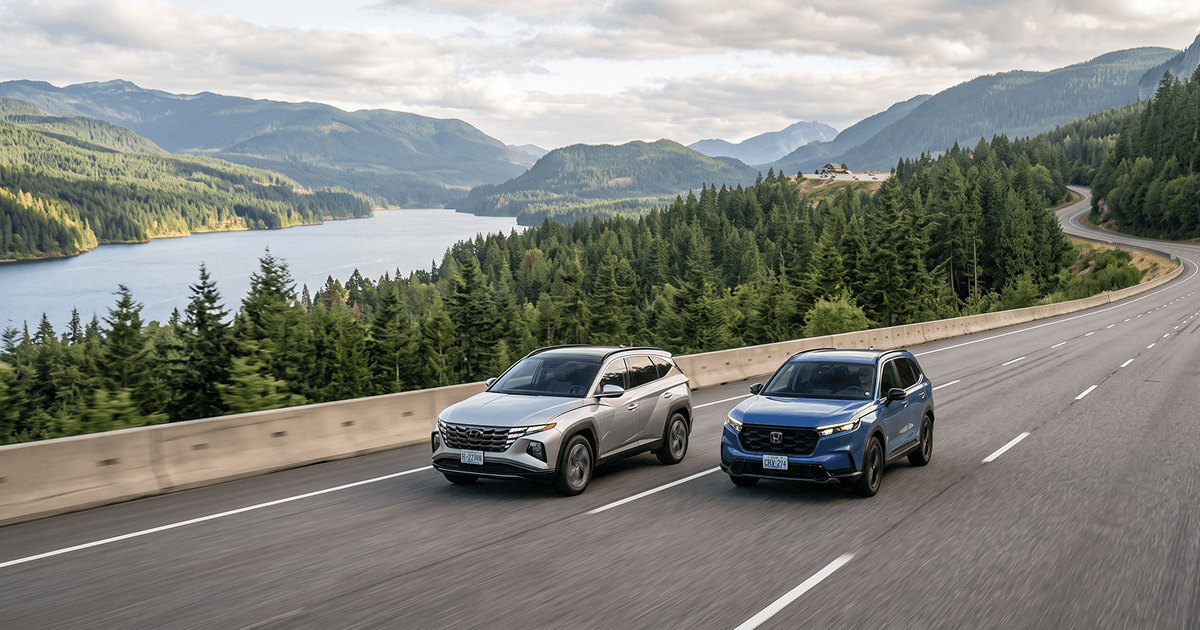
Last updated Sep 30th, 2026If you're shopping for a compact SUV, there's a good chance you've narrowed your search to the Hyundai Tucson and Honda CR-V. And honestly, you really can't go wrong. Both have earned their place as two of the most popular SUVs on the road by offering comfortable interiors, practical cargo space, impressive safety features, and available hybrid powertrains.
But while they compete in the same segment, they don't have the same personality.
The Tucson leans toward comfort and technology. It has bold styling, a modern cabin, and a long list of standard features that make it feel like you're getting a lot for your money.
The Honda CR-V takes a different approach. It focuses on refinement, efficiency, and everyday usability. It's the SUV that quietly does everything well, which is one reason it's become a favorite among families and commuters alike.
So which one deserves a spot in your driveway? Let's take a closer look.
Find Your Best Price
See what others paid and get upfront pricing from local dealers.

Quick Comparison
If you're short on time, here's the quick version.
Choose the Hyundai Tucson if you want:
- A more modern-looking interior
- More standard technology for the price
- Excellent warranty coverage
- A smooth, comfortable ride
- Great overall value
Choose the Honda CR-V if you want:
- Outstanding fuel economy, especially as a hybrid
- Excellent resale value
- A spacious cabin
- Confident handling
- A long history of reliability
Both SUVs are excellent choices. The better one simply depends on what matters most to you.
How We Compared the Hyundai Tucson and Honda CR-V
When comparing these SUVs, we focused on the categories buyers care about most, including:
- Exterior styling
- Interior comfort
- Passenger space
- Cargo capacity
- Technology
- Performance
- Fuel economy
- Safety
- Reliability
- Warranty
- Pricing
- Overall value
After all, buying an SUV isn't just about horsepower or cargo space. It's about finding the vehicle that fits your lifestyle.
Exterior Design
Let's start with first impressions.
The Hyundai Tucson isn't afraid to stand out. With sharp body lines, hidden daytime running lights, and an aggressive front grille, it looks more futuristic than almost anything else in the segment. Even a base model has a premium feel that turns heads in a parking lot.
The Honda CR-V takes a more understated approach. Honda refined the latest generation with clean lines and a more mature appearance. It doesn't try to grab attention, but it has a timeless look that's likely to age well.
Here's the good news: neither design is wrong.
If you like bold styling and want something that feels fresh every time you walk up to it, the Tucson is hard to beat.
If you'd rather have a classic SUV design that won't go out of style anytime soon, the CR-V is an easy choice.
Winner: Hyundai Tucson
The Tucson simply has more personality, and that's something many buyers appreciate.
Interior Comfort and Cabin Quality
This is where both SUVs really start to shine.
The Hyundai Tucson feels surprisingly upscale inside. The dashboard is clean and uncluttered, the available dual screens create a modern atmosphere, and the materials feel more expensive than you might expect at this price point.
Hyundai has clearly focused on making the cabin feel relaxing. Whether you're driving across town or heading out on a weekend road trip, it's an SUV that's easy to spend time in.
The Honda CR-V approaches comfort a little differently.
Rather than trying to impress with flashy technology, Honda focuses on thoughtful ergonomics. Everything is exactly where you expect it to be, the seats are supportive, and visibility is excellent. It's the kind of interior that feels natural after only a few minutes behind the wheel.
If we had one small criticism, it's that the CR-V's cabin isn't quite as visually exciting as the Tucson's. It looks refined, but the Hyundai feels a little more special.
Winner: Hyundai Tucson
If interior design matters to you, the Tucson has one of the nicest cabins in the compact SUV class.
Passenger Space and Cargo Capacity
Compact SUVs have become family vehicles, which means space matters.
Fortunately, both the Tucson and CR-V deliver.
The Tucson offers generous rear legroom that adults will appreciate during longer trips, while the wide rear doors make installing child seats surprisingly easy.
The Honda CR-V counters with one of the roomiest cabins in the segment. Rear passengers have plenty of space to stretch out, and the cargo area is among the largest you'll find in a compact SUV.
If you're constantly loading strollers, sports equipment, luggage, or groceries, you'll appreciate the extra flexibility.
The difference isn't dramatic, but if cargo capacity is one of your top priorities, the Honda earns a slight edge.
Winner: Honda CR-V
Technology and Infotainment
If you're someone who loves technology, this category gets interesting.
Hyundai has built a reputation for packing its vehicles with features, and the Tucson continues that tradition.
Available features include:
- Large touchscreen displays
- Wireless Apple CarPlay and Android Auto
- Digital instrument cluster
- Hyundai Digital Key
- Wireless phone charging
- Surround View Monitor
- Remote Smart Parking Assist
- Premium Bose audio
The Honda CR-V includes the features most buyers expect, including smartphone integration, available wireless charging, Google built-in on select trims, and a user-friendly infotainment system.
Honda's interface is simple, responsive, and easy to learn.
But here's where the Tucson pulls ahead.
Dollar for dollar, Hyundai typically gives buyers more technology without requiring them to move into the highest trim levels.
That's a big deal if you're trying to stay within a budget.
Winner: Hyundai Tucson
Performance and Driving Experience
Neither of these SUVs is trying to be a sports car, and that's perfectly okay.
The Tucson focuses on comfort first.
Its suspension smooths out rough pavement, road noise is well controlled, and steering feels light enough to make city driving easy.
The CR-V feels a little more athletic.
Honda has always done a great job balancing ride comfort with responsive handling, and the latest CR-V continues that tradition. It feels composed through corners without sacrificing everyday comfort.
If you enjoy driving, you'll probably appreciate the CR-V a bit more.
If you simply want a relaxing commute, the Tucson has the advantage.
Winner: Tie
One is more comfortable.
One is more engaging.
Neither choice is wrong.
Fuel Economy
Fuel economy is one of the biggest differences between these 2 SUVs, especially once hybrid models enter the conversation.
The gas-powered Hyundai Tucson is efficient enough for everyday commuting, but the Honda CR-V generally has the advantage at the pump. Honda rates the Front Wheel Drive 2026 CR-V at up to 28 mpg in the city and 33 mpg on the highway. Actual fuel economy depends on trim, drivetrain, weather, traffic, and driving habits.
For shoppers driving mostly around town, even a small fuel economy advantage can add up over several years. That does not automatically make the CR-V the better purchase, but it gives Honda an early lead for commuters who would rather spend less time visiting the gas station.
Winner: Honda CR-V
The CR-V is the stronger choice for gas-powered efficiency.
Hyundai Tucson Hybrid vs Honda CR-V Hybrid
Here is where the comparison gets more interesting.
The 2026 Honda CR-V Hybrid uses a 204 horsepower 2 motor hybrid system. Depending on trim and drivetrain, Honda lists ratings as high as 43 mpg in the city and 36 mpg on the highway. The hybrid powertrain is available on Sport Hybrid, TrailSport Hybrid, Sport L Hybrid, and Sport Touring Hybrid trims.
The Tucson Hybrid takes a slightly different approach. It pairs a turbocharged gas engine with electric assistance and standard HTRAC All Wheel Drive. That setup may appeal to shoppers who want stronger acceleration and standard added traction rather than chasing the highest possible mpg figure. Hyundai also offers a Tucson Plug-In Hybrid with an EPA estimated 32 miles of electric range when fully charged.
In simple terms, the Honda is the efficiency specialist. The Hyundai is the more flexible option for drivers who want standard All Wheel Drive, lively power delivery, or the ability to complete shorter drives using electricity in the plug-in model.
Winner for Fuel Economy: Honda CR-V Hybrid
Winner for Powertrain Choice: Hyundai Tucson
The CR-V Hybrid is likely the better fit for high-mileage commuters. The Tucson lineup gives shoppers more ways to balance efficiency, traction, and electric driving.
Safety and Driver Assistance
Both SUVs arrive with the kind of safety technology that used to be reserved for expensive luxury vehicles.
The Tucson includes Hyundai SmartSense features across the lineup, with systems designed to assist with forward collision risks, lane positioning, driver attention, and other common driving situations. Higher trims add equipment such as Highway Driving Assist, surround view monitoring, and additional parking technology. The 2026 Tucson also earned a 5-star overall safety rating from NHTSA and a 2026 Top Safety Pick Plus award from IIHS.
Every 2026 CR-V includes Honda Sensing, which brings features such as adaptive cruise control, lane keeping assistance, road departure mitigation, and forward collision warning. Available Real Time AWD can also help provide added traction in changing road conditions.
The important thing to remember is that driver assistance systems are there to support you, not take over the drive. You still need to stay alert, keep your hands on the wheel, and adjust your speed for conditions.
Winner: Tie
Both offer strong standard safety packages. The Tucson may appeal more to shoppers who want advanced camera and parking features, while the CR-V keeps its core driver assistance technology simple and easy to use.
Reliability and Long-Term Ownership
Honda has spent decades building a reputation for dependable vehicles, and that history gives the CR-V an advantage for buyers who plan to keep their SUV well beyond the loan term.
The CR-V is also known for strong resale appeal. That matters because the purchase price is only part of what a vehicle costs. A model that retains more of its value may leave you in a better position when it is time to sell or trade.
The Tucson should not be dismissed, though. Hyundai has improved its vehicle quality significantly and backs the Tucson with lengthy warranty protection. For some shoppers, that warranty may provide more confidence than a reputation alone.
No vehicle is guaranteed to be trouble-free. Maintenance habits, mileage, climate, and how the vehicle is driven can all affect long-term durability.
Winner: Honda CR-V
The CR-V gets the advantage for its established ownership reputation. The Tucson makes a convincing case with its warranty and growing track record.
Warranty Coverage
This is one category where Hyundai does not believe in being subtle.
The Tucson includes a 5-year or 60,000-mile new vehicle limited warranty and a 10-year or 100,000-mile powertrain limited warranty for the original owner. Transfer rules, exclusions, and coverage details apply, so used vehicle shoppers should review the warranty carefully.
Honda provides a 3-year or 36,000-mile new vehicle limited warranty, along with 5-year or 60,000-mile powertrain coverage. Honda roadside assistance is available during the 3-year or 36,000-mile limited warranty period.
That difference is meaningful for shoppers who plan to keep their SUV for many years. A longer warranty does not guarantee lower ownership costs, but it can reduce some of the uncertainty that comes with long-term ownership.
Winner: Hyundai Tucson
Hyundai offers the stronger factory warranty package.
Pricing and Trim Levels
The 2026 Honda CR-V starts at an MSRP of $30,920 before destination charges, taxes, registration, options, and actual dealer pricing. Gas trims include LX, EX, and EX L, while hybrid shoppers can choose from Sport Hybrid, TrailSport Hybrid, Sport L Hybrid, and Sport Touring Hybrid.
Honda does a good job of making the lineup easy to understand. Gas models cover the value and comfort side of the market, while hybrid trims add efficiency, sportier styling, and more premium features.
The Tucson lineup also gives shoppers several choices, including gas, hybrid, and plug in hybrid models. The gas powered XRT adds rugged styling, while upper trims focus more heavily on comfort, cameras, digital displays, and convenience features.
The Tucson often feels more generous at a given price point. Hyundai tends to include technology and comfort features earlier in the trim lineup, which can help shoppers avoid climbing all the way to the most expensive model.
The CR-V may cost more once comparably equipped, but some buyers will consider its fuel economy, resale potential, and ownership reputation worth the difference.
Winner: Hyundai Tucson for Upfront Value
Winner: Honda CR-V for Potential Long-Term Value
This is a category where the cheapest option is not always the best deal. Compare trims based on the equipment you actually want, not only the starting MSRP.
Which SUV Is Better for Families?
Both SUVs make excellent family vehicles, but they solve family life in slightly different ways.
The Tucson feels designed for families who want comfort and convenience. Its spacious rear seat, wide door openings, available surround view camera, and generous passenger volume can make child seat installation, school drop-off, and crowded parking lots easier. Honda’s own comparison information lists the Tucson with more maximum passenger and cargo volume than the CR-V, although measurements and usable space can feel different in person.
The CR-V feels designed for families who want everything to be straightforward. The controls are easy to understand, visibility is excellent, the rear seat is roomy, and the cargo area is shaped to handle the usual collection of groceries, backpacks, strollers, and sports gear.
Winner: Tie
Choose the Tucson for a more modern cabin and extra available convenience technology. Choose the CR-V for simple controls, excellent visibility, and an easygoing ownership experience.
Which SUV Is Better for Road Trips?
The Tucson is a comfortable place to settle in for a long drive. Its soft ride, quiet cabin, and available highway assistance technology can help make a 5-hour trip feel less like a 5-hour trip.
The CR-V counters with supportive seats, confident handling, and excellent hybrid fuel economy. Fewer fuel stops can be a very real advantage when everyone in the car has a different opinion about where to stop.
Cargo space is strong in both. Honda lists up to 76.5 cubic feet of maximum cargo volume for the CR-V, while its own competitor comparison lists the Tucson at up to 80.3 cubic feet.
Winner: Tie
The Tucson is the comfort pick. The CR-V is the efficiency pick.
Which SUV Is Better for Snow and Bad Weather?
Both SUVs offer All Wheel Drive, but there are a few differences worth knowing.
The Tucson is available with HTRAC All Wheel Drive, and All Wheel Drive comes standard on the Tucson Hybrid. That makes the hybrid especially appealing to drivers who want efficiency without giving up added traction.
The CR-V offers Real Time AWD across much of the lineup. The TrailSport Hybrid adds standard All Wheel Drive, all-terrain tires, and 8.2 inches of ground clearance for shoppers who regularly deal with unpaved roads or rougher conditions.
Neither system can overcome poor tires or unsafe driving. All Wheel Drive helps the vehicle accelerate on slippery roads, but winter tires can make a larger difference when braking or turning.
Winner: Honda CR-V TrailSport Hybrid for Light Adventure
Winner: Hyundai Tucson Hybrid for Standard AWD Value
For ordinary winter commuting, either SUV can work well when properly equipped.
Which SUV Offers Better Value?
The Tucson makes a strong first impression on a budget.
It gives shoppers a stylish cabin, plenty of technology, spacious seating, and excellent warranty coverage. You may be able to get the features you want without moving into the most expensive trim, which is always a nice surprise when building a new vehicle.
The CR-V plays the longer game.
It may not feel quite as flashy, but its fuel economy, resale appeal, practical design, and established reputation make it a compelling long-term purchase. It is the type of SUV that may not show off on the first date but becomes increasingly easy to appreciate after years of ownership.
Winner: Tie
The Tucson offers better feature value upfront. The CR-V may deliver better value over a longer ownership period.
Hyundai Tucson vs Honda CR-V: Which One Should You Buy?
Choose the Hyundai Tucson if you want:
- A bold design
- A more modern interior
- Generous technology for the price
- Longer factory warranty coverage
- Gas, hybrid, and plug-in hybrid choices
- A smooth and comfortable ride
Choose the Honda CR-V if you want:
- Excellent fuel economy
- A polished driving experience
- Strong resale appeal
- Simple and intuitive controls
- A well-established reliability reputation
- An adventure-focused hybrid trim
Overall Winner for Features and Comfort: Hyundai Tucson
Overall Winner for Efficiency and Long-Term Confidence: Honda CR-V
Overall Comparison: Tie
That may sound like an easy way out, but these SUVs are genuinely close.
The Tucson feels like the more exciting purchase. It gives you dramatic styling, useful technology, and a lot of vehicle for the money.
The CR-V feels like the safer long-term bet. It is refined, efficient, practical, and remarkably difficult to find fault with.
Your best choice will become much clearer after driving them back to back. Pay attention to seat comfort, visibility, acceleration, cabin noise, control layout, and the features included at your target price.
Final Thoughts
The Hyundai Tucson and Honda CR-V are 2 of the strongest compact SUVs available because they make everyday life easier without asking shoppers to make major sacrifices.
The Tucson is the better fit for buyers who want personality, technology, comfort, and warranty coverage. It looks more adventurous than the typical compact SUV and delivers an interior that feels more upscale than its price might suggest.
The CR-V is the better fit for buyers who value efficiency, simplicity, confident handling, and long-term ownership appeal. The available hybrid is especially attractive for commuters who want excellent fuel economy without switching to a fully electric vehicle.
There is no wrong answer here. There is simply the SUV that fits your priorities better.
Want More Car Buying Advice?
Add AutoFinder as a preferred source on Google to help you discover more of our automotive guides and research.
FAQs
Is the Hyundai Tucson better than the Honda CR-V?
The Tucson may be better for shoppers who want a modern interior, more available technology, longer warranty coverage, and a comfortable ride. The CR V may be better for drivers who prioritize fuel economy, resale value, simple controls, and an established reliability reputation. The best choice depends on how you plan to use your SUV.
Which is more reliable, the Tucson or CR-V?
The Honda CR V has a longer established reputation for reliability and long-term ownership. The Tucson provides additional reassurance through Hyundai’s 10-year or 100,000-mile powertrain limited warranty for the original owner. Maintenance history, driving habits, and mileage can influence the reliability of either vehicle.
Which has more cargo space, the Tucson or CR-V?
Both provide excellent cargo capacity for the compact SUV class. Honda’s published competitor comparison lists up to 80.3 cubic feet of maximum cargo volume for the Tucson and 76.5 cubic feet for the CR V. Actual usability also depends on the shape of the cargo area and how the rear seats fold.
Is the Tucson Hybrid better than the CR-V Hybrid?
The Tucson Hybrid may be better for shoppers who want standard All Wheel Drive, stronger acceleration, and a technology-focused interior. The CR-V Hybrid may be better for drivers focused on maximum fuel economy and a responsive driving experience. Honda lists ratings as high as 43 mpg city and 36 mpg highway for certain configurations.
Which SUV has the better warranty?
The Hyundai Tucson has the stronger factory warranty. Hyundai provides a 5-year or 60,000-mile new vehicle limited warranty and a 10-year or 100,000-mile powertrain limited warranty for the original owner. Honda provides shorter basic and powertrain coverage, although exact terms and exclusions should always be reviewed before purchasing.
Featured Articles
Related Articles
Hyundai Palisade vs Kia Telluride: Which 3 Row SUV Is Better?
Vehicle Comparisons
2026 Hyundai Tucson vs Toyota RAV4: SUV Comparison
Vehicle Comparisons
2025 Hyundai Sonata Limited vs. Kia K5 GT: Luxury Meets…
New and Used Car Reviews: Features, Specs, and Insights
The information provided in this article is for general informational purposes only and may change over time. Vehicle pricing, availability, specifications, incentives, financing terms, interest rates, and other details may vary by vehicle, dealer, lender, location, and individual circumstances. AutoFinder does not guarantee the accuracy or availability of information provided by third parties. Always confirm current vehicle details, pricing, terms, and eligibility directly with the participating dealer or appropriate provider before making a purchase or financial decision.