Car Pricing & Value
How to Know If a Dealer's Trade In Offer Is Fair
OVERVIEW
A fair trade-in offer is not necessarily the highest number you find online. It is an offer that makes sense for your specific vehicle and holds up when you compare it with other real offers on similar terms.
Before accepting an offer, research your vehicle's approximate value, get more than one appraisal when possible, and compare the offers in writing. Look at the amount, expiration date, inspection requirements, deductions, and whether the offer depends on buying another vehicle.
The goal is simple: know what your car is realistically worth before it becomes one of several numbers in your next car deal.
What Is a Fair Trade-In Offer?
There is no single number that automatically makes a trade-in offer fair.
Your vehicle does not have one universal value. What a dealer is willing to pay can depend on its age, mileage, condition, equipment, accident history, local demand, and how that vehicle fits the dealer's inventory.
That is also why comparing your trade-in offer directly with the advertised price of a similar used car can be misleading.
A dealer preparing a vehicle for resale may have costs after acquiring it. The dealership also needs room between what it pays for a vehicle and what it may eventually sell it for.
Instead of asking whether your offer matches retail prices, ask a more useful question:
How does this offer compare with what other qualified buyers are willing to pay for my actual car right now?
That is the benchmark that matters.
For a broader look at what happens during the appraisal and trade process, see How Does Trading In a Car Work? A Complete Guide.
How Do I Know If a Dealer Is Giving Me a Fair Trade-In Value?
Start with research, but do not stop with an online estimate.
A practical process looks like this:
Research an approximate value. Use reputable vehicle valuation resources to establish a general range.
Enter the vehicle accurately. Mileage, trim, equipment, condition, and vehicle history can change the estimate.
Get an actual offer. An estimate tells you what a vehicle might be worth. A real offer tells you what someone is currently willing to pay.
Get another appraisal when possible. Comparing real offers gives you much better context for judging the first one.
Compare the terms, not just the dollar amounts. Make sure you understand whether each offer is firm, conditional, or subject to inspection.
Ask whether the dealer can improve the offer. If another buyer has offered more, show the dealer the competing offer and ask whether there is room to move.
If one dealer offers $18,000 and another offers $18,300, you probably have a fairly tight picture of the current market for your car.
If one offers $15,500 and another offers $18,500, you have a reason to investigate the difference before accepting either number.
The spread between real offers can tell you more than a single online estimate ever could.
What Is the Best Way to Compare Dealer Trade-In Offers?
Put the offers side by side.
Do not rely on memory or compare only the largest number printed at the top.
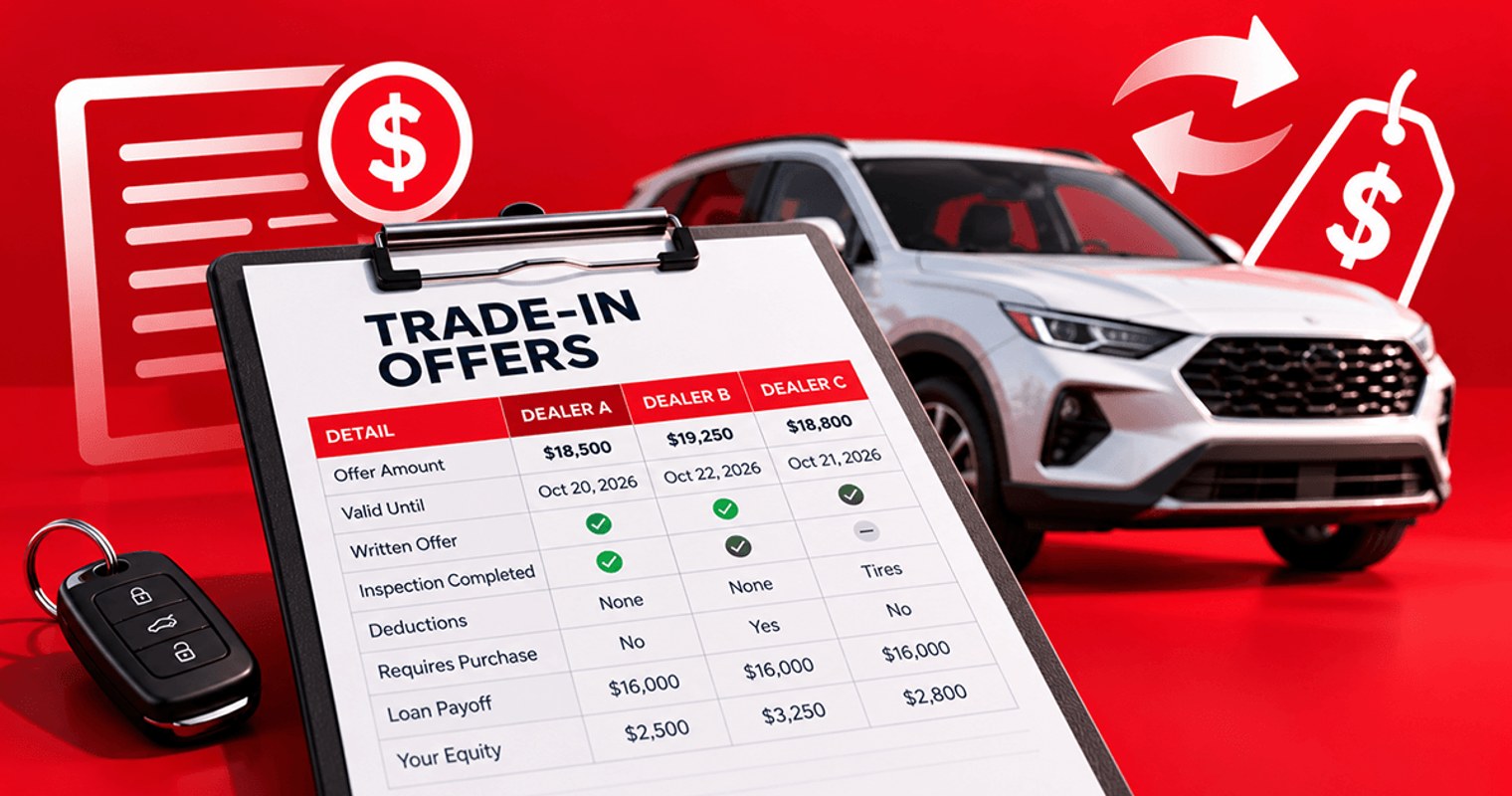
Use a scorecard like this:
| What to compare | Offer 1 | Offer 2 | Offer 3 |
|---|---|---|---|
| Trade in offer | |||
| Offer expiration | |||
| Written offer | |||
| Inspection completed | |||
| Remaining conditions | |||
| Deductions | |||
| Requires another purchase | |||
| Loan payoff | |||
| Positive or negative equity |
The scorecard forces you to compare the same things across each offer.
Suppose you receive these two offers:
Dealer A: $20,000
Dealer B: $20,500
Dealer B looks better immediately.
But suppose Dealer B's offer still requires an inspection while Dealer A has already inspected the vehicle and provided a written offer.
The $500 difference still matters, but now you understand that the two numbers are not quite as comparable as they first appeared.
The strongest offer is generally the one that gives you the best combination of value and certainty.
Is an Online Trade-In Estimate the Same as an Offer?
No.
An online valuation can be useful for research, but an estimated value and an actual offer serve different purposes.
An estimate helps you establish a reasonable starting range based on the information entered.
An offer represents what a specific buyer is willing to pay, subject to whatever conditions are attached to it.
That distinction matters when you start negotiating.
If an online tool estimates your vehicle at $21,000 but the real offers you receive are clustered around $19,000, do not automatically assume every buyer is making an unfair offer.
First, check that your trim, mileage, options, condition, and vehicle history were entered accurately. Then compare several real offers.
The market for your specific vehicle becomes much clearer once actual buyers put numbers on it.
Why Might Two Dealers Offer Different Amounts for the Same Car?
A lower offer does not automatically mean a dealership is trying to take advantage of you.
Dealers can value the same vehicle differently.
One dealership may already have several similar vehicles in inventory. Another may have a stronger need for your model.
A dealer may expect different reconditioning costs based on its inspection. Local demand can differ. The dealership may also have different plans for the vehicle after acquiring it.
That is why getting another appraisal can be so useful.
You are not trying to prove that one dealer is right and another is wrong. You are finding out which buyer values your particular vehicle most.
Should I Negotiate My Trade-In Separately From the New Car Price?
It is usually easier to evaluate the deal when you keep the major numbers separate.
That does not mean you need to hide the fact that you have a trade.
Instead, know these numbers independently:
The price of the vehicle you are buying
Your trade-in allowance
Your current loan payoff, if applicable
Your positive or negative equity
Your amount financed
For example, imagine one dealer offers $20,000 for your trade while another offers $18,500.
The first offer looks $1,500 better.
But if the vehicle you are buying costs $2,000 more at the first dealership, the larger trade allowance does not necessarily produce the better overall deal.
This is why AutoFinder recommends looking beyond the trade number by itself.
Compare listings and vehicle pricing before you negotiate so you have context for the car you are buying as well as the one you are trading.
Should You Tell a Dealer About Your Trade-In?
You do not need to treat your trade like a secret.
The more important goal is keeping the numbers clear enough that you can evaluate each part of the transaction.
You can tell the dealer you have a vehicle to trade while still asking to see the purchase price, trade allowance, financing terms, and other transaction amounts separately.
This also helps keep the process straightforward for the dealership, especially if there is an existing loan that needs to be paid off.
A good deal should still make sense when you look at the individual numbers.
How Do You Compare Offers If You Still Owe Money on the Car?
If your vehicle has a loan, the highest trade-in offer is important, but your equity tells you what that offer means financially.
Use this calculation:
Trade-in offer minus loan payoff equals vehicle equity
Suppose your current payoff is $19,000.
| Trade in offer | Loan payoff | Equity |
|---|---|---|
| $21,000 | $19,000 | $2,000 positive |
| $19,000 | $19,000 | Break even |
| $17,000 | $19,000 | $2,000 negative |
With positive equity, the amount remaining after the loan is satisfied can generally go toward your next vehicle.
With negative equity, you still have a shortfall to deal with.
That makes a stronger trade offer especially valuable when you are upside down. Raising an offer from $17,000 to $18,000 reduces your negative equity from $2,000 to $1,000.
If you still owe money on your vehicle, read Can You Trade In a Car With a Loan? Negative Equity Explained before accepting the trade.
What Should You Ask When a Dealer Gives You a Trade-In Offer?
You do not need to turn the appraisal into an interrogation.
A few direct questions can tell you most of what you need to know:
Is this the final offer after inspection?
How long is the offer valid?
Is the offer dependent on me buying another vehicle here?
Were there any condition issues that reduced the appraisal?
Are there any deductions that are not shown in this number?
Can you improve the offer?
Can I get the offer in writing?
If the offer is substantially below another appraisal, ask why.
There may be a reasonable explanation. You may have entered the condition differently online, the dealer may have identified damage during inspection, or another buyer may simply value the vehicle more.
The answer helps you decide what to do next.
What Are the Red Flags When Comparing Trade-In Offers?
A different offer is not automatically a red flag. The concern is when you cannot tell what the offer actually means.
Look more closely when:
The trade amount is only verbal.
You cannot get a clear explanation of major deductions.
The offer changes significantly after inspection without an explanation.
A large trade allowance is paired with a noticeably higher vehicle price.
The offer depends on terms that were not clear when it was presented.
You are being asked to focus only on the monthly payment.
You owe money on the trade and cannot see how the loan payoff is being handled.
The numbers discussed with you do not match the final paperwork.
A trade-in transaction can involve several moving pieces without anything being wrong.
The key is that you should be able to follow the numbers.
Can You Negotiate a Dealer's Trade-In Offer?
Yes, a trade-in offer can be negotiable.
The strongest argument is usually another real offer.
Suppose Dealer A offers $18,000 and Dealer B gives you a written offer for $19,250.
Instead of arguing about what your car should be worth, you can show Dealer A the competing offer and ask whether it can match or beat it.
That changes the conversation from:
“I think my car is worth more.”
to:
“I have another offer for $19,250. Can you improve yours?”
The second conversation is based on an actual market offer.
The dealer may match it, improve its offer somewhat, or decide it cannot justify paying more.
Any of those outcomes gives you useful information.
Should You Take the Highest Trade-In Offer?
Usually you want the strongest offer, but make sure you are comparing equal terms.
A $500 higher trade allowance does not automatically make the entire transaction $500 better if the vehicle you are buying costs more or other parts of the deal changed.
This is where separating the numbers becomes valuable.
Compare:
Vehicle purchase price
Trade-in allowance
Loan payoff
Equity
Taxes and fees
Financing terms
Amount financed
Out the door price
If you are comparing vehicles at different dealerships, AutoFinder's Out the Door Price Calculator can help you look beyond the advertised vehicle price and estimate the complete purchase cost.
Can Preparing Your Car Help You Get a Better Offer?
It can help make the appraisal process smoother and make sure the dealer is evaluating the vehicle as it actually sits.
Before an appraisal:
Remove personal items and trash.
Give the interior and exterior a basic cleaning.
Gather service records if you have them.
Bring all keys and key fobs.
Know your vehicle's trim and major factory equipment.
Be prepared to disclose known damage or mechanical issues.
Be cautious about spending heavily on repairs just to increase a trade offer.
A repair that costs you $1,000 does not automatically add $1,000 to the appraisal.
If the vehicle needs significant work, consider getting an appraisal first. Then you can decide whether the potential improvement in value justifies paying for the repair yourself.
For a complete preparation strategy, see How to Maximize Your Trade-In Value in 2026.
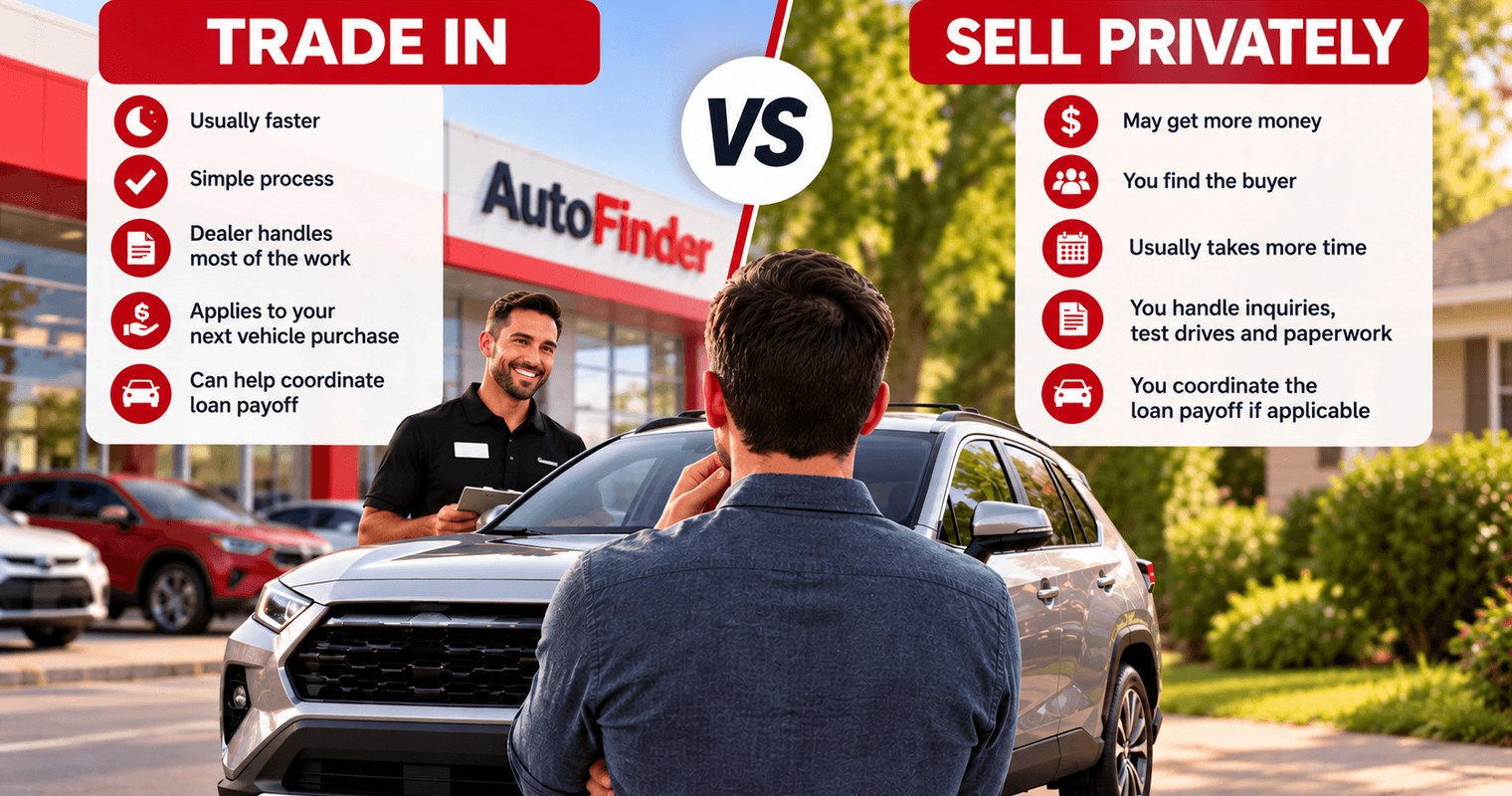
Should You Trade In or Sell the Car Privately?
A dealer trade and private sale solve the same problem in different ways.
Trading is usually simpler. The dealership can incorporate the vehicle into the same transaction as your next purchase and can coordinate an existing loan payoff when necessary.
Selling privately may produce a higher selling price, but you are responsible for finding a buyer, arranging payment, handling paperwork, and coordinating the title and loan payoff when applicable.
The right comparison is not simply:
Which number is higher?
It is:
How much more could I realistically receive by selling privately, and is that difference worth the additional time and work?
See Trade In vs. Sell Privately: Which Is Better? for a deeper comparison.
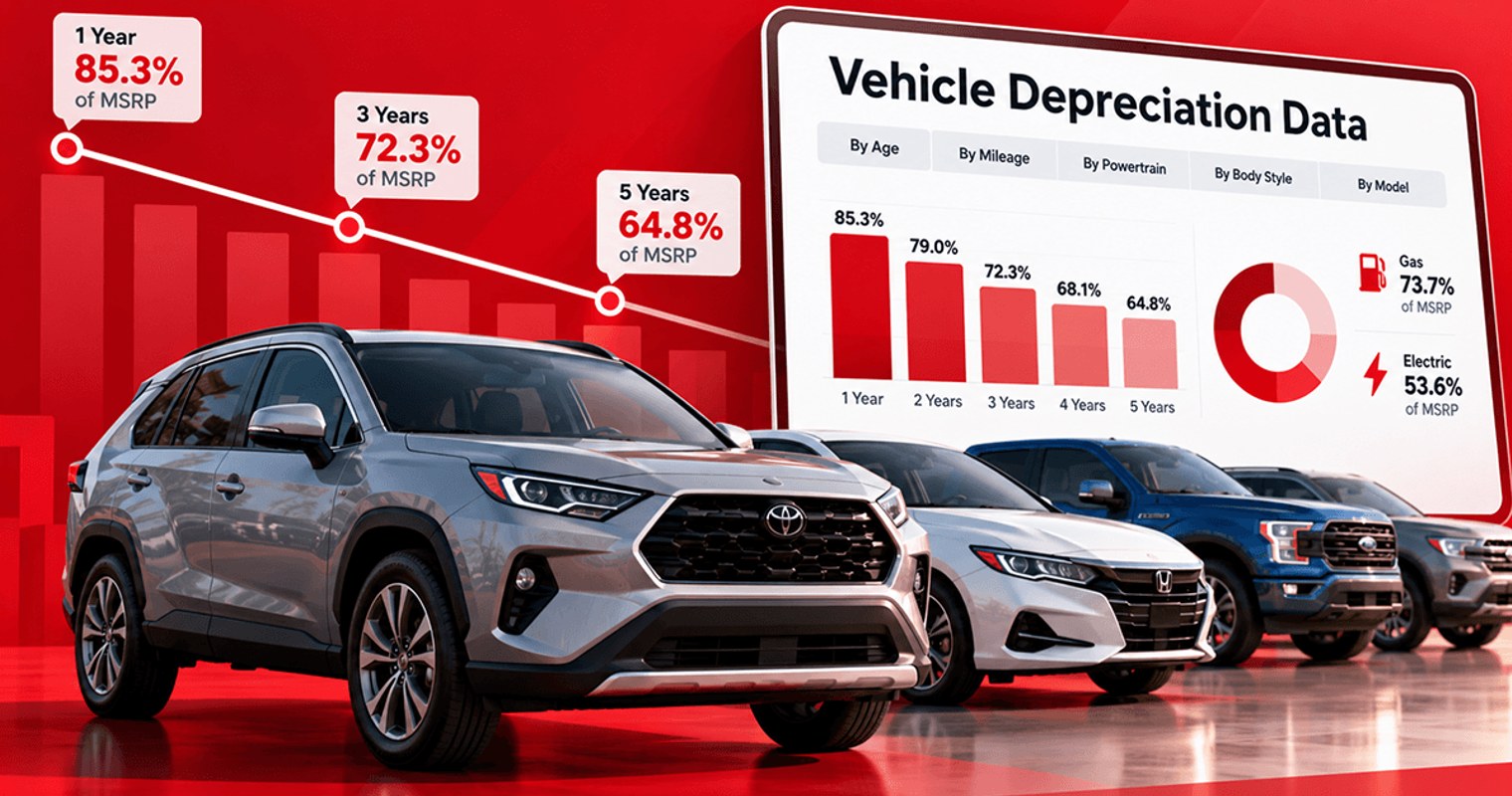
Does Vehicle Depreciation Affect Whether an Offer Is Fair?
Yes, but depreciation does not happen at exactly the same rate for every vehicle.
Vehicle age, mileage, body style, powertrain, model, condition, and market conditions can all affect used vehicle pricing.
AutoFinder's analysis of 1,769,621 used vehicle listings found that advertised retail pricing relative to original base MSRP generally declined as vehicles aged from one to five years. The largest decline within that range occurred between ages two and three.
That does not tell you what a dealer should offer for your individual car. AutoFinder's dataset measures advertised retail prices, not dealer trade offers or wholesale values.
It does show why a generic rule about what every vehicle “should” be worth can be misleading.
For the full analysis, see Trade In Market and Vehicle Depreciation Data.
How Do You Decide Which Trade-In Offer to Accept?
Before accepting an offer, run one final check.
Ask yourself:
Did I research the approximate value of my vehicle?
Do I have another real offer for comparison?
Are the offers based on the same vehicle condition?
Have the vehicles been inspected?
Are the offers in writing?
Do I understand any conditions or deductions?
If I have a loan, do I know my current payoff?
Do I know my positive or negative equity?
Have I compared the price of the vehicle I am buying separately?
Do I understand the complete transaction, not just the monthly payment?
You do not need to squeeze every possible dollar out of your trade for an offer to be fair.
You need enough information to recognize whether the offer is competitive and whether the complete transaction works for you.
Once you know that, you can compare vehicles and dealer pricing on AutoFinder and decide which combination of trade value and next vehicle makes the most sense.
The information in this article is for general informational purposes only. Trade-in offers, vehicle values, financing, taxes, fees, loan payoffs, dealership policies, and transaction terms vary by vehicle, dealer, lender, location, and individual transaction. Confirm current values and transaction details before making a purchase or trade decision.

Get a real offer in 2 minutes
Sell or trade your car 100% online. No haggling, no headaches.

Continue to Carvana to enter your vehicle and get your offer.