Car Basics
What is RPM
OVERVIEW
RPM stands for revolutions per minute. In a car, it tells you how fast the engine is spinning.
If your tachometer reads 2,000 RPM, the engine's crankshaft is rotating about 2,000 times each minute. Honda describes the tachometer as the gauge that shows engine speed in revolutions per minute.
RPM changes constantly while you drive. It rises when you accelerate, usually drops when the transmission shifts into a higher gear, and settles lower when the engine is idling.
For most drivers, RPM is useful because it gives you a quick look at what the engine is doing. You do not need to watch it constantly, but understanding the gauge can help explain why your engine sounds different during acceleration, why a transmission downshifts, and what the red section of the tachometer means.
What Does RPM Stand For?
RPM stands for revolutions per minute.
One revolution is one complete rotation. In a gasoline or diesel car, the RPM reading generally refers to how many times the engine's crankshaft rotates in 1 minute.
For example:
| Tachometer Reading | What It Means |
|---|---|
| 800 RPM | Engine rotates about 800 times per minute |
| 2,000 RPM | Engine rotates about 2,000 times per minute |
| 4,000 RPM | Engine rotates about 4,000 times per minute |
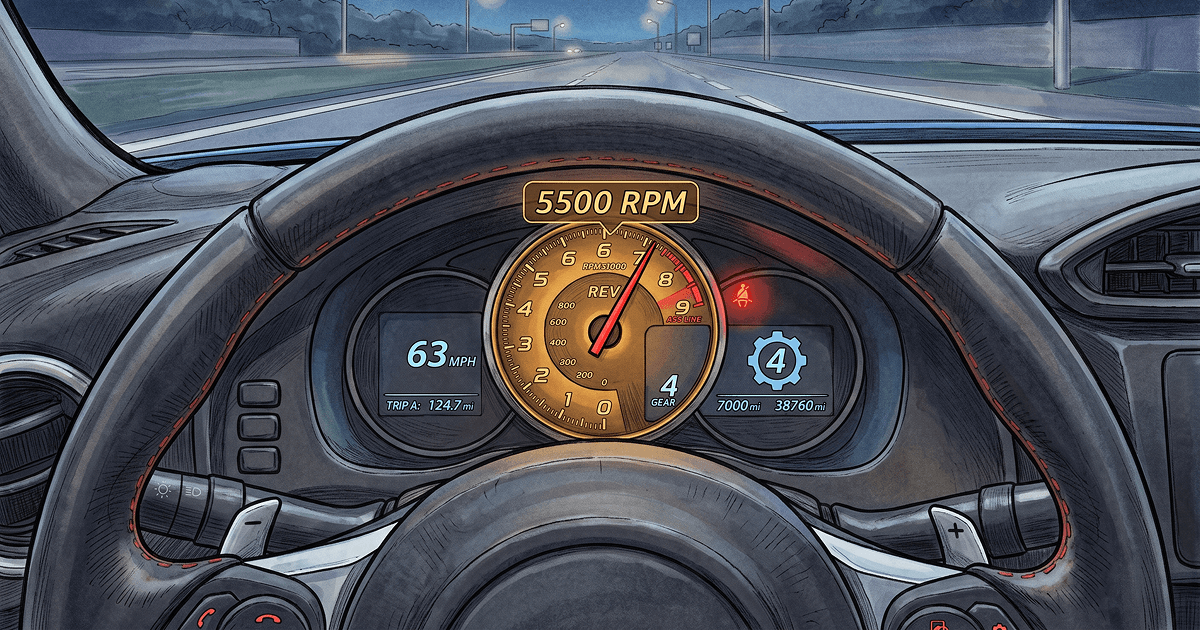
You may also see a tachometer marked with numbers such as 1, 2, 3, 4, and 5 alongside an "x1000" label. In that case, a reading of 3 represents approximately 3,000 RPM.
What Is a Tachometer?
A tachometer is the gauge or display that shows engine RPM.
It usually appears near the speedometer in the instrument cluster.
The speedometer tells you how fast the car is traveling. The tachometer tells you how fast the engine itself is spinning.
Those 2 numbers are related, but they are not the same thing. You can travel at the same road speed while the engine runs at different RPM depending on the gear, transmission behavior, and driving conditions.
That is why you may see RPM rise sharply when your automatic transmission downshifts even though your road speed has not changed much.
Why Does RPM Change While You Drive?
RPM changes because the engine does not operate at one constant speed.
When you press the accelerator, the engine generally spins faster to produce the power needed to increase speed.
Once the transmission moves into a higher gear, RPM can drop while the vehicle continues accelerating.
You may also notice RPM rise when:
- Accelerating hard
- Driving uphill
- Passing another vehicle
- The transmission downshifts
- Starting the engine when it is cold
- Certain accessories place additional load on the engine
A temporary change in RPM is often completely normal.
Toyota, for example, notes that engine speed can increase during a cold start, during automatic transmission downshifts, or when certain engine driven accessories add load.
What Is a Normal RPM When a Car Is Idling?
There is no single idle RPM that applies to every vehicle.
Many gasoline engines idle somewhere below 1,000 RPM once warmed up, but the exact number depends on the engine and operating conditions.
You may see a higher RPM immediately after starting a cold engine. That can be normal while the engine warms up.
Air conditioning or other equipment can also cause small changes in idle speed.
Instead of worrying about one exact number, pay more attention to behavior that is unusual for your car. An idle that suddenly becomes much higher, lower, rougher, or unstable may be worth investigating.
What Is a Good RPM While Driving?
There is no ideal RPM that works for every car or situation.
A vehicle cruising steadily on the highway may operate at relatively low RPM because the transmission is using a higher gear.
Accelerating onto the highway may require considerably more RPM.
A performance car may also be designed to make much of its power higher in the rev range than a vehicle tuned primarily for fuel economy.
The better approach is to let the vehicle operate within the range its manufacturer designed for normal use rather than trying to hold one specific RPM number.
Modern automatic transmissions handle most of this for you.
Is High RPM Bad for a Car?
Not automatically.
Engines are designed to operate across a range of speeds. Higher RPM is normal when you need more acceleration or the transmission selects a lower gear.
Problems are more likely when the engine is operated beyond its intended limits or stays near the redline unnecessarily.
Honda warns drivers not to operate the engine with the tachometer in the red zone because excessive engine speed can damage the engine.
Occasionally seeing 4,000 or 5,000 RPM during acceleration does not automatically mean something is wrong. Whether that is normal depends on the engine and its designed operating range.
What Does the Redline Mean?
The redline represents the upper end of the engine's recommended RPM range.
On many tachometers, this area is literally marked in red.
Car and Driver defines redline as the maximum recommended engine speed, and manufacturers generally warn against operating the engine in that range.
The exact redline varies by engine.
A diesel truck, economy sedan, sports car, and motorcycle can all have very different maximum engine speeds.
Modern vehicles also typically use electronic controls that help protect the engine from excessive RPM, but that is not a reason to intentionally keep the engine near its limit.
Is Low RPM Better Than High RPM?
Not always.
Lower RPM can help reduce noise and may improve efficiency during steady cruising, which is one reason modern transmissions shift into higher gears when possible.
But forcing an engine to operate at very low RPM while asking for a lot of power can also be undesirable.
The correct RPM depends on what you are asking the car to do.
During highway cruising, lower RPM may be completely appropriate. During acceleration or climbing a hill, the engine may need to spin faster.
Modern automatic transmissions are designed to manage this balance without requiring much input from the driver.
Why Does RPM Go Up When I Accelerate?
Pressing the accelerator tells the engine to produce more power.
One way an engine can produce more power is by spinning faster.
Horsepower is related to both torque and engine speed. In simplified terms, horsepower depends on torque multiplied by RPM.
That is why you often hear the engine get louder and see the tachometer rise when accelerating.
Once the transmission shifts, RPM may drop again even though the vehicle continues gaining speed.
Why Does RPM Drop When the Transmission Shifts?
A higher gear allows the vehicle to maintain or increase road speed without requiring the engine to spin as quickly.
Imagine riding a bicycle.
In a low gear, your legs may pedal quickly while the bike travels relatively slowly. Move into a higher gear and you can travel faster with fewer pedal rotations.
A transmission does something broadly similar for the engine.
When an automatic transmission shifts up, engine RPM usually falls. When it needs more power and shifts down, RPM usually rises.
What Does RPM Mean in a Manual Car?
RPM becomes more noticeable when you drive a manual transmission because you choose when to change gears.
The tachometer helps you see where the engine is operating before you shift.
Shift too early and the engine may not have enough power for what you are asking it to do. Wait too long and you can move unnecessarily close to the engine's redline.
The ideal shift point depends on the vehicle and how you are driving.
Normal commuting calls for a very different approach from hard acceleration.
You do not need to hit a specific RPM every time you shift. With experience, many manual drivers rely as much on engine sound and feel as they do on the tachometer.
What Does RPM Mean in an Automatic Car?
RPM measures the same thing whether the vehicle has an automatic or manual transmission.
The difference is that an automatic transmission normally chooses the gears for you.
You may notice RPM rise when the vehicle downshifts for acceleration and fall again after it changes into a higher gear.
Some automatic transmissions also behave differently from traditional geared automatics, which can make RPM feel unfamiliar.
Why Does a CVT Hold High RPM?
A continuously variable transmission, or CVT, does not use fixed gears in quite the same way as a traditional automatic transmission.
During harder acceleration, a CVT may allow the engine to rise to an efficient or powerful part of its RPM range and remain there while vehicle speed increases.
That can sound unusual if you are accustomed to hearing a traditional automatic shift several times.
The engine may sound as if it is holding one long gear, even though the transmission is continuously adjusting its ratio.
That behavior can be normal for a CVT.
Does Higher RPM Mean More Horsepower?
RPM plays a role in horsepower, but higher RPM alone does not automatically mean more power.
An engine's torque output changes throughout its operating range.
Horsepower is calculated using both torque and RPM, which is why manufacturers often list peak horsepower at a specific engine speed.
For example, a performance engine may reach peak horsepower at 6,500 RPM while producing its strongest torque lower in the range. Toyota's GR Corolla is one example where peak horsepower occurs at 6,500 RPM.
This is also why 2 engines operating at the same RPM can produce very different amounts of power.
RPM vs. MPH: What Is the Difference?
RPM measures engine speed.
MPH measures vehicle speed.
| Measurement | What It Tells You |
|---|---|
| RPM | How fast the engine is rotating |
| MPH | How fast the vehicle is traveling |
A car could be traveling at 60 MPH while running at 1,800 RPM in a high gear.
The same car might briefly run at 4,000 RPM while accelerating toward 60 MPH in a lower gear.
The transmission connects those 2 measurements by changing the relationship between engine speed and wheel speed.
RPM Pros and Cons: Is Higher RPM Better?
Higher RPM is neither automatically good nor bad. It depends on why the engine is spinning faster.
Pros
- More power may be available
- Useful for acceleration
- Helps during passing
- Normal during downshifts
- Performance engines may be designed for it
Cons
- More engine noise
- Fuel use can increase
- More heat can be generated
- Staying near redline can add stress
- Excessive RPM can damage an engine
For normal driving, there is usually no reason to chase either especially high or especially low RPM. The engine and transmission are designed to use different parts of the rev range as conditions change.
Why Is My RPM High but My Car Is Not Accelerating?
This deserves more attention than a normal RPM increase.
If engine speed rises significantly but the vehicle does not accelerate the way you expect, there could be several explanations.
A CVT may sometimes create this sensation during normal operation because RPM can remain relatively high while the transmission changes ratios.
In other vehicles, unusually rising RPM without a matching increase in speed can potentially point to a transmission or clutch issue.
For example, a worn clutch in a manual transmission can allow engine speed to increase without transferring the expected amount of power to the wheels.
If the behavior is new, severe, or accompanied by warning lights, unusual noises, burning smells, or shifting problems, have the vehicle inspected.
Why Does My RPM Go Up and Down While Idling?
Small RPM changes can be normal.
The engine computer may adjust idle speed as the engine warms up or as accessories add load.
Larger or repeated fluctuations are different.
If RPM continually surges and falls, especially if the engine feels rough or sounds unusual, the vehicle may need diagnosis.
Possible causes vary widely, so the tachometer alone cannot tell you what needs to be repaired.
Pay attention to any warning lights and other symptoms rather than trying to diagnose the car solely from the RPM reading.
Should You Pay Attention to RPM When Buying a Used Car?
It can tell you a few useful things during a test drive.
Start the vehicle and watch how it idles. Once warmed up, the engine should generally settle into a relatively steady operating speed.
During the drive, pay attention to how RPM responds when you accelerate.
The number itself matters less than whether the behavior feels smooth and consistent.
Things worth noticing include:
- Unstable idle
- RPM surging
- RPM rising without expected acceleration
- Harsh or delayed shifts
- Unusual engine noise
- Warning lights
- RPM behaving differently after the engine warms up
None of these automatically tells you what is wrong, but they can be reasons to investigate further before buying.
A prepurchase inspection is much more useful than trying to diagnose a mechanical problem from the tachometer alone.
How AutoFinder Helps You Research Your Next Car
RPM is one small piece of understanding how a car drives.
When comparing vehicles on AutoFinder, look at the complete powertrain, including the engine, transmission, horsepower, torque, fuel economy, drivetrain, and how the car feels during a test drive.
A vehicle with more horsepower is not automatically more enjoyable for every shopper. Likewise, an engine that operates at higher RPM is not necessarily working harder than it should.
Specifications give you context. Driving the vehicle tells you whether the way it delivers its power feels right for you.
Final Thoughts
RPM means revolutions per minute, and in a car it describes how fast the engine is spinning.
The tachometer gives you that information while you drive.
RPM naturally rises and falls as you accelerate, change gears, climb hills, cruise, or idle. Higher RPM is not automatically a problem, and lower RPM is not automatically better.
What matters is whether the engine is operating normally for the situation.
You generally do not need to think much about RPM in a modern automatic car. But once you understand what the number means, the sounds and behavior of the engine start to make a lot more sense.
Want More Car Buying Advice?
Add AutoFinder as a preferred source on Google to help you discover more of our automotive guides and research.