Lotus cars are made by Lotus Cars, the British performance automaker known for lightweight sports cars, precise handling, and a motorsport history stretching back more than 70 years.
But the modern Lotus story is more global than the badge alone might suggest.
Lotus remains headquartered in Hethel, Norfolk, England, where the company has been based since 1966. Its traditional sports cars are manufactured there, including the Emira. Lotus also operates an electric vehicle manufacturing facility in Wuhan, China, where newer models including the Eletre and Emeya are produced.
Then there is the ownership question.
Lotus is part of Group Lotus, and Chinese automotive company Geely became the majority shareholder in 2017.
So, is Lotus British or Chinese?
The most accurate answer is that Lotus is a British automotive brand with global ownership and manufacturing operations.
Its identity, headquarters, sports car manufacturing, and much of its engineering heritage remain firmly rooted in the United Kingdom. Geely's investment has helped Lotus expand into new segments, particularly premium electric vehicles.
The company develops performance cars and electric vehicles under the Lotus brand, with manufacturing split between facilities in the United Kingdom and China.
Today:
Lotus is a British automotive brand
Group Lotus is the parent organization behind Lotus Cars
Geely is the majority shareholder in Group Lotus
Lotus sports cars are manufactured in Hethel, England
The Lotus Eletre and Emeya are manufactured in Wuhan, China
Lotus maintains design and engineering operations in multiple countries
That global structure can make Lotus seem more complicated than it really is.
Geely owns a controlling interest in Lotus, but Lotus continues to operate as a distinct performance car brand with its own vehicles, engineering philosophy, history, and identity.
Is Lotus a British Car Company?
Yes.
Lotus is a British automotive brand, and England remains central to the company's identity and operations.
The Lotus story began with founder Colin Chapman, who built his first competition car in 1948. Chapman formally established Lotus Engineering in 1952.
The company eventually moved to Hethel, Norfolk, in 1966.
That location remains the home of Lotus today.
Hethel includes the company's headquarters, engineering operations, manufacturing facilities, and famous test track. The site was originally an airfield, and portions of its former runways became the test circuit Lotus has used for vehicle development.
That connection matters because Lotus has always placed unusual emphasis on how a vehicle feels from behind the wheel.
Handling, steering response, weight, suspension tuning, and driver involvement are not simply marketing themes for the brand. They have shaped Lotus vehicles for generations.
Modern ownership has changed.
The product lineup has changed.
The company has become much more global.
But the British part of Lotus has not disappeared.
Who Owns Lotus Cars?
Lotus is controlled by Geely Holding, a large automotive group based in China.
Geely acquired a 51% stake in Group Lotus in 2017, becoming its majority shareholder.
That acquisition became a major turning point for Lotus.
For years, Lotus had an enthusiastic following and considerable engineering credibility but operated on a relatively small scale compared with major global automakers.
Geely's involvement brought additional investment and resources.
Since then, Lotus has expanded its manufacturing operations, developed new electric vehicles, entered the SUV market, introduced a four door performance car, and broadened its ambitions well beyond the small sports cars traditionally associated with the company.
The important distinction is that Geely ownership does not mean Lotus vehicles are simply rebadged versions of other Geely products.
Lotus remains its own automotive brand with dedicated design, engineering, manufacturing, and product development operations.
What Is Geely?
Geely Holding is a global automotive group headquartered in China.
Its automotive investments extend across several brands and businesses, which means shoppers may recognize Geely's involvement elsewhere in the industry.
For Lotus, the important part of the relationship is access to investment, technology, manufacturing scale, and resources that would have been difficult for a relatively small sports car company to develop entirely on its own.
That support has allowed Lotus to pursue a much broader product strategy.
A company once primarily associated with small 2 seat sports cars now sells an electric SUV and an electric performance sedan alongside its traditional sports car offerings.
That is a substantial change.
But Lotus is still expected to make those vehicles feel like Lotuses.
That is where the company's engineering identity remains important.
Who Founded Lotus?
Lotus was founded by Colin Chapman, one of the most influential figures in British automotive and motorsport history.
Chapman built his first competition car in 1948 while studying structural engineering at University College London. The first car to carry the Lotus name followed in 1951, and Lotus Engineering was formally established in 1952.
Chapman's philosophy emphasized reducing weight rather than simply adding more power.
That approach became fundamental to Lotus.
It influenced famous road cars including the Elan, Esprit, Elise, Exige, and Evora, as well as Lotus racing cars.
It also helped establish the brand's reputation for vehicles that prioritize steering, balance, and driver involvement.
Modern Lotus vehicles are significantly more technologically complex than Chapman's early creations, but the company continues to position driving dynamics as a defining part of the brand.
Where Are Lotus Cars Made?
There is no longer one answer for every Lotus.
The company currently has major vehicle manufacturing operations in Hethel, England, and Wuhan, China.
Where a Lotus is built depends on the model.
Hethel, England
Hethel is the traditional home of Lotus.
The company has operated there since 1966, and the site remains central to Lotus sports car development and manufacturing.
The Chapman Production Centre at Hethel currently manufactures the Lotus Emira. The facility has capacity for approximately 5,000 vehicles annually.
Lotus also identifies Hethel as the manufacturing home of the electric Evija hypercar.
These vehicles represent the more traditional side of Lotus.
They are low-volume performance cars closely connected with the company's British sports car history.
Wuhan, China
Lotus established its Global EV Production Centre in Wuhan as part of its expansion into higher-volume electric vehicles.
The facility manufactures the Lotus Eletre and Lotus Emeya.
This is an important distinction for shoppers.
A Lotus Emira and a Lotus Eletre wear the same badge, but they are built in different countries and represent very different parts of the company's product strategy.
That does not make one a real Lotus and the other something else.
It reflects how much the company has expanded.
Which Lotus Cars Are Made in England?
The Lotus Emira is manufactured at Hethel in Norfolk, England.
It is also a particularly significant vehicle for the company because Lotus describes it as its final petrol-powered sports car.
The Emira follows a long line of British-built Lotus sports cars that includes vehicles such as the Elise, Exige, Evora, Esprit, and Europa.
Lotus also produces the limited-production electric Evija hypercar at its UK manufacturing headquarters.
For shoppers who associate Lotus primarily with compact British sports cars, the Emira is the model that most directly carries that tradition forward.
Which Lotus Cars Are Made in China?
The Lotus Eletre and Emeya are manufactured at the Lotus Global EV Production Centre in Wuhan, China.
Lotus Technology has overseen manufacturing of these models there as the company expands its electric vehicle lineup.
The facility is significantly different from the low-volume manufacturing environment at Hethel.
It was developed around advanced electric vehicle production and incorporates automated manufacturing and extensive quality control systems.
The Eletre and Emeya are also fundamentally different vehicles from traditional Lotus sports cars.
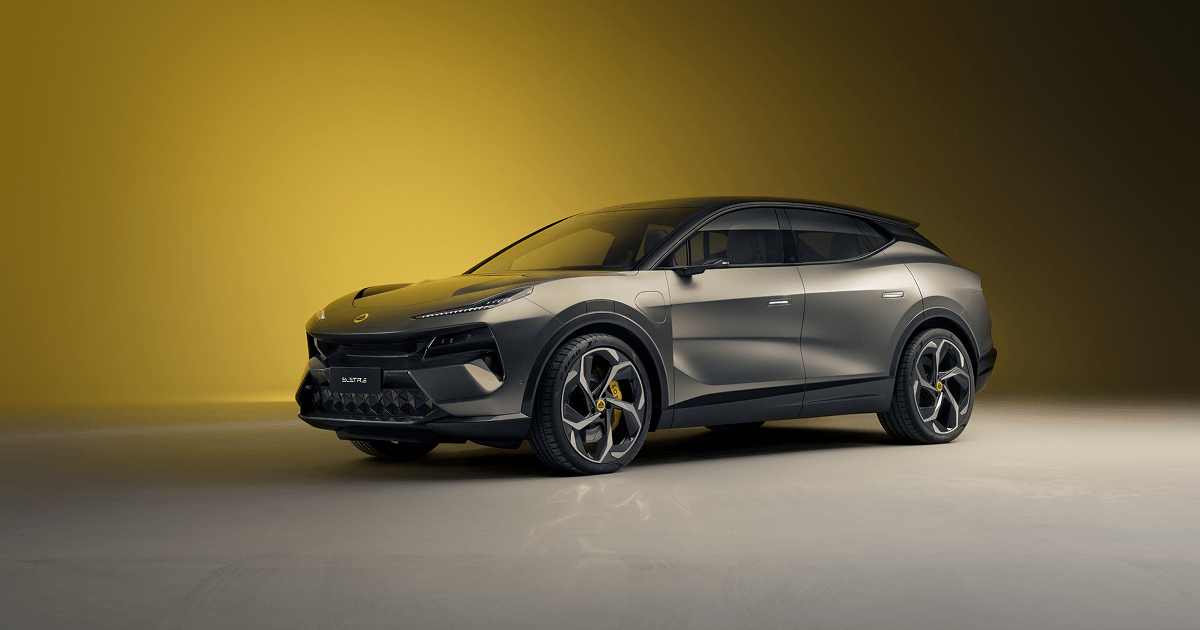
The Eletre is an electric performance SUV.
The Emeyais an electric four-door grand tourer.
Both move Lotus into vehicle categories it historically did not compete in.
What Cars Does Lotus Make?
Modern Lotus is no longer just a sports car company.
Its lineup now spans traditional performance cars, electric luxury vehicles, and an electric hypercar.
Lotus Emira
The Emira is the closest connection to the Lotus most enthusiasts already know.
It is a mid-engine sports car focused on handling and driver involvement.
It also represents the end of an era as Lotus's final petrol-powered sports car.
For someone who thinks of Lotus as lightweight, low-slung, and designed around corners rather than cargo space, the Emira is the familiar answer.
That sentence alone shows how much Lotus has changed.
Historically, the idea of a large Lotus SUV would have seemed almost impossible. The Eletre takes Lotus into a completely different market while attempting to retain the performance focus associated with the brand.
It is manufactured at Lotus's EV production facility in Wuhan.
Lotus Emeya
The Emeya is an electric performance grand tourer.
It combines four-door practicality with the power and technology expected from a modern premium EV.
Like the Eletre, it is manufactured in Wuhan.
Its role is different from the Emira.
The Emira is primarily about the traditional sports car experience.
The Emeya is designed to make Lotus relevant to buyers who want performance but also need a vehicle they can use more easily every day.
Lotus Evija
The Evija is Lotus's electric hypercar.
It was introduced as the company's first fully electric production vehicle and marked the beginning of Lotus's transition toward electric performance.
Production is extremely limited, so the Evija is less important as an everyday shopping option than it is as a demonstration of what Lotus can do with electric performance technology.
Is Lotus Still Really Lotus Under Geely?
That depends on what someone believes makes a Lotus a Lotus.
If the definition is that every Lotus must be a tiny British sports car with minimal weight and almost no practical considerations, the modern lineup looks very different.
An electric SUV like the Eletre is clearly not an Elise.
But automotive brands change.
What Lotus has tried to preserve is its emphasis on vehicle dynamics and engineering.
The company continues to operate its historic Hethel facility, manufacture sports cars in England, maintain its test track, and develop vehicles around performance and handling. At the same time, Geely's investment has given Lotus the resources to enter parts of the market it could not realistically reach before.
The result is a broader version of Lotus.
Whether you prefer the Emira or the Eletre may depend on what you want from the brand.
But both are part of the modern Lotus story.
Does Lotus Make Its Own Engines?
Not every major component in a Lotus is manufactured by Lotus itself.
Like virtually every modern automaker, Lotus works with outside suppliers and technology partners.
Historically, Lotus has used engines sourced from other manufacturers and then integrated them into vehicles designed around Lotus's own performance objectives.
The Emira is a good example.
Depending on version, it has been offered with powertrains sourced from established manufacturers rather than an engine developed entirely from scratch by Lotus.
That does not mean another company makes the Emira.
An automaker does not need to manufacture every engine, transmission, computer, brake component, or battery cell itself to be the manufacturer of the vehicle.
Lotus's expertise has traditionally been in how those pieces come together.
Chassis design.
Suspension tuning.
Steering.
Weight management.
Aerodynamics.
Vehicle dynamics.
That is where much of the Lotus character comes from.
Is Lotus a Luxury Car Brand?
Modern Lotus occupies an interesting position between performance and luxury.
Historically, Lotus was not defined by traditional luxury.
An Elise was not trying to surround its driver with the softest leather, biggest screens, or quietest cabin.
It was trying to make a corner interesting.
The Eletre and Emeya have expanded that definition considerably.
These vehicles combine high performance with sophisticated interiors, advanced technology, premium materials, and prices that put them into competition with established luxury brands.
That means Lotus today can reasonably be considered a premium performance brand.
But driving experience remains an important part of how it differentiates itself.
Is Lotus the Same Company as Lotus F1?
Not exactly.
Lotus has a legendary Formula 1 history through Team Lotus, which Colin Chapman established in the 1950s.
The racing operation became one of Formula 1's most influential teams, helping pioneer technologies and design ideas that changed the sport.
But the history of the Lotus name in Formula 1 and the corporate history of Lotus Cars are not identical.
There have also been later Formula 1 teams using the Lotus name that were separate from Chapman's original Team Lotus.
For a car shopper, the important takeaway is that Lotus Cars has genuine motorsport roots.
Its performance reputation was not created only through road car marketing.
Competition was part of the company's identity from the beginning.
What Makes Lotus Different From Other Performance Brands?
Lotus has traditionally approached performance differently.
A company can make a vehicle faster by adding more power.
Lotus built much of its reputation by asking whether the car could become better through less weight, better balance, more responsive steering, or smarter suspension engineering.
That philosophy produced some unusual vehicles.
Lotus cars were not always the most powerful cars in their class.
They often did not need to be.
The objective was to make the driver feel connected to what the car was doing.
Modern electric vehicles complicate that philosophy because batteries add considerable weight.
The challenge for today's Lotus is applying decades of vehicle dynamics knowledge to larger, heavier, more technologically complex cars.
That may ultimately determine how successfully the company carries its identity into the electric era.
Should You Consider Buying a Lotus?
Lotus deserves consideration if driving experience matters to you.
The Emira is especially compelling for someone who wants a dedicated sports car with distinctive styling and a more unusual ownership experience than choosing a more common performance vehicle.
The Eletre and Emeya appeal to a different shopper.
They offer electric performance, sophisticated technology, and greater everyday practicality while still carrying Lotus's focus on driving dynamics.
There are practical considerations.
Lotus has a much smaller sales and service footprint than major mainstream automakers.
That means buyers should consider where their nearest authorized service location is before purchasing.
Parts availability, insurance costs, depreciation, and long term maintenance should also be researched for the exact model.
A Lotus is unlikely to be the most practical choice for every shopper.
That is not really why people buy one.
How AutoFinder Helps You Research Lotus Cars
Lotus now offers vehicles aimed at very different buyers.
AutoFinder can help you compare the details that matter before deciding which direction makes sense.
You can research:
Lotus models
Vehicle pricing
Performance specifications
Gas and electric powertrains
Features and technology
Available inventory
Competing performance vehicles
The right Lotus depends heavily on what you want the vehicle to do.
Someone shopping for an Emira probably has very different priorities from someone considering an Eletre.
Understanding those differences makes it easier to find the vehicle that actually fits your life.
Final Thoughts
Lotus cars are made by Lotus, a British performance brand with a much more global operation than it had in the past.
The company's headquarters and traditional sports car manufacturing remain in Hethel, England, where Lotus has been based since 1966. The Emira is built there, maintaining a direct connection with generations of British Lotus sports cars.
Lotus's newer electric Eletre and Emeya are manufactured at the company's EV production facility in Wuhan, China.
Geely became the majority shareholder of Group Lotus in 2017, giving the company additional resources to expand its technology, manufacturing, and vehicle lineup.
So calling Lotus simply British or simply Chinese misses part of the story.
Lotus is a British performance brand with global ownership, engineering, and manufacturing operations.
The company looks very different from the one Colin Chapman started more than 70 years ago.
But the question it has to answer with every new model remains familiar.
Does it drive like a Lotus?
Frequently Asked Questions
Yes. Geely Holding became the majority shareholder in Group Lotus in 2017 after acquiring a 51% stake. Lotus remains a British automotive brand headquartered in Hethel, England, with its own design, engineering, and manufacturing operations. Geely's investment has helped fund Lotus's expansion into electric vehicles and new vehicle categories.