What Documents Do You Need to Buy a Car?
Last updated Aug 25th, 2026Buying a car involves more paperwork than buying most everyday products, but the process does not have to feel overwhelming.
The documents you need depend on how you plan to pay, whether you have a vehicle to trade, and the registration requirements in your state. A cash buyer may need only identification, insurance information, and payment. A buyer applying for financing may also need proof of income, residence, and employment.
Bringing the right documents can save time at the dealership and help prevent delays when you are ready to take your new vehicle home.
This guide explains what most buyers should bring, which additional documents may be requested for financing, and what paperwork to expect before leaving the dealership.
Registration and insurance requirements vary by state, so confirm the rules where you live before completing your purchase. Dealers frequently handle at least part of the title and registration process, but that is not universal.
Find Your Best Price
See what others paid and get upfront pricing from local dealers.

Quick Answer: What Should You Bring to Buy a Car?
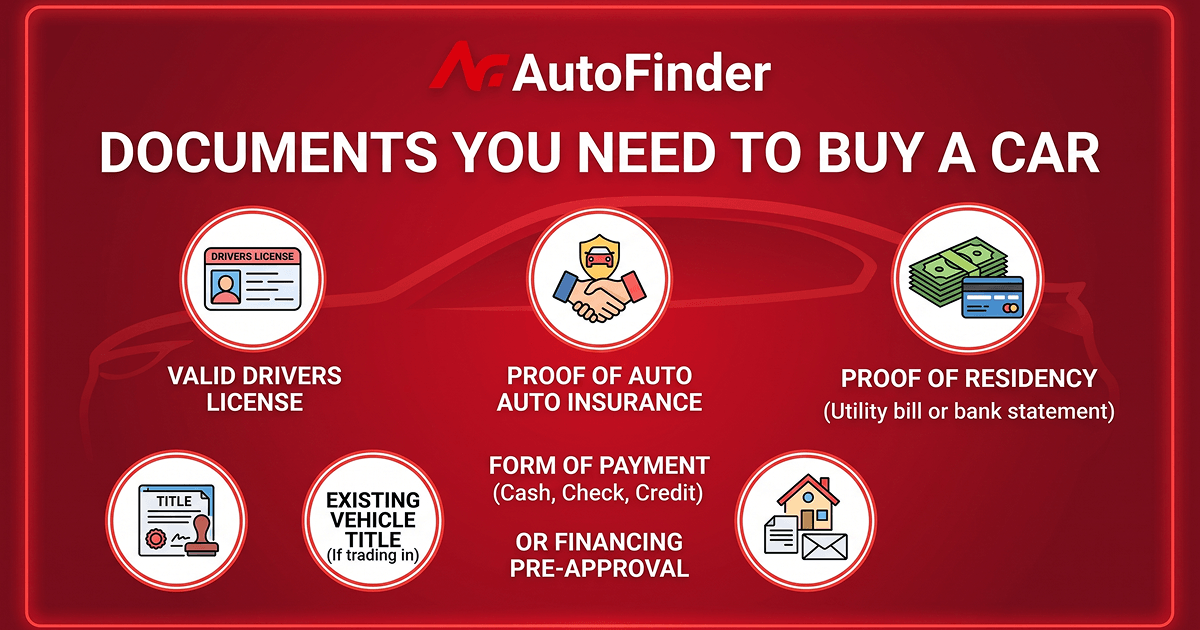
Most buyers should be prepared to bring:
- A valid driver’s license or government-issued identification
- Proof of auto insurance
- Your preferred form of payment
- Car loan pre-approval information, when applicable
- Proof of income, if requested by the lender
- Proof of residence, if requested by the lender
- Employment information
- Your Social Security number or taxpayer identification information for financing and certain registration transactions
- The title, registration, loan payoff details, and keys for a trade-in vehicle
- Any documents needed for a manufacturer incentive
You may not need every item on this list. Calling the dealership before your appointment is the easiest way to confirm what will be required for your specific purchase.
A Valid Driver’s License or Government-Issued Identification
Your driver’s license is usually the first document a dealership will request.
It confirms your identity and shows that you are legally licensed to drive the vehicle. Dealerships commonly request a valid license before a test drive and may make a copy for their records.
Make sure the information on your license is current. If the address differs from the one on your financing application, the lender may ask for an additional document confirming where you live.
A buyer who does not have a driver’s license may still be able to purchase a vehicle in some circumstances, but registration, financing, insurance, and test drive rules can create additional steps. That situation should be discussed with the dealership, insurer, lender, and local motor vehicle agency before the purchase.
Proof of Auto Insurance
You will generally need insurance before driving a newly purchased vehicle away from the dealership.
Your insurer may provide proof through an identification card, mobile application, email, or policy document. State motor vehicle agencies may require evidence of financial responsibility before completing registration. California, for example, accepts insurance company documents or identification cards as evidence of coverage.
Some existing policies provide temporary coverage for a newly acquired vehicle, but the terms and time limits vary. Do not assume your current policy automatically provides the coverage you need.
Contact your insurance company before visiting the dealership and provide the vehicle identification number once you have selected a vehicle. This also gives you an opportunity to compare the insurance cost of different models before committing to one.
Financed and leased vehicles usually require more protection than the state minimum. Your lender or leasing company may require collision and comprehensive coverage in addition to liability insurance.
Your Preferred Form of Payment
The dealership will need to know how you plan to pay your down payment or complete a cash purchase.
Accepted payment methods vary by dealership and may include:
- Cashier check
- Certified check
- Electronic transfer
- Personal check
- Debit card
- Credit card for a limited amount
- Financing proceeds
Large cash payments and electronic transfers may require additional verification. Dealerships may also limit the amount that can be placed on a credit card.
Ask which payment methods are accepted before your appointment. This is particularly important if you are buying outside normal banking hours or traveling to a dealership far from home.
Car Loan Preapproval Documents
Arranging financing before visiting a dealership can help you understand the annual percentage rate, loan length, and maximum amount you are approved to borrow.
The Federal Trade Commission recommends shopping for financing before shopping for the vehicle. A preapproval gives you an offer to compare against the financing available through the dealership.
Bring the preapproval letter or have a digital copy available. It may include:
- Approved loan amount
- Annual percentage rate
- Loan term
- Expiration date
- Vehicle eligibility requirements
- Lender contact information
A dealership may still be able to offer a more competitive rate. Comparing the terms gives you the freedom to choose the option that works best for your budget.
Focus on the complete financing offer, not only the monthly payment. A longer loan may reduce the monthly amount while increasing the total interest paid over the life of the loan.
Proof of Income
A lender may ask for proof that you have enough income to repay the loan.
The exact requirements depend on the lender, your credit profile, the amount financed, and the type of income you receive.
Common proof of income documents include:
- Recent pay statements
- Bank statements showing regular deposits
- Tax returns
- W-2 forms
- 1099 forms
- Social Security or retirement benefit statements
- Court-ordered support documentation
- Employment offer letter
Not every buyer will be asked for all of these documents. Applicants with established credit and easily verified income may complete the process with less paperwork.
Buyers who are self-employed may be asked for additional financial records because their income can be more difficult to verify through a traditional employer.
Bring current documents and make sure the income listed on your application can be supported by the records you provide.
Proof of Residence
A lender may request proof of your current residential address.
This helps verify your identity and gives the lender a confirmed address for account notices and vehicle-related correspondence.
Possible documents include:
- Utility bill
- Lease agreement
- Mortgage statement
- Bank statement
- Insurance statement
- Government correspondence
- Property tax statement
The document should usually show your name, current address, and a recent date.
Requirements vary by lender, so ask whether a digital statement is acceptable or whether a printed copy is needed.
Employment Information
Even when separate employment documents are not required, a financing application may ask for:
- Employer name
- Employer address
- Employer phone number
- Job title
- Length of employment
- Gross monthly or annual income
A lender may contact your employer to verify the information.
Recent graduates, workers who recently changed jobs, and people with irregular income may need to provide additional records. Having those documents ready can help the application move more smoothly.
Social Security Number or Taxpayer Information
A lender generally needs identifying information to review your credit and process a financing application.
Depending on the transaction, that may include your Social Security number or another taxpayer identification number. Certain state tax and registration forms also request taxpayer identification information.
You should provide sensitive information only through a secure application process to a dealership, lender, insurer, or government agency you trust.
Avoid sending an image of your Social Security card through an unsecured message unless the receiving organization has specifically confirmed a secure method.
Documents Needed When Trading In a Car
Trading in your current vehicle adds a few more documents to the process.
Bring:
- Vehicle title, if you own the vehicle outright
- Current registration
- Loan account number, if money is still owed
- Lender contact information
- Estimated payoff amount
- All keys and key fobs
- Maintenance records, when available
- Information for every person listed on the title
A valid certificate of title identifies the legal owner and is used to complete an ownership transfer. Title requirements and transfer deadlines vary by state.
If you still have a loan, the dealership will contact the lienholder and request the official payoff amount. The amount owed is then compared with the trade-in value.
When the trade value is greater than the payoff, you have positive equity that may be applied toward the purchase.
When the payoff is greater than the trade value, you have negative equity. Review carefully how that balance will be paid or added to the new loan. Rolling it into the new financing increases the amount borrowed and may leave you owing more than the replacement vehicle is worth.
If more than one person appears on the title, ask whether every owner must sign the transfer paperwork or be present.
Documents Needed to Qualify for Special Incentives
Some manufacturer incentives are available only to qualifying buyers.
You may need documentation for programs involving:
- Recent college graduates
- Military service members or veterans
- First responders
- Current owners of the same brand
- Owners of a competing brand
- Customers returning a leased vehicle
- Employees of participating companies
The required document could be a diploma, transcript, military identification, proof of current ownership, lease agreement, or employer verification.
Do not assume that every advertised discount applies to every buyer. Ask the dealership to identify each incentive included in the quoted price and confirm the documents needed to qualify.
What Documents Do You Need for a Cash Purchase?
A cash purchase usually requires less financial documentation because you are not applying for a loan.
You will generally need:
- Valid identification
- Proof of insurance
- Accepted payment
- Registration information
- Trade-in documents, when applicable
Paying cash does not eliminate taxes, title fees, registration costs, or required dealership paperwork.
Before transferring money, request a full out-the-door price in writing. Confirm the vehicle identification number, purchase amount, taxes, fees, accessories, and any products included in the agreement.
What Documents Do You Need for a Private Party Purchase?
Buying from an individual can require more direct involvement from both the buyer and seller.
Documents may include:
- Properly assigned vehicle title
- Bill of sale
- Odometer disclosure
- Lien release, when applicable
- Emissions or safety inspection documents, where required
- Registration application
- Sales tax forms
- Proof of insurance
- Identification
State requirements vary considerably. In California, for example, a private party buyer generally has 10 days to transfer ownership. New York uses specific tax forms for some private vehicle transactions.
Before paying, compare the seller identification with the name on the title, confirm the vehicle identification number, and verify that any lien has been properly released.
What Paperwork Will You Sign at the Dealership?
The documents you bring are only part of the process. You will also review and sign paperwork created for the sale.
That may include:
- Purchase agreement
- Retail installment contract
- Odometer disclosure
- Title and registration application
- Privacy disclosures
- Finance disclosures
- Warranty documents
- Optional product agreements
- Trade-in documentation
- Temporary registration paperwork
A vehicle sale contract contains the vehicle information, buyer information, and financial terms of the transaction. Review it carefully before signing.
Confirm that the purchase price, down payment, trade allowance, loan amount, interest rate, loan length, fees, and optional products match the agreement you accepted.
Do not rush simply because the paperwork is lengthy. Ask for an explanation of any charge or term you do not understand.
Documents to Take Home After Buying the Car
Before leaving the dealership, collect copies of every document you signed.
Your file may include:
- Final purchase agreement
- Financing or lease contract
- Temporary registration
- Odometer statement
- Warranty information
- Optional product contracts
- Proof of payment
- Trade-in receipt
- Vehicle history report for a used car
- Used car Buyers Guide
- Any written promises made by the dealership
Dealers must display a Buyers Guide on used vehicles covered by the Federal Trade Commission rule. The guide provides information about warranty coverage and other terms of the sale.
Store these documents in a secure place. Keep an accessible copy of your registration and insurance information in the format required by your state, but avoid leaving unnecessary financial or identity documents inside the vehicle.
A Simple Car Buying Document Checklist
Before leaving home, confirm that you have:
- Driver’s license or government-issued identification
- Proof of insurance
- Down payment or payment instructions
- Financing preapproval
- Proof of income, when requested
- Proof of residence, when requested
- Employment details
- Trade-in title and registration
- Loan payoff information
- Incentive qualification documents
- Contact details for your insurer and lender
A quick call to the dealership can confirm whether anything else is needed for your state, lender, or transaction.
How AutoFinder Helps You Prepare Before You Buy
The most stressful part of buying a car is often not choosing the vehicle. It is trying to make several financial and paperwork decisions at once.
AutoFinder helps you research vehicles, compare trims, explore pricing, and review available inventory before contacting a dealership.
That preparation gives you more time to:
- Compare vehicles that fit your budget
- Review features before choosing a trim
- Research pricing
- Request insurance estimates
- Arrange financing
- Organize the documents needed for the purchase
When you arrive prepared, the dealership can spend less time tracking down missing information and more time helping you complete the purchase.
Final Thoughts
Most buyers will need identification, proof of insurance, and a payment method to buy a car. Buyers using financing may also need income, residence, employment, and taxpayer information. A trade-in adds the title, registration, payoff details, and keys to the list.
The exact requirements depend on your state, lender, dealership, and personal financial situation. Confirming the checklist before your appointment is the simplest way to avoid an unnecessary second trip.
Bring the documents you may need, review everything before signing, and leave with copies of the completed paperwork. A little preparation can make the final stage of buying your vehicle feel much more manageable.
Want More Car Buying Advice?
Add AutoFinder as a preferred source on Google to help you discover more of our automotive guides and research.
FAQs
Do you need a driver license to buy a car?
A driver’s license is commonly used to confirm identity and is generally required before a dealership allows a test drive. Purchasing without a driver license may be possible in certain circumstances, but insurance, registration, financing, and delivery requirements can make the process more complicated.
Do you need proof of income to buy a car?
Cash buyers generally do not need to prove income. A lender may request recent pay statements, bank statements, tax returns, or other records when you apply for financing. The documents required depend on the lender and your financial profile.
Can you buy a car without proof of insurance?
You may be able to complete part of the purchase process, but you generally need appropriate coverage before driving the vehicle away and registering it. Insurance requirements vary by state and financing agreement.
What documents do you need to trade in a car?
Bring the title if you own the vehicle, current registration, loan payoff information if money is still owed, identification, and every key or key fob. Additional signatures may be required when more than one owner appears on the title.
Should you bring a car loan pre-approval to the dealership?
Yes. A pre-approval shows the amount, rate, and term available from another lender. You can use it as a comparison if the dealership offers financing. The Federal Trade Commission recommends shopping for financing before shopping for a vehicle.
Featured Articles




The information provided in this article is for general informational purposes only and may change over time. Vehicle pricing, availability, specifications, incentives, financing terms, interest rates, and other details may vary by vehicle, dealer, lender, location, and individual circumstances. AutoFinder does not guarantee the accuracy or availability of information provided by third parties. Always confirm current vehicle details, pricing, terms, and eligibility directly with the participating dealer or appropriate provider before making a purchase or financial decision.