Car Pricing & Value
Leasing vs Buying: Which Has the Lowest Monthly Payment?
OVERVIEW
If your main goal is getting the lowest monthly payment on a comparable new car, leasing will often cost less per month than financing.
The reason comes down to what you are paying for.
When you finance a car, you are borrowing money toward purchasing the vehicle. Make all the required payments and, once the loan is paid off, the car is yours.
A lease works differently. Your payments are based largely on the value the vehicle is expected to lose while you are driving it, along with financing charges, taxes, fees, and other applicable costs. Since you are not paying toward ownership of the entire vehicle, the monthly payment can be lower.
That lower payment comes with a tradeoff. At the end of a typical lease, you return the vehicle unless you choose to buy it. Finance a car, and you are working toward owning something that still has value after the loan ends.
So if the question is simply which option usually offers the lower monthly payment, leasing has the advantage.
If you want to know which costs less overall, the answer depends on how long you keep your cars, how much you drive, the terms of the deal, and what you plan to do next.
Quick Answer: Is Leasing or Buying Better for a Lower Monthly Payment?
Leasing often provides a lower monthly payment than financing the same or a similarly priced new vehicle.
Imagine you are looking at a $40,000 car.
If you finance it, your loan is based on the amount you actually borrow after your down payment, trade-in, taxes, fees, and other applicable charges are accounted for.
With a lease, the vehicle is expected to retain some value when the agreement ends. This is known as its residual value. Your lease payment is based in large part on the difference between the vehicle's starting value for the lease and that expected residual value, plus financing charges, taxes, and fees.
You are essentially paying for the portion of the vehicle you use during the lease rather than paying toward ownership of the entire $40,000 car.
This can make a more expensive vehicle look surprisingly affordable when you focus only on the monthly number. It is also why the payment should never be the only number you compare.
Why Are Lease Payments Often Lower Than Loan Payments?
Depreciation is a big part of the answer.
Cars generally lose value as they age and accumulate mileage. When you lease, the leasing company estimates what the vehicle will be worth when the agreement ends. That figure is the residual value.
Much of your lease payment covers the difference between the vehicle's starting value for the lease and its expected residual value. Financing charges, commonly expressed through a money factor or rent charge, plus applicable taxes and fees are added as well.
Financing a purchase takes a different approach because you are borrowing money to buy the vehicle rather than use it for a set period.
That is how you can end up with 2 very different monthly payments on the same car.
How Does Financing a Car Work?
When you finance a vehicle, you agree on a purchase price and borrow money to cover some or all of it.
Your monthly loan payment typically includes principal and interest. The principal reduces the balance you owe, while interest is what the lender charges you for borrowing the money.
Once you make all the required payments, you own the vehicle outright.
Several factors determine what that monthly payment looks like:
- Vehicle price
- Down payment
- Trade in value
- Loan amount
- Interest rate
- Loan term
- Taxes and fees
Putting more money down reduces how much you need to borrow, which can lower both the payment and the amount of interest you pay.
Choosing a longer loan term can also reduce the monthly payment, but it does so by spreading the debt across more months. Depending on the rate and term, you may end up paying more interest overall.
Pros and Cons of Financing a Car
Pros
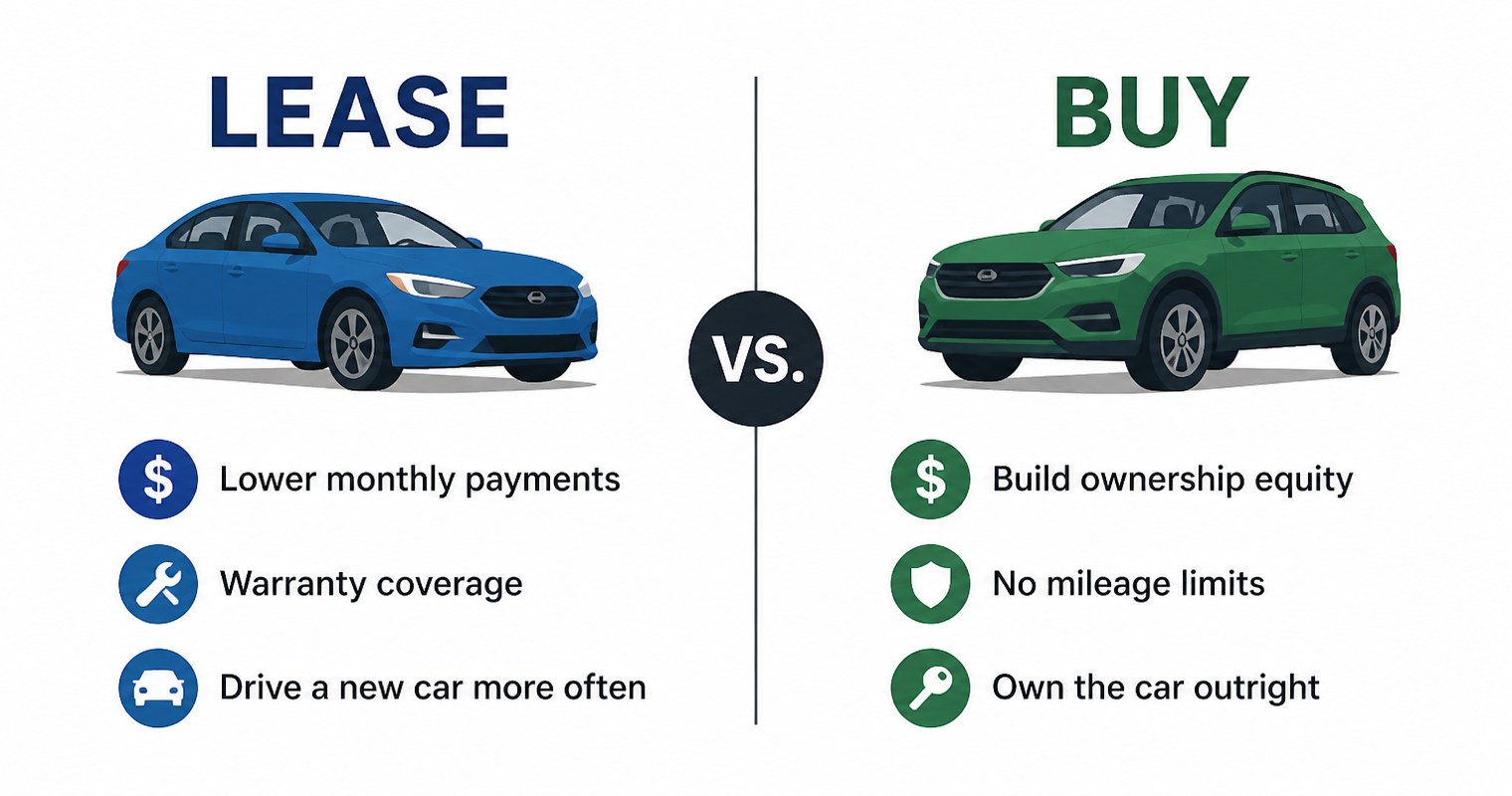
- You own the car after payoff
- No lease mileage limits
- Freedom to sell when you want
- More flexibility with modifications
- Potential for payment free years
Cons
- Monthly payments may be higher
- You take on depreciation risk
- Longer loans can mean more interest
- Repairs become your responsibility as the car ages
For shoppers planning to keep a vehicle well beyond the loan term, those payment-free years can be one of the strongest arguments for buying.
How Does Leasing a Car Work?
A lease is closer to paying for the use of a vehicle for a set period than purchasing it outright.
Many leases run for roughly 2 to 4 years. The agreement establishes terms such as:
- Lease length
- Allowed mileage
- Amount due at signing
- Monthly payment
- Residual value
- Money factor or rent charge
- Potential end of lease charges
You make the required payments and follow the terms of the agreement. When the lease ends, you generally return the vehicle.
Some leases also give you the option to purchase the car for a predetermined amount.
This arrangement can work particularly well for drivers who like replacing their vehicles every few years. Someone who keeps cars for a decade or drives well above the mileage allowance may find the restrictions much less appealing.
Pros and Cons of Leasing a Car
Pros
- Often lower monthly payments
- Newer vehicle every few years
- Often within factory warranty
- Less long term depreciation risk
- Easy path into newer technology
Cons
- You usually do not own the car
- Mileage limits apply
- Excess wear can cost extra
- Modifications may be restricted
- Continuous leasing means continuous payments
Neither list makes leasing inherently good or bad. It simply works better for certain driving and ownership habits.
How Much Lower Can a Lease Payment Be?
There is no standard amount.
Some vehicles lease particularly well because they have strong expected residual values, manufacturer-supported lease programs, or both. Another vehicle with a lower sticker price could actually have a higher lease payment.
Your credit can also affect the deal.
An advertised lease offer may be available only to shoppers who meet certain credit qualifications. It may also require several thousand dollars due at signing to achieve the payment shown in the advertisement.
Before deciding that one lease is cheaper, look at the entire offer. A $399 monthly payment with a large amount due upfront is a very different deal from $399 per month with much less required at signing.
Does Putting Money Down Make Leasing Cheaper?
Putting more money down can lower the monthly lease payment, but it does not necessarily improve the deal.
Suppose one lease requires $5,000 upfront to reach an attractive advertised payment. Another requires much less upfront but has a higher monthly payment.
Looking only at the monthly figures makes the first lease appear cheaper.
A better starting point is to consider:
Amount due at signing + total monthly payments + expected applicable fees
There is also some risk to making a large upfront payment on a lease. If the vehicle is stolen or totaled early in the agreement, you may not recover that money in the way you expect.
Instead of putting thousands down simply to make the monthly payment look better, compare the overall lease structure.
Can a Longer Car Loan Beat a Lease Payment?
Sometimes it can.
Stretching a loan across more years lowers the amount of principal that needs to be repaid each month. An 84-month loan, for example, can have a much more manageable payment than a 48-month loan on the same amount financed.
The tradeoff is time and potentially interest.
A longer loan can mean:
- More total interest
- More time in debt
- Greater risk of owing more than the car is worth
- Making payments as the vehicle gets older
An 84-month loan lasts 7 years. That is a long time to be making payments on the same vehicle.
If the only way to get the payment into your budget is to dramatically extend the loan, take another look at the vehicle price and the total amount you will pay before signing.
Leasing vs. Buying: Which Is Better for Your Monthly Budget?
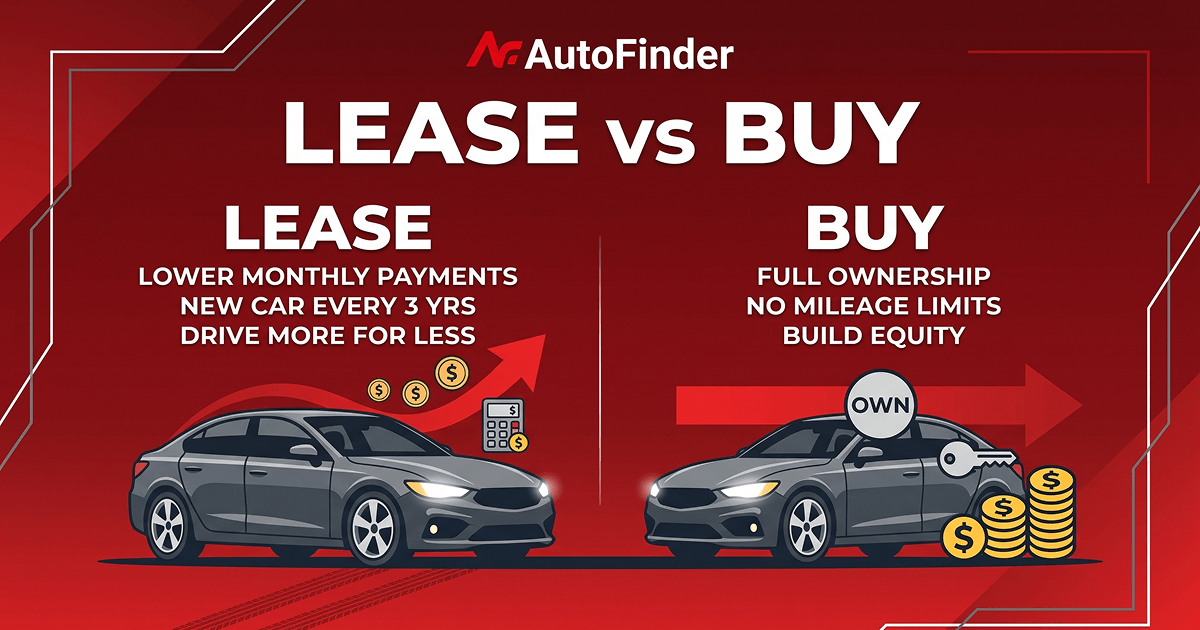
If monthly cash flow is your biggest concern, leasing can have an advantage. You may be able to drive a newer vehicle for less per month than you would spend financing the same car with a traditional loan.
But monthly affordability is only one part of the decision.
| Consideration | Leasing | Buying |
|---|---|---|
| Monthly payment | Often lower | Often higher |
| Ownership | Usually return at end | Own after payoff |
| Mileage | Usually limited | No lease mileage limit |
| Long term payments | Continue if you keep leasing | Can end after payoff |
| Modifications | Usually restricted | More freedom |
| Vehicle changes | Easy every few years | Better suited to long term ownership |
If you are comparing the 2 purely on what leaves your bank account next month, leasing may look better.
If you are comparing where you will be 7 or 10 years from now, buying starts to look very different.
When Does Leasing Make More Sense?
Leasing tends to work best when your driving habits line up naturally with the agreement.
It may be worth considering if you:
- Want a lower payment on a new vehicle
- Like getting a new car every few years
- Drive a predictable number of miles
- Prefer staying within factory warranty coverage
- Do not care about eventually owning the vehicle
- Keep your vehicles in good condition
- Want newer technology regularly
Consider someone who drives around 8,000 miles per year and already knows they want a different vehicle every 3 years. A lease may fit that lifestyle without requiring much compromise.
Someone driving 25,000 miles per year for work is dealing with a very different situation.
When Does Buying Make More Sense?
Buying becomes more appealing the longer you plan to keep the vehicle.
Once the loan is paid off, the car belongs to you and the monthly loan payment disappears.
Buying may be a better fit if you:
- Keep cars for many years
- Drive a lot of miles
- Want complete ownership
- Modify your vehicles
- Do not want mileage restrictions
- Want the freedom to sell whenever you choose
- Want the possibility of payment-free years
Consider someone who finances a reliable car for 5 years and keeps it for 10.
The payment may be higher than a lease during those first 5 years, but the owner then has another 5 years without a loan payment.
A driver who leases a new vehicle every 3 years will likely still be making monthly payments throughout that same period.
Does Leasing Save Money on Repairs?
Leasing can reduce your exposure to some repair costs because the vehicle may remain within at least part of its original factory warranty during the lease.
Covered mechanical problems may therefore be handled under warranty instead of turning into an unexpected repair bill.
You still have ownership expenses while leasing. Routine maintenance, tires, damage, and other costs may remain your responsibility depending on the agreement and warranty.
Buying shifts the timeline.
Keep a purchased vehicle beyond its warranty and you take on more of the repair risk yourself. In exchange, you may eventually reach the point where you no longer have a monthly car payment.
For some drivers, keeping a paid-off vehicle and budgeting for occasional repairs is preferable to maintaining a predictable lease payment indefinitely.
What Happens If You Drive Too Many Miles on a Lease?
Mileage is one of the biggest practical limitations of leasing.
Your agreement specifies how many miles you are allowed to drive. Go beyond that amount and you may owe an excess mileage charge when you return the vehicle.
Before signing, look at how much you actually drive rather than how much you hope to drive.
Your current odometer and maintenance records can give you a much better estimate.
If you drove 18,000 miles last year, choosing a lease with a substantially lower annual mileage allowance just to get a cheaper payment could become expensive when the vehicle is returned.
High mileage drivers often have more flexibility with ownership.
What Happens If Your Leased Car Has Damage?
Normal wear is generally expected when you return a leased vehicle. Damage or wear beyond what the leasing company considers normal may result in additional charges.
Depending on the agreement, this could include significant:
- Body damage
- Wheel damage
- Interior damage
- Missing equipment
- Tire wear
You do not have to treat a leased car like it belongs in a museum, but you are expected to return it in acceptable condition.
If kids, pets, work equipment, or your lifestyle tend to be hard on vehicle interiors and exteriors, owning may give you more freedom.
Is Leasing Better If You Always Want a New Car?
This is one of the situations where leasing can make a lot of sense.
Suppose you already know you replace your vehicle about every 3 years.
You could buy a new car, trade it after 3 years, buy another, and repeat the process. Leasing creates a more predictable structure around essentially the same behavior.
You use the vehicle for the agreed period, return it, and move into something else.
You give up ownership, but that may not matter much if you never intended to keep the car in the first place.
It can also make it easier to move into newer safety features, infotainment systems, powertrains, and other technology every few years.
Is Buying Better If You Keep Cars for a Long Time?
For long-term ownership, buying usually becomes much more compelling.
Imagine 2 drivers starting with new vehicles.
One leases a new car every 3 years. The other finances a car for 5 years and keeps it for 10.
During the first several years, the buyer may have the higher payment.
After the loan is paid off, however, that driver can spend years without a monthly loan payment. Insurance, fuel, maintenance, registration, tires, and repairs still exist, but the loan itself is gone.
The driver who continues leasing simply moves into another lease.
Those payment-free years are a big reason buying can work out better financially for people who keep reliable vehicles for a long time.
Should You Lease an Electric Car?
Electric vehicles add another wrinkle to the lease versus buy decision.
EV technology continues to develop, with changes in driving range, charging performance, batteries, software, and available features. Future resale values can also be difficult to predict for some models.
A lease shifts some of that future value uncertainty away from you because the residual value is established as part of the agreement.
It also gives you an easy opportunity to move into newer EV technology after a few years.
Buying can still make plenty of sense if you find an EV you genuinely want to keep. The specific lease terms, incentives, expected depreciation, charging situation, and your ownership plans should guide the decision rather than a blanket rule that EVs should always be leased or always be purchased.
Does Leasing Affect Insurance Costs?
You still need auto insurance on a leased vehicle, and the leasing company may require specific levels of coverage.
Insurance deserves a place in your comparison because the vehicle with the lowest payment is not necessarily the cheapest one to have sitting in your driveway each month.
Before signing, get an insurance quote for the actual vehicle.
This can be particularly useful when comparing luxury vehicles, EVs, performance models, or vehicles for younger drivers, where premiums can vary considerably.
What Should You Compare Besides the Monthly Payment?
The easiest way to make a bad lease or loan look appealing is to focus on one number.
Instead, compare:
- Vehicle selling price
- Amount due upfront
- Monthly payment
- Number of payments
- Interest rate or lease money factor
- Mileage allowance
- End of lease fees
- Insurance
- Maintenance
- Expected ownership period
- Vehicle value at the end of your comparison period
Try to compare both choices across the same period too.
A 36-month lease and an 84-month loan are completely different financial commitments. Looking only at which has the smaller monthly payment does not tell you which leaves you in the better position.
How to Compare a Lease and Loan Fairly
Start with the same time period.
If you want to compare both options over 3 years, the lease side might look something like:
Amount due at signing + 36 monthly payments + expected fees
For the purchase, you might consider:
Down payment + 36 loan payments + relevant ownership expenses
There is one major difference at the end of those 3 years.
The buyer still owns a vehicle with resale or trade-in value. The lessee typically returns the vehicle unless they decide to purchase it.
Include that remaining vehicle value when evaluating the results. Otherwise, you are only comparing how much money went out rather than what you have to show for it afterward.
Do Not Shop Only by Monthly Payment
Monthly payment matters. It has to fit your budget.
The problem comes when it becomes the only number you discuss.
A payment can be lowered by putting more money down, extending the loan, changing the lease mileage allowance, or choosing a different financing structure. None of those changes automatically means the vehicle itself became a better deal.
Before agreeing to a payment, make sure you can answer:
- What is the vehicle selling price?
- How much am I paying upfront?
- How long will I make payments?
- What interest rate am I paying?
- What is the total amount I will pay?
- What happens when the agreement ends?
A $450 monthly payment can be a great deal or a terrible one. You need the rest of the numbers to know which.
Can You Negotiate a Lease?
Some parts of a lease may be negotiable.
One of the most important is the vehicle's selling price, which can affect the capitalized cost used to calculate the lease.
Manufacturer incentives can also have a major effect on lease pricing. A vehicle with strong lease support this month may have a very different offer later.
Instead of assuming leasing will always produce the better deal, compare the actual offers available when you are ready to shop.
And when you compare those offers, make sure you are looking beyond the advertised payment. The amount due at signing, mileage allowance, lease term, residual value, applicable fees, and other terms all help determine what you are really paying.
Final Thoughts
If your only priority is getting the lowest monthly payment on a comparable new vehicle, leasing will often have the advantage.
You are generally paying for the portion of the vehicle's value you use during the lease rather than working toward purchasing the entire car.
But monthly payment is only one piece of the decision.
Leasing can work well for someone who wants a new vehicle every few years, drives predictable mileage, and does not care about eventually owning the car.
Buying tends to become more attractive for drivers who keep their vehicles for a long time, put on lots of miles, want more flexibility, or like the idea of eventually having no monthly car payment.
Before choosing either one, compare the full cost over the same period and think about what you will have at the end.
The cheapest payment today is not always the option that costs you the least tomorrow.