What Does Out the Door Price Mean When Buying a Car
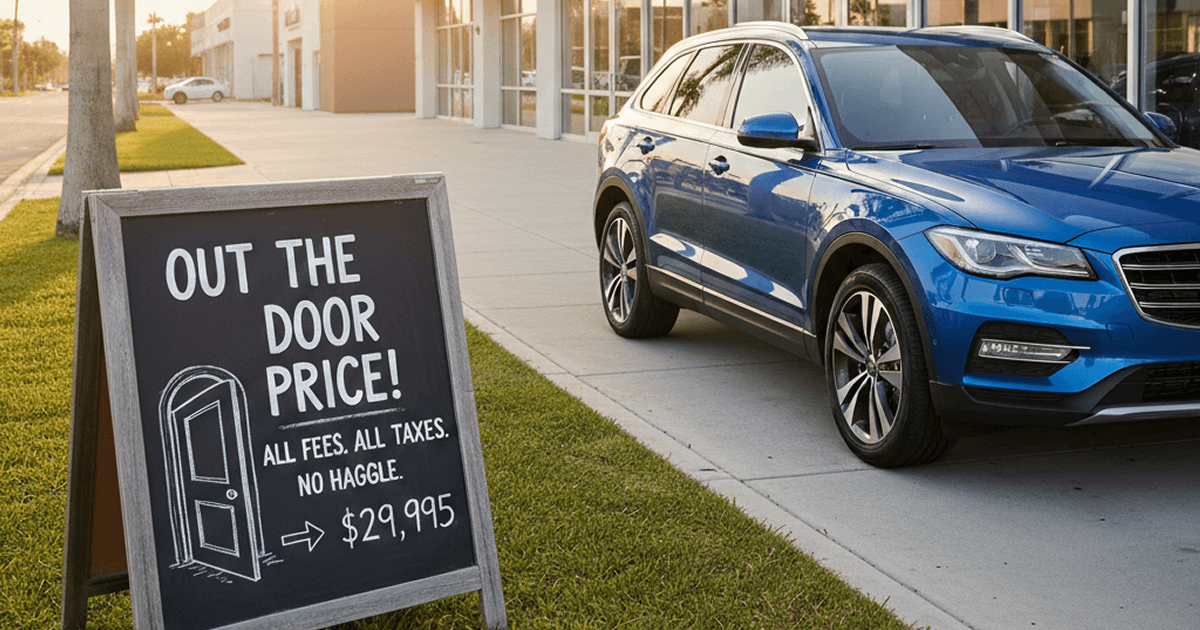
Last updated Sep 15th, 2026The out-the-door price is the total amount you pay to purchase a vehicle, including the negotiated price, sales tax, registration, title fees, and dealer documentation fees. It is the final number required to complete the transaction and drive the car home.
Out the door price includes:
- Negotiated vehicle price
- Sales tax based on your location
- Title and registration fees
- Required dealer documentation fees
Out the door price does not automatically include optional add-ons like extended warranties or service plans unless you choose to add them.
Understanding the out-of-the-door price helps you:
- Compare dealers accurately
- Avoid unexpected charges
- Calculate your true monthly payment
Find Your Best Price
See what others paid and get upfront pricing from local dealers.

What Does Out-the-Door Price Mean
If you have ever shopped for a car, you have probably heard the phrase out the door price. It sounds simple, but it is one of the most important numbers in the entire buying process.
The out-the-door price is the total amount you will actually pay to drive the car home. Not just the sticker price. Not just the negotiated price. The full number that includes everything required to complete the purchase.
Understanding this number gives you clarity, control, and confidence before you sign anything.
What Is Included in the Out the Door Price
The out-the-door price includes more than the vehicle itself. It typically covers:
- The negotiated vehicle price
- Sales tax
- Registration and title fees
- Documentation fees
- Dealer fees required for processing
In short, it is the final total after all required costs are added.
If a vehicle is advertised for $30,000, the out-the-door price may be several thousand dollars higher once taxes and fees are included. That is why this number matters so much.
What Is Not Included
Some optional products may not automatically be included in the out-the-door price unless you choose them. These can include:
- Extended warranties
- Service plans
- Gap coverage
- Add on accessories
It is important to confirm exactly what is included before agreeing to the final number.
Why the Out-the-Door Price Matters
Many buyers focus on monthly payments. That can be helpful, but it does not tell the full story.
The out-the-door price matters because:
- It shows the true total cost
- It prevents surprise charges
- It makes comparing dealers easier
- It keeps negotiations clear and transparent
When you ask for the out-of-the-door price upfront, you remove confusion from the conversation.
How to Ask for the Out-the-Door Price
You can simply say:
“What is the full out-the-door price, including all taxes and fees?”
That question signals that you want the complete picture. It also keeps negotiations focused on the final total, not just the sticker price.
A clear, written breakdown is always helpful so you can review each item line by line.
Out the Door Price vs MSRP
MSRP stands for Manufacturer Suggested Retail Price. It is the starting point, not the final cost.
The out-the-door price takes the negotiated price and adds:
- Taxes
- Government fees
- Required dealer charges
Two vehicles with the same MSRP can have different out-of-the-door prices depending on location, tax rate, and dealership fees.
Real World Example of an Out the Door Price
Let’s say you negotiate a vehicle price of $30,000.
Here is how the final out-the-door price might look:
Vehicle price: $30,000
Sales tax at 6 percent: $1,800
Title and registration fees: $400
Documentation fee: $300
Your total out-the-door price would be $32,500.
That means even though the car was listed at $30,000, the actual amount required to complete the purchase is $32,500.
Want to estimate the total for a vehicle you're considering? Use AutoFinder's Out the Door Price Calculator to add the vehicle price, taxes, and applicable fees and get an estimated total.
Seeing the full breakdown makes everything clearer. Instead of focusing only on the sticker price, you understand the real number that matters. That clarity helps you budget properly, compare offers confidently, and avoid last-minute surprises.
How Out the Door Price Affects Your Monthly Payment
Your monthly payment is based on the amount you finance, not just the vehicle price. That means the out-of-the-door price plays a direct role in what you pay each month.
Using the earlier example, if the vehicle price is $30,000 but the out-the-door total is $32,500, you are financing the higher number unless you cover part of it with a down payment.
For example, if you finance $32,500 at a 6 percent interest rate for 60 months, your monthly payment will be higher than if you financed only $30,000.
Understanding the full out-of-the-door price before discussing financing helps you avoid surprises and choose a payment that fits comfortably within your budget.
Monthly Payment Comparison Example
Let’s compare two scenarios using a 60-month loan at a 6 percent interest rate.
If you finance $30,000 for 60 months at 6 percent, your monthly payment would be about $580.
If you finance $32,500 for 60 months at 6 percent, your monthly payment would be about $628.
That is a difference of about $48 per month.
Over the life of the loan, that small monthly increase adds up to nearly $2,900 more paid overall.
This is why focusing on the full out the door price matters. A few thousand dollars in added fees may not seem dramatic at first, but they directly impact your monthly payment and the total amount you pay over time.
How Location Affects Your Out the Door Price
Where you buy your car can directly impact your out the door price. Sales tax rates vary by state and sometimes even by city. Registration and title fees also differ depending on local regulations.
For example, a vehicle purchased in one state may carry a significantly different tax burden than the same vehicle purchased elsewhere. That is why comparing prices across regions without factoring in taxes and fees can be misleading.
Understanding your local tax rate ahead of time helps you estimate the full cost more accurately and avoid surprises when the paperwork is presented.
Why Out the Door Price Helps You Compare Dealers
Two dealerships can advertise the same vehicle at the same sticker price, yet the final total can look very different once fees are added.
Focusing on the out-the-door price allows you to compare apples to apples. Instead of getting distracted by discounts or promotions, you look at the full number that actually matters.
This approach keeps the conversation simple and transparent. It also makes it easier to identify which offer truly provides the best overall value.
Final Thought
The out-the-door price is the number that truly matters. It cuts through marketing language and gets straight to the real cost of the car. When you understand it, you shop smarter and avoid surprises.
Car buying should feel clear, not confusing. When you focus on the full price from the start, you stay in control and make decisions with confidence.
FAQs
Is out the door price the final amount I pay?
Yes. It represents the total amount required to complete the purchase.
Does out the door price include tax?
Yes. Sales tax is typically included in the out the door number.
Is registration included in the out the door price?
Yes. Registration and title fees are usually part of the total.
Should I always ask for out the door pricing?
Yes. It gives you a clear understanding of what you will actually pay.


The information provided in this article is for general informational purposes only and may change over time. Vehicle pricing, availability, specifications, incentives, financing terms, interest rates, and other details may vary by vehicle, dealer, lender, location, and individual circumstances. AutoFinder does not guarantee the accuracy or availability of information provided by third parties. Always confirm current vehicle details, pricing, terms, and eligibility directly with the participating dealer or appropriate provider before making a purchase or financial decision.