Best SUVs for Winter Driving and Snow
Last updated Sep 16th, 2026Winter can make an SUV feel like a smart choice, but the SUV badge alone does not make a vehicle ready for snow.
The better winter SUVs combine useful ground clearance with All Wheel Drive or Four Wheel Drive, well-suited tires, good visibility, and features that make cold weather easier to deal with. What you actually need depends on where and how you drive.
Someone commuting on regularly plowed roads has different priorities than a driver dealing with deep snow, steep hills, or rural roads. Families may care more about 3 rows and winter comfort, while another shopper may want a smaller SUV that is easy to drive year-round.
Our picks for the best SUVs for winter driving are:
- Subaru Forester
- Mazda CX-50
- Toyota RAV4 AWD
- Jeep Grand Cherokee 4x4
- Honda Pilot AWD
- Toyota Grand Highlander AWD
- Ford Bronco Sport
- Subaru Outback
Each approaches winter differently, which is why it is worth thinking about your normal driving before deciding how much winter capability you really need.
Find Your Best Price
See what others paid and get upfront pricing from local dealers.

What Makes an SUV Good for Winter Driving?
All Wheel Drive gets plenty of attention, but it is only one piece of a winter-ready SUV.
Look at the entire vehicle.
Useful winter characteristics include:
- All wheel drive or four wheel drive
- Tires appropriate for the conditions
- Useful ground clearance
- Traction and stability control
- Good outward visibility
- Effective headlights
- Heated seats and steering wheel
- Heated mirrors
- Strong front and rear defrosting
- Snow or terrain driving modes
Not every shopper needs everything on that list.
Ground clearance matters much more if you regularly drive through accumulating snow before the plows arrive. Someone driving almost exclusively on cleared highways may put more value on comfort, fuel economy, and predictable road manners.
The goal is not to buy the most rugged SUV possible. It is to find one prepared for the winters you actually experience.
1. Subaru Forester
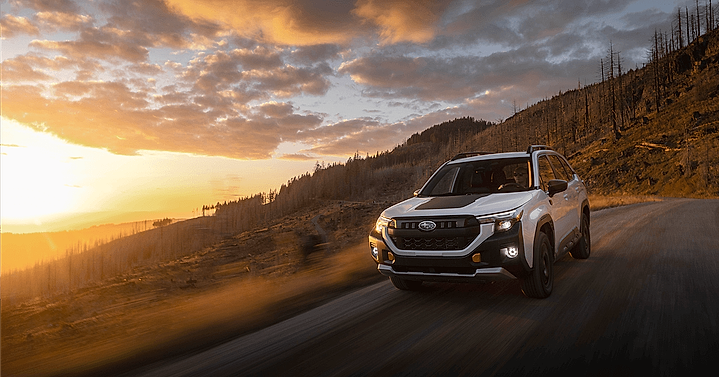
The Subaru Forester makes a strong case for winter shoppers because its core snow-friendly equipment does not require moving into a specialized trim.
The 2026 Forester comes standard with Subaru Symmetrical All Wheel Drive and has 8.7 inches of ground clearance in most configurations. The Wilderness increases ground clearance to 9.3 inches and adds enhanced dual-function X MODE.
For most commuters, the regular Forester already provides plenty to work with.
The combination of standard AWD, substantial clearance, a relatively upright driving position, and useful cargo space makes it easy to understand why the Forester fits this list.
The Wilderness becomes more interesting if your winter involves deeper snow, less maintained roads, or regular trips beyond paved streets.
That distinction is important. You do not necessarily need the most rugged Forester simply because it snows where you live.
Best for: Shoppers who want a practical compact SUV with standard AWD and useful ground clearance.
2. Mazda CX-50
The Mazda CX-50 takes a slightly different approach.
It comes standard with Mazda's i Activ AWD system, and gasoline models provide between 8.3 and 8.6 inches of ground clearance depending on configuration. Mazda also equips the CX-50 with Mi Drive, which includes an Off Road mode in addition to its normal driving settings.
That gives the CX-50 useful hardware for changing winter conditions without turning it into an oversized SUV.
It is especially worth considering for someone who wants winter capability but still cares about how a crossover feels during the other 9 months of the year.
There are gasoline and hybrid versions of the CX-50, so pay attention to the configuration you are shopping. Specifications such as ground clearance vary between them.
Best for: Drivers who want standard AWD, useful clearance, and a compact SUV that still feels at home on everyday roads.
3. Toyota RAV4 AWD
The RAV4 earns its place because it gives shoppers several ways to build a practical winter SUV.
AWD is available across portions of the lineup, and shoppers can also consider hybrid configurations depending on their priorities.
The RAV4 is particularly well suited to someone who needs winter traction but does not regularly tackle extreme conditions.
Think snowy commutes, school drop-offs, grocery runs, weekend trips, and highways that may be messy before the plows catch up.
That is an important category of winter driving. You do not need an off road focused SUV simply because your area gets regular snow.
When shopping, make sure you verify the drivetrain of the exact RAV4 you are considering. AWD is not standard on every version, so the model name alone does not tell you whether a particular vehicle has it.
Best for: Shoppers who want a practical everyday SUV with available AWD and plenty of configurations to consider.
4. Jeep Grand Cherokee 4x4
Winter driving looks different when roads are not consistently cleared.
That is where the Jeep Grand Cherokee becomes more interesting.
The 2026 Grand Cherokee offers 4x4 capability along with Jeep's Selec Terrain system, which provides selectable Auto, Sport, Rock, Snow, and Mud/Sand modes on equipped models.
Snow mode is designed to adjust vehicle systems for winter conditions, while available 4x4 equipment and ground clearance give the Grand Cherokee more capability when snow becomes deeper or roads become rougher.
That does not mean every commuter needs one.
If most of your winter driving happens on plowed suburban streets, a smaller AWD crossover may be easier to own and more than capable enough.
The Grand Cherokee makes more sense when your winter routinely asks more of the vehicle.
Best for: Drivers dealing with deeper snow, rough roads, hills, or winter conditions that call for more substantial 4x4 capability.
5. Honda Pilot AWD
Winter does not stop being a consideration once you need 3 rows.
The Honda Pilot gives families an available i-VTM4 AWD system and multiple selectable drive modes. The 2026 Pilot TrailSport includes AWD with Trail Torque Logic plus Normal, ECON, Snow, Tow, Sport, Trail, and Sand modes. It also increases ground clearance to 8.3 inches.
The TrailSport is the more rugged option, but not every family needs it.
A regular AWD Pilot can make more sense if your winter consists primarily of maintained roads and your bigger priorities are passenger space, comfort, and everyday usability.
Families who regularly travel to ski areas, cabins, or places where roads may not be as predictable have more reason to look at the TrailSport.
That flexibility is what makes the Pilot useful here. You can choose the amount of capability that fits your life rather than paying for equipment you may never use.
Best for: Families that need 3 rows and want available AWD, with a more capable TrailSport option for tougher winter travel.
6. Toyota Grand Highlander AWD
The Toyota Grand Highlander belongs on the list for a different reason: winter capability is not very helpful to a family if the SUV does not have enough room for everyone.
The 2026 Grand Highlander offers several AWD configurations across its gasoline and hybrid lineups. Certain versions also include Snow mode, while gas AWD and Hybrid MAX configurations can offer additional terrain settings.
It also offers seating for up to 8 depending on configuration.
That makes it particularly interesting for larger families who need to think about winter traction, passenger space, and cargo at the same time.
You may not need its size if most trips involve 1 or 2 people. But once you start adding kids, car seats, luggage, coats, boots, and winter gear, that extra room can become useful quickly.
Best for: Larger families that want 3 rows, available AWD, and plenty of room for winter trips.
7. Ford Bronco Sport
The Bronco Sport is worth considering if you want something smaller than a traditional midsize SUV but expect to encounter more than lightly covered pavement.
Its compact dimensions make it manageable for everyday use, while its drivetrain and available terrain-focused equipment give it a more rugged side.
That combination can make sense for drivers who live on rural roads, regularly head toward ski areas, or simply need more winter capability than a road focused crossover provides.
The important question is whether you will use it.
If your entire winter consists of driving from a heated garage onto a plowed interstate, you may not need the extra capability.
If your driveway is the last one the plow reaches, the equation changes.
Best for: Shoppers who want a smaller SUV with more emphasis on rough weather and changing road conditions.
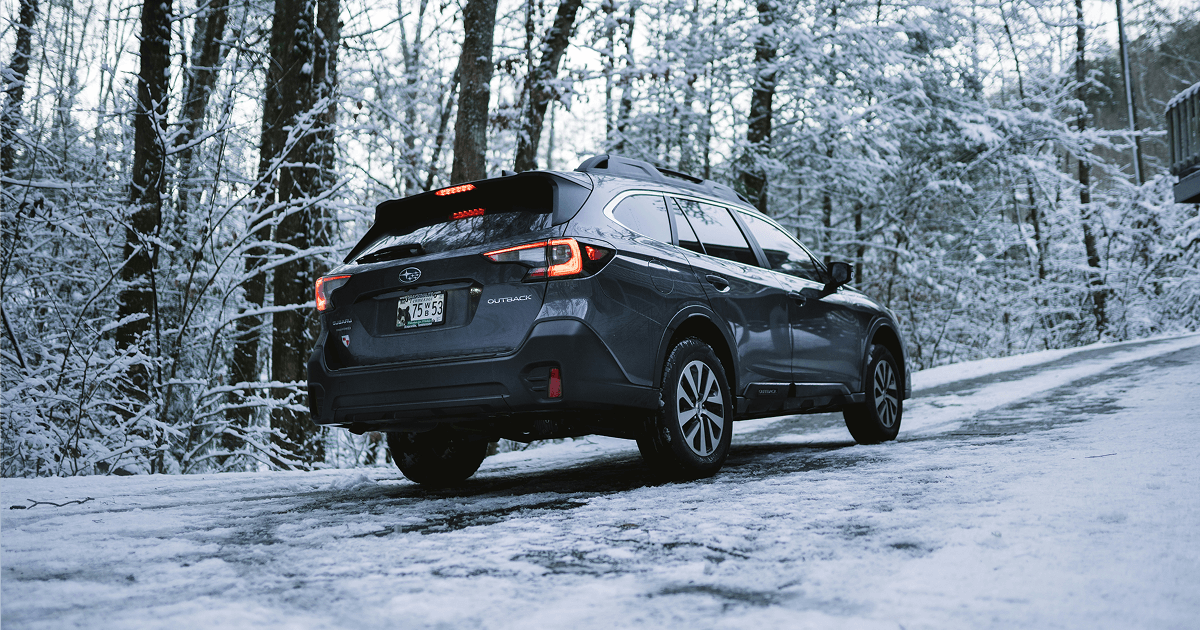
8. Subaru Outback
The Outback blurs the line between wagon and SUV, but its combination of cargo space, clearance, and standard AWD makes it difficult to leave off a winter SUV shopping list.
It comes standard with Symmetrical All Wheel Drive and offers 8.7 inches of ground clearance in regular configurations. More rugged versions provide additional clearance.
The Outback sits lower and longer than the Forester, which gives it a different feel.
That can be appealing if you want cargo flexibility and winter capability but do not particularly want the upright shape of a conventional SUV.
It is also a useful reminder that winter capability does not always require the tallest or largest vehicle.
Best for: Drivers who want standard AWD, generous cargo flexibility, and SUV like clearance in a lower profile package.
Is AWD or 4WD Better for Winter Driving?
Both can work well in snow, but they suit somewhat different needs.
AWD is common in crossovers and automatically manages power between the wheels as driving conditions change. It requires very little from the driver and is well suited to normal winter roads.
That makes AWD a natural fit for SUVs such as the Forester, CX 50, RAV4, Pilot, and Grand Highlander.
Four wheel drive becomes more appealing as conditions become more demanding.
If you regularly encounter deep snow, unplowed roads, steep terrain, or rough surfaces, a 4WD SUV such as a properly equipped Grand Cherokee may give you capabilities you would actually use.
More capability is not automatically better.
If you spend almost all of your time on maintained pavement, AWD may give you the winter traction you want without pushing you toward a more rugged SUV than you need.
How Much Ground Clearance Is Good for a Winter SUV?
There is no magic number.
The amount of clearance you need depends heavily on how deep the snow gets before the roads you use are cleared.
A driver in a city where streets are plowed quickly has less reason to prioritize clearance. Someone who lives several miles down an unplowed road may care about it quite a bit.
For context, the regular 2026 Subaru Forester provides 8.7 inches of ground clearance, while the Wilderness increases that to 9.3 inches. The gasoline Mazda CX 50 ranges from 8.3 to 8.6 inches depending on configuration.
Those numbers are useful for comparison, but they should not become a target you chase without considering everything else.
Ask yourself how often snow actually gets deep enough for the underside of your current vehicle to become a concern.
Are Bigger SUVs Better in Snow?
No.
A larger SUV may provide more ground clearance, passenger room, and space for winter gear, but size by itself does not create traction.
In fact, a smaller SUV can be easier to maneuver through crowded streets, tight parking areas, and narrow roads after snowbanks start piling up.
Vehicle weight, drivetrain, tires, clearance, stability systems, and the conditions underneath you all matter.
Choose a larger SUV because you need the passenger space, cargo room, towing ability, or additional capability. Do not assume that adding another foot of vehicle automatically makes winter easier.
Do Winter Tires Matter if Your SUV Has AWD?
Yes.
AWD helps distribute power while the vehicle accelerates. Tires influence how effectively the SUV can accelerate, turn, and stop.
Those are not the same thing.
An SUV having AWD does not mean you can ignore what is actually touching the road.
If your area regularly experiences snow, ice, and sustained cold temperatures, consider whether winter tires make sense for your driving.
At minimum, inspect the tires already on the vehicle. Tread condition and tire type deserve attention before winter arrives.
A capable AWD SUV with heavily worn tires is not suddenly winter ready because it has an AWD badge on the liftgate.
What Winter Features Should You Look For in an SUV?
Some cold weather features affect how the vehicle handles winter. Others simply make winter mornings less miserable.
Useful features can include:
- Heated front seats
- Heated steering wheel
- Heated mirrors
- Windshield de icing features
- Remote start
- Snow driving mode
- Surround view cameras
- Effective front and rear defrosting
- LED headlights
- All weather floor mats
You probably do not need all of them.
Someone regularly parking outside overnight may value remote start and a heated steering wheel much more than a driver whose SUV spends every night in a garage.
Make a short list of the features you would actually use rather than automatically moving to a more expensive trim.
What Is the Best SUV for Deep Snow?
When deep snow becomes a regular part of the drive, prioritize ground clearance, drivetrain capability, and tires more heavily.
The Forester Wilderness, Grand Cherokee 4x4, Bronco Sport, and Pilot TrailSport deserve closer consideration from this list if you regularly encounter deeper accumulation or less maintained roads.
They still serve different shoppers.
A Forester Wilderness keeps things relatively compact. The Grand Cherokee provides more substantial 4x4 capability. The Pilot TrailSport gives families 3 rows. The Bronco Sport combines a smaller footprint with a more rugged focus.
The right answer depends on what happens after the snow melts too.
Buying an SUV solely around the worst storm of the year can leave you driving more vehicle than you need the other 364 days.
What Is the Best Winter SUV for a Family?
Start with how many seats you actually use.
A family of 4 may have plenty of room in a Forester, RAV4, or CX 50.
Larger families or households regularly carrying extra passengers have more reason to consider a Pilot or Grand Highlander.
Then think about what winter adds to your cargo.
Heavy coats take up space. So do boots, sleds, skis, snowboards, emergency supplies, luggage, and everything else that somehow ends up in the back during a winter trip.
Do not evaluate passenger capacity using seat count alone. Sit in the SUV, try the rows you will actually use, and look at how much cargo room remains when those seats are occupied.
Is a Hybrid SUV Good for Winter Driving?
It can be.
A hybrid powertrain does not determine whether an SUV is good or bad in snow.
Drivetrain, tires, ground clearance, traction systems, and vehicle configuration still matter.
Several popular SUVs offer hybrid versions with AWD, giving shoppers the opportunity to combine winter traction with improved fuel economy.
The important part is checking the exact configuration.
Do not assume the gasoline, hybrid, and plug in hybrid versions of the same SUV have identical AWD systems, clearance, tires, or driving characteristics.
Treat each powertrain as its own configuration when comparing winter capability.
Should You Buy a Rugged Trim for Winter?
Sometimes, but not automatically.
Automakers increasingly offer versions with names such as Wilderness, TrailSport, and other terrain focused packages.
These trims may add ground clearance, different tires, underbody protection, modified suspension, terrain modes, or other equipment.
Those upgrades can be useful if you regularly encounter deeper snow or rough roads.
For normal commuting, you may be better served by a regular AWD version with the features and tires appropriate for your climate.
For example, the Forester already has standard AWD and 8.7 inches of clearance before you move to the Wilderness. The Pilot is available with AWD without requiring the TrailSport.
Start with the road you actually drive. Then decide whether the rugged version solves a real problem.
What Should You Check When Shopping for a Winter SUV?
Once you find an SUV you like, check the exact configuration.
That matters because 2 versions of the same model may have very different winter equipment.
Confirm:
- Whether AWD or 4WD is included
- Ground clearance
- Tire type and condition
- Snow or terrain modes
- Heated features
- Visibility
- Headlight equipment
- Passenger and cargo space
- Fuel economy
- Price
Then take a test drive.
Check your sightlines and seating position. Try the climate controls. Make sure important functions are easy to operate when you are wearing gloves.
If you are shopping used, pay particular attention to tire condition and confirm that the AWD or 4WD system is operating properly.
Should You Choose an SUV Just Because You Live Somewhere Snowy?
Not necessarily.
If your roads are plowed quickly and you rarely drive during storms, a sedan or hatchback may work perfectly well.
Our guide to the best cars for snow covers vehicles beyond traditional SUVs and explains why tires, drivetrain, and ground clearance all deserve consideration.
If you know an SUV fits your passenger and cargo needs anyway, winter capability becomes another factor in choosing the right one.
That is a much better reason to buy an SUV than simply assuming winter requires one.
What About the Best New SUVs for This Winter?
This page is designed to stay useful beyond a single model year.
If you are specifically shopping the newest vehicles, our guide to the best 2026 SUVs for winter driving focuses on current model year choices and equipment.
Keeping the 2 questions separate matters.
Someone researching winter SUVs generally may be shopping new or used. Someone searching specifically for a 2026 SUV needs current trims, features, and model year information.
Use the guide that matches where you are in the shopping process.
How AutoFinder Helps You Find a Winter Ready SUV
Once you know what kind of winter capability you need, the next step is finding SUVs equipped the right way.
AutoFinder helps shoppers browse dealership inventory and compare the vehicles available to them.
Pay close attention to trim and drivetrain when you search.
An SUV may be offered with front wheel drive and AWD. Another may have a winter friendly feature only on certain trims. Terrain focused versions can add capability but may also increase the price.
Once a specific SUV catches your attention, the dealership can confirm its equipment, current availability, tire information, pricing, financing options, and other details before you schedule a visit.
That helps turn a broad search for a “good winter SUV” into a much more useful comparison between actual vehicles.
Final Thoughts
The best SUV for winter driving is not automatically the biggest or most rugged one.
For everyday winter driving, the Subaru Forester, Mazda CX 50, and Toyota RAV4 offer practical ways to add AWD and useful clearance without moving into a large SUV.
The Jeep Grand Cherokee and Ford Bronco Sport make more sense when winter includes deeper snow or rougher roads. The Honda Pilot and Toyota Grand Highlander give families more room without leaving winter capability behind.
The Subaru Outback offers another route for drivers who want standard AWD and cargo flexibility without the shape of a traditional SUV.
Start with your normal winter, not the worst storm you can remember. Then choose the drivetrain, clearance, tires, space, and cold weather features that fit the rest of your life too.
FAQs
What SUV is best for winter driving?
The best winter SUV depends on your driving conditions and space needs. The Subaru Forester is worth considering for standard AWD and useful ground clearance, while SUVs such as the Honda Pilot and Toyota Grand Highlander add 3-row family space. Drivers regularly facing deeper snow or rough roads may want to consider more rugged configurations.
Is AWD necessary for a winter SUV?
AWD is not strictly necessary, but it can improve traction when accelerating on slippery surfaces. Tires, road conditions, ground clearance, stability control, and driver behavior also matter. If you regularly drive in snow, AWD can be a useful feature, but it should be considered as part of the SUV's complete winter setup.
Is AWD or 4WD better for driving in snow?
AWD works well for many drivers because it automatically adjusts power distribution as road conditions change. Four Wheel Drive can offer additional capability for deeper snow, rough roads, and more demanding terrain. For normal commuting on maintained roads, AWD may be all you need. More challenging conditions can make 4WD more useful.
Are SUVs better than cars for winter driving?
SUVs can have an advantage in deeper snow because they often provide more ground clearance. That does not make every SUV better than every car in winter. An AWD car with appropriate tires may work very well on maintained roads. Choose an SUV when its clearance, passenger space, cargo room, or other capabilities fit your needs.
How much ground clearance should a winter SUV have?
There is no required amount of ground clearance for winter driving. Drivers using plowed roads may not need much additional height, while people regularly traveling before roads are cleared can benefit from more clearance. Consider typical snow depth and road maintenance where you live instead of choosing an SUV based on a clearance number alone.
Do I need winter tires if my SUV has AWD?
AWD does not replace appropriate tires. AWD primarily helps distribute power when accelerating, while tires also affect steering and braking grip. Drivers who regularly encounter snow, ice, and sustained cold temperatures should consider whether dedicated winter tires make sense for their climate and normal driving conditions.


The information provided in this article is for general informational purposes only and may change over time. Vehicle pricing, availability, specifications, incentives, financing terms, interest rates, and other details may vary by vehicle, dealer, lender, location, and individual circumstances. AutoFinder does not guarantee the accuracy or availability of information provided by third parties. Always confirm current vehicle details, pricing, terms, and eligibility directly with the participating dealer or appropriate provider before making a purchase or financial decision.